Einstein’s relativity theory of moral superiority
Let me get you through my friend Siyam’s experience. On a summer afternoon, Siyam took his private SUV to pick up his younger sister from school, a quick trip that should have just taken ten minutes. The school bells had rung half an hour ago, but he was still stuck in a traffic jam near Dhanmondi 27 signal, one that barely made an ant-sized move, so an agitated Siyam turned into an armchair traffic analyst to find out the bottleneck.
Einstein’s relativity theory of moral superiority
Let me get you through my friend Siyam’s experience. On a summer afternoon, Siyam took his private SUV to pick up his younger sister from school, a quick trip that should have just taken ten minutes. The school bells had rung half an hour ago, but he was still stuck in a traffic jam near Dhanmondi 27 signal, one that barely made an ant-sized move, so an agitated Siyam turned into an armchair traffic analyst to find out the bottleneck.
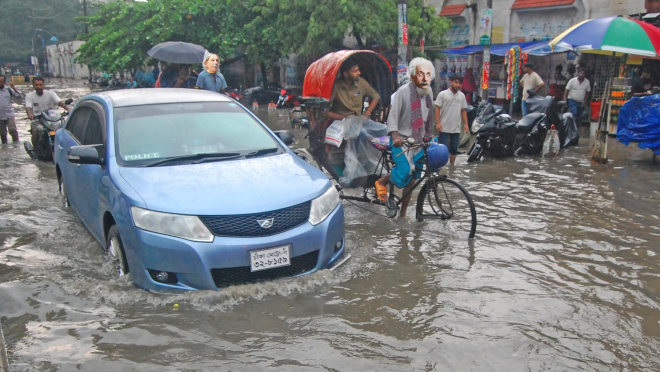
Through the limited view of the car’s windscreen, he judgmentally observed the swarm of rickshaws not giving an inch to other vehicles, as if Gandalf’s ghost had possessed them, vowing that he shall not pass.
He finally found his scapegoat and ranted to his driver about how the first motion he would pass in parliament if he ever became the Prime Minister was to seize all of these rickshaws in a pile, and then dump them into a vast landfill where massive shredding machines would mercilessly welcome these junks into their grinding mouths.
A week later, Siyam was on his way to meet his college friends on a rickshaw, but yet again, he was met with the wrath of the Dhanmondi 27 traffic. His friends were bored of waiting for him, and had already made thousands of phone calls to slander his sense of time, while he helplessly endured the banter.
So Siyam masked his armchair traffic analyst role again. From the rickshaw seats, his findings showed that some pampered passengers in private cars had occupied much of the road and feasted on his valuable time to make him look guilty to his friends, while the rickshaws were caged into small spaces. The grayscale metallic tide of cars stretched endlessly in this congestion.
Siyam rebuked the thin air that if only everyone had chosen the nimble rickshaws or communal buses over individualistic cars, no one would have to spend time looking out to strangers they will never remember or get free low-quality red-light therapy.
Why is it that Siyam’s mind changes only when he changes vehicles? Time does not play a trick and neither do the vehicle drivers or the vehicle itself. But he still seems to contradict himself. Fortunately for Siyam, he is not alone in this.
Under this psychological glitch, our brain performs leaps of logic to preserve our moral superiority. This is called ‘Ultimate Attribution Error’, developed from the ‘In-group and out-group bias’. An individual like Siyam tends to view the group he identifies with as the ‘in-group’ no matter what vehicle he takes up, while the other group bearing distinctive characteristics as ‘out-group’.
Consequently, in a situation where it demands an immediate diagnosis to the problem, it leads to ‘ultimate attribution error’. When he was in his SUV, Siyam saw the rickshaws as the only lawless troublemakers out there to dismantle modern society, overlooking the bulky size of his own vehicle. But the moral compass flipped like a coin when he was part of the rickshaw passenger group, the private cars became metal monsters overnight, coveting his valuable time, whereas the sprawling rickshaws were rendered innocent for occupying spaces and breaking lanes collectively.
Mankind has known from Albert Einstein’s theory of relativity that the view of the world or an event depends on where one stands. But at the Dhanmondi 27 signal, or anywhere in Dhaka, the rule is even simpler: your view of the world depends entirely on which seat you are occupying.
Deep down, no one wants to exchange their moral superiority for the admission that they are indeed a small yet crucial part of the entire congestion or any other issue, which is funny because does that not make them morally superior? Next time, when Siyam walks by a busy road near Dhanmondi 27, whom will he blame for the menacing congestion?