Where the clouds came down to meet us: A monsoon journey through Rangamati
Where the clouds came down to meet us: A monsoon journey through Rangamati
We had been planning this trip throughout July. The monsoon, the rain and the hills, what could possibly be a better combination than enjoying the rain from high up in the hills? We had always wanted to witness clouds forming before our eyes, gathering over the hills and slowly beginning to rain. We finally set out for Rangamati.
Our main target was to trek to three waterfalls: Na-Kata, Muppochhara and Dhuppani. The bus from Dhaka to Rangamati cost Tk850 per person. We chose the last bus of the night so that we could reach Rangamati early and continue towards Bilaichhari.
Bilaichhari was our choice because it is beautiful, our cottage was on top of a hill surrounded by hills and the waterfalls were relatively close making it a convenient base.
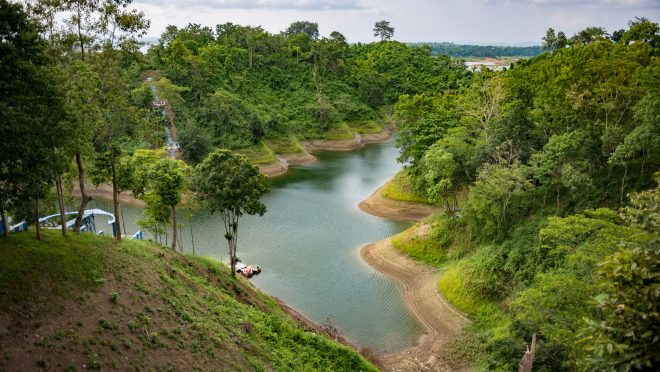
We arrived in Rangamati in the morning and took a local boat to Bilaichhari. Instead of booking a private boat, we chose a local one for only Tk140 per person. There were six of us. The three- hour journey was an experience in itself with Kaptai Lake and magnificent hills surrounding us. From Bilaichhari, we headed towards Niladri Resort where we had pre-booked two rooms for Tk 2,000 per room per night. Before reaching the cottage, we stopped at a local market for breakfast and enjoyed bash korol.
And then, nature welcomed us in its own way.
Our cottage had a beautiful view of the surrounding hills. As soon as we arrived, we noticed clouds forming over the distant hills. Slowly, they gathered, became darker and then the rain started. We could literally see the rain moving towards us. The rainfall travelled across the hills before reaching us. It was one of those sights that photographs can never truly capture. Later, we returned to the local market for lunch. Afterward, we hired a private boat towards Na-Kata and Muppochhara waterfalls for Tk 1,500. After about an hour crossing Kaptai Lake, we reached our destination. We hired a local guide and paid around Tk 1,000 as a local fee for our group.
Na-Kata Waterfall is situated downstream and took around 40–50 minutes of trekking to reach. Muppochhara lies deeper in the hills and required another 30 minutes of uphill trekking.
The trail itself was beautiful. Greenery, hills and the sound of flowing water made the journey memorable but the rain transformed everything. The landscape seemed to come alive and every turn looked like a scene from another world.
There is, however, an important warning for anyone attempting such a trek during the monsoon: be extremely careful. Rain makes hill trails muddy and dangerously slippery. During our trek, some teammates badly cut their feet which later made us concerned about infection. Still, we enjoyed both waterfalls. We spent more time at Na-Kata because the downstream water flow was stronger. We even bathed in the waterfall and thoroughly enjoyed the experience. By evening, we returned to our cottage. The night was reserved for gossip, food, music and simply enjoying one another’s company. For dinner, we had bamboo chicken and bash korol.
It was a full-moon night. We sat in the middle of the hills with Rabindra Sangeet playing through our JBL speaker. The hills were illuminated by moonlight while clouds floated across the sky. Strangely enough, the sky began to clear just enough for us to enjoy the moonlit night. It almost felt as if nature itself was happy that we had come. Perhaps it really was.
Our original plan was to trek to Dhuppani Waterfall the following day. But because of the heavy rain, we decided to postpone it. The trail would have become even muddier and more dangerous. After seeing teammates injure their feet, we became concerned about safety and infection. Perhaps nature wanted us to stop trekking and simply enjoy Bilaichhari, so we decided to return another time for Dhuppani.
The following morning, after the rain stopped, we explored the local life of Bilaichhari Upazila. It was fascinating to see how people live and work in this remote region. Mobile connectivity was extremely limited. Robi worked reasonably well while Grameenphone and Banglalink had no usable connectivity.
Later, we had lunch at a local bazaar and decided that our final dinner would be a proper local feast. We ordered chicken kebab and paratha. The kebab was surprisingly cheap, only Tk 40 per stick.
The next morning, we checked out and took a local boat towards Kaptai. From Kaptai, we took a CNG back to Rangamati. Then, we explored Rangamati city. We visited a local bazaar and observed everyday life, the fish and the local products.
In the afternoon, we visited Rajban Vihara. It is one of the most significant Buddhist sites in Rangamati. After days of trekking, the peaceful surroundings gave the afternoon a sense of serenity. By evening, we took another bus for Dhaka. Our three-day trip cost us only around Tk 5,000 per person. For a journey filled with hills, lakes, waterfalls, rain, moonlight, local food and unforgettable companionship, it was more than worth it.
We may not have completed everything we planned. We did not reach Dhuppani Waterfall, some returned with cuts on their feet and the rain made the trails difficult. But perhaps that is what made the trip special. Travel does not always have to go according to plan. Sometimes, the unexpected becomes the most memorable part.
The moonlit night in the hills, the rain travelling across the mountains, the waterfalls, the boat rides across Kaptai Lake, the taste of bamboo chicken and bash korol, the laughter inside our cottage, and six friends sharing the same journey, these are moments photographs can never fully preserve.
Some journeys are not meant to be understood by pictures alone. They stay deeper in the mind and wait to return whenever we find a quiet moment to look back. And whenever that happens, I will remember Rangamati as the place where the clouds came down to meet us.