Barriers of applying abroad after HSC
“12 bochor English porar por, eto eto coaching korar por abar English essay lekhar course e vorti hote hoy?”
Barriers of applying abroad after HSC
“12 bochor English porar por, eto eto coaching korar por abar English essay lekhar course e vorti hote hoy?”
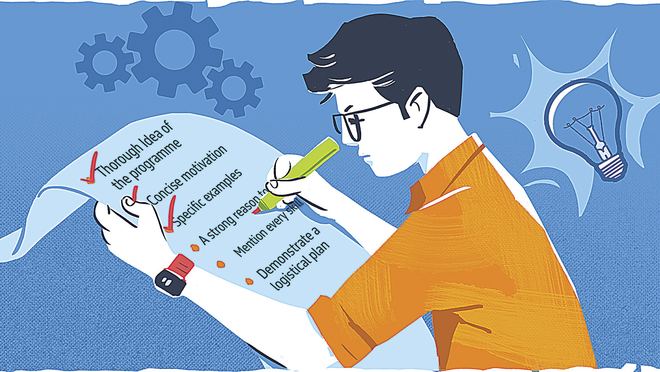
My aunt threw this question at my cousin when he asked for Tk1500 to enrol in an online essay-writing workshop. There’s nothing wrong with taking an essay-writing course. We should obviously invest when it comes to developing a useful skill. But her question was valid.
Why doesn’t a “Golden GPA 5” in HSC or twelve years of staring at English For Today and Chowdhury and Hossain grammar books prepare us to write a single, standard 650-word college application essay?
Where did twelve years of English learning go so wrong that an entire industry of paid seminars, workshops, and crash courses had to step in to teach teenagers how to write 650 words about themselves?
Well, our curriculum teaches us to reproduce English, not to use it. We spend over a decade memorising “My Aim in Life” paragraphs, “Seasons of Bangladesh” essays, completing sentence structures, and rearranging jumbled sentences. But the moment an NCTB student opens an application prompt asking them to “reflect on a time your worldview was challenged,” they realise their entire academic life was designed to make sure their worldview was never challenged at all.
The essay can still be fixed with a Tk1500 course and a few sleepless nights. But how do you fix the illusion our ‘Golden GPA 5’ path brought to us?
Every year after the SSC and HSC examination results, our newsfeeds fill with grand celebrations. The pride is understandable when you consider what those teenagers went through: memorising entire textbooks, grinding through heavy guidebooks, moving from Panjeree to Anupam, sitting for endless model tests, and sacrificing every afternoon they could have spent playing with friends.
This local glory creates the illusion that if you achieved a GPA 5 in the boards, you must be a brilliant student. But that glory shatters the moment one of these “brilliant” students decides to take a chance and apply abroad.
They knock on the doors of global universities with their pristine GPA 5, only to discover that foreign admissions officers do not find Bangladeshi board transcripts reliable. When almost every applicant holds a perfect GPA, a board certificate tells an admissions team virtually nothing about who deserves a four-crore-taka scholarship and who should be sent a polite rejection. To prove the very academic ability they were praised for at home, these students are forced back to square one: standardised testing.
Most of these students embrace the challenge and start studying for the SAT and IELTS. But here again, since we spent twelve years memorising answers and solving eighty reading comprehensions purely in the hope of getting a familiar passage on the board exam, our actual reading ability was quietly killed at the root. Facing long, complex SAT passages, students realise they never truly learned how to read for deep comprehension or sustain focus through dense arguments.
But again, just like essays, standardised tests can also be passed with hard work and maybe some courses. Does the nightmare end there? Not even close. Once the test scores are secured and the personal essay is polished, students enter the actual application. And the challenges they face here just because of studying in the national curriculum are unbearable.
First comes the ordeal with their own institutions. Most teachers in Bangladeshi colleges have no concept of what a global Letter of Recommendation requires. The only recommendation they are equipped to offer is a generic sentence on the official pad stating, “XYZ is a student of good moral character.”
Try explaining to a senior lecturer that an international recommendation requires an evaluation of your intellectual curiosity and analytical growth, and you face a 90% chance of being called “beyadob” for daring to teach your teacher. Even if you manage to explain what is needed, the universities require the teacher to submit the evaluation themselves.
If you’re applying using sources like the Common App, you’re saved a huge hassle. If not, welcome to the part that makes you question every second you keep on trying. University emails coming to your teacher from 10 different universities, with 10 different login emails, with 10 different links, and some of them even ending up in his spam folder. Begging your teacher to open the mail, click that link, and convincing him you’re not hacking his bank account makes you curse the entire system behind this.
If you somehow pass the recommendation hurdle, you run into a word called “counsellor”. In Abroad, a school counsellor tracks your entire academic trajectory, extracurricular profile, and personal growth. They are the ones who contextualise your journey for an admissions committee. If your grades suddenly dipped in one term because you were hospitalised with dengue, the counsellor explains that context so the university doesn’t judge you unfairly.
Funny thing is, in almost every national curriculum school, there is no such thing called a counsellor. No one tracks your academics, your personal development, your struggles, or your activities outside the classroom. No one to tell the admission that you failed that semester because you were fighting for your life. You make a random teacher your counsellor, inform the university about the situation, and move on to cursing the system again while hoping the university is kind enough to believe your words.
After going through all this, you start believing you can overcome anything and everything now. But then comes the emotional war at home because of overlapping timelines.
National curriculum students generally attempt to apply during three windows: before their HSC exams, during their HSC year, or during a gap year after HSC. But anyone who attempts the first two windows is pushed to the brink of exhaustion.
The pre-HSC application cycle directly collides with college pre-test and test examinations. At this crucial juncture, family and teachers line up to deliver the classic warning: “Dui noukay pa diona” and focus on the board exams.
If students wait until after HSC, the international application deadlines land right in the middle of the gruelling Bangladeshi university admission season. Once again, they hear the same advice: stick to the local path.
Before writing this article, I talked with some people who applied and went through the process but ultimately gave up. My initial expectation was to hear about the language barrier or academic difficulty.
Instead, almost all of them said the same thing: they had already overcome the language gap, built their own skill sets, and figured out the complex application portals entirely on their own, only to be pulled back at the end by families insisting they abandon the process, or refusing to provide the funds for application fees and focus on Bangladeshi boards and admissions first.
For the few who secured fee waivers or had supportive families and somehow made it to the submit button, the decision usually arrived months later. Some of the deserving students get what they deserve and make it out of the vicious cycle. But many of these students wake up at four in the morning, open their inboxes, and find a wall of polite rejections.
Where did it go wrong now?
Having no real extracurriculars or a meaningless list jotted together at the last minute because you weren’t allowed to participate in anything because of academics does not get you into a competitive university.
A recommendation letter that reads like a character verification certificate does not earn you a scholarship. A personal essay that fails to articulate genuine personal evolution does not open doors. The system we are in doesn’t help you win or achieve your dreams. Students realise this long after the rejections arrive, when the process has already left them too scarred to try again. They are exhausted, tired of fighting for their dreams, tired of competing with peers over test scores, tired of pleading with teachers for basic paperwork, and tired of begging their families to trust that their dream was meant to make everyone proud and get a good education.
And when they finally give up on that dream, they open a blank Microsoft Word document and write an article about what the system did to them and what it continues to do, year after year, to thousands of teenagers who simply imagined a world beyond it.