The Departed at 20: Its lies feel more human than ever
The first thing I remember about The Departed is not the ending. It is the constant feeling that something was about to go wrong.
The Departed at 20: Its lies feel more human than ever
The first thing I remember about The Departed is not the ending. It is the constant feeling that something was about to go wrong.
Someone was always hiding something. A phone call could change everything, a conversation could expose someone, and even the characters who appeared to be in control seemed one step away from being discovered. Watching it for the first time, I was more interested in finding out who would survive and who would be exposed.
Twenty years later, I find myself watching the film differently.
I still enjoy the crime, the tension and the performances, but what stays with me now is the idea of identity. Both Billy Costigan and Colin Sullivan spend most of the film pretending to be someone they are not. One is an undercover police officer inside the mob, while the other is a criminal informant working inside the police department. Their lives depend on keeping their real identities hidden, and that becomes increasingly difficult as the film progresses.
That idea feels more interesting to me now than it did when I first watched the film.
One of the most interesting things about The Departed is that the story did not originally belong to Boston.
The film is based on the 2002 Hong Kong crime thriller Infernal Affairs, directed by Andrew Lau and Alan Mak. The original film also follows two men working undercover on opposite sides of the law. Martin Scorsese and screenwriter William Monahan took that basic premise and rebuilt it for an American setting.
The story moved from Hong Kong to Boston, the characters were reworked, and the criminal organisation became an Irish-American mob led by Frank Costello, played by Jack Nicholson. Monahan also brought a strong sense of Boston into the screenplay, while Scorsese gave the story the atmosphere and moral complexity that had become central to his crime films.
That transformation is one reason The Departed never feels like a simple remake to me. It took an existing story and gave it a completely different identity.
In a way, that fits the film perfectly. Almost everyone in The Departed is trying to become someone else.
By the time The Departed was released in 2006, Martin Scorsese had already spent decades exploring crime, loyalty and violence through films such as Mean Streets, Goodfellas and Casino. Another gangster film could easily have felt repetitive, but The Departed gave him a different way to explore those subjects.
The film was also an important moment in Scorsese’s career. He had received several Oscar nominations for directing but had never won. In 2007, The Departed finally gave him the Academy Award for Best Director, while the film also won Best Picture, Best Adapted Screenplay and Best Film Editing.
That makes the film’s 20th anniversary feel slightly different to me. It is not only the anniversary of a popular crime thriller. It is also the anniversary of the film that finally brought one of cinema’s most respected directors his first directing Oscar.
Leonardo DiCaprio’s Billy Costigan is probably the character I connect with most whenever I revisit the film.
He is not the kind of undercover character who seems to enjoy the danger. He is constantly anxious because he knows that one mistake could expose him. He cannot fully trust the people around him, and he cannot explain the reason for his behaviour to the people closest to him.
That makes his journey different from the usual crime-film hero. Costigan is not simply trying to catch criminals. He is trying to survive long enough to return to a normal life.
The older I get, the more noticeable that becomes. When I first watched The Departed, the tension of his undercover life was exciting. Now, I notice how exhausting it must have been to live without knowing who he could trust.
Matt Damon’s Colin Sullivan is almost the opposite of Costigan.
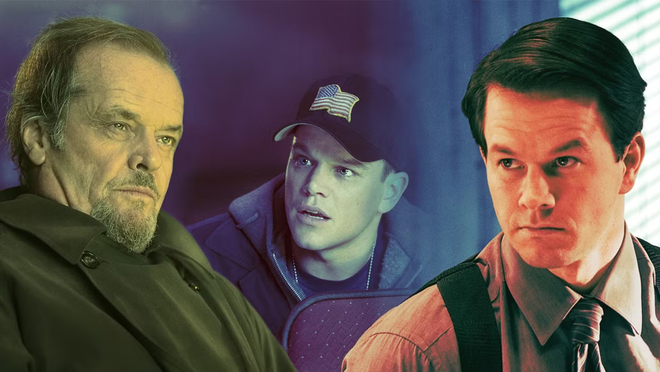
Costigan is pretending to be a criminal while secretly working for the police. Sullivan is pretending to be a respectable police officer while secretly working for Costello.
Both men are living double lives, but their motivations are very different.
Costigan wants to get out, whereas Sullivan wants to protect the life he has built.
That difference makes Sullivan particularly interesting because he does not initially appear to be the obvious villain. He is successful, respected and seemingly in control. His problem is that everything he has built depends on keeping one secret.
The more I rewatch the film, the more I realise that Sullivan’s biggest fear is not being caught. It is losing the identity he created for himself.
Then there is Frank Costello.
Jack Nicholson’s performance is one of the main reasons the film never feels completely predictable. Costello can be charming, funny and threatening within the same conversation. You never quite know what he is going to do next, which makes every scene involving him feel dangerous.
What I find interesting about him now is how little he needs to explain himself. He has built a reputation that allows other people to fear him before he even does anything.
That is what makes Costello so effective as the centre of the criminal world. Everyone around him is constantly trying to understand what he knows and what he might do with that information.
When you watch a film for the first time, you usually want to know what happens next. When you watch it years later, you already know the major turns, so your attention moves somewhere else.
That happened to me with The Departed.
I no longer watch only to find out who the mole is or how the story will end. I notice the smaller details: the conversations between characters, the way people react when they realise something is wrong, and the pressure Costigan carries throughout the film.
The story feels less like a puzzle now and more like a study of people trying to maintain lives built on lies.
That is probably why I appreciate it more today.