France school protests leave hundreds injured as unrest spreads nationwide
France school protests leave hundreds injured as unrest spreads nationwide
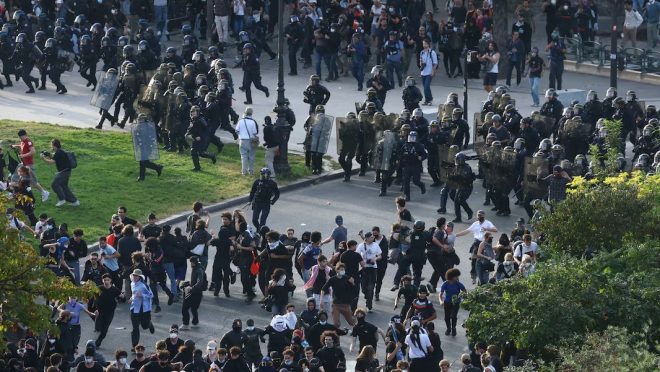
Demonstrations swept across France on Tuesday as students, teachers and parents took to the streets over deteriorating school conditions, with Prime Minister Sebastien Lecornu describing the unrest as the most violent student protests in decades.
Police fired tear gas and water cannons to disperse violent groups on the fringes of demonstrations in Paris, Strasbourg, Rennes and Toulouse, among other cities.
The interior ministry said more than 250,000 people took part in protests across dozens of cities, while organisers put the figure at around 450,000.
Lecornu told lawmakers that at least 215 teenagers and 85 school staff had been injured, calling it “the heaviest toll in decades paid by the school system”. More than 700 police officers were also injured, according to his office.
The protests, which began in deprived Paris suburbs in September, have spread nationwide, with students protesting overcrowded classrooms, teacher shortages, inadequate funding and poor maintenance at schools.
Students have complained of basic problems including water leaks and rat infestations. The High School Students Union said more than half of France’s high schools had been blockaded or closed for the day, while some education authorities moved classes online.
In Paris, police said clashes involved around 300 people, many of them hooded or masked. Several storefronts were damaged, while the Interior Ministry said 488 people were arrested and 48 security personnel were injured on Tuesday.
In Marseille and Nantes, protesters carried signs accusing the state of neglecting public education. In Toulouse, parents joined the front of a march through the city.
The protests have also triggered a debate over the use of force against minors. Rights groups, students and parents have accused authorities of using disproportionate force, while the government has said the movement has been hijacked by outsiders and descended into urban violence in some areas.
More than 1,800 people, including 1,483 minors, are being prosecuted for unspecified offences, the Justice Ministry said on Monday.
Government promises action
Lecornu has ordered ministers to address students’ key demands, including replacing absent teachers, reviewing the 8am-to-6pm school day and considering longer lunch breaks.
The government will also examine repairs needed at ageing school buildings, with Lecornu asking ministers to submit initial proposals by the end of October.
But implementing reforms could prove difficult as France faces pressure to reduce its widening budget deficit amid weak economic growth and rising borrowing costs.
The yield on France’s 10-year bonds briefly exceeded 5% last week, its highest level in 24 years, as concerns grew over the country’s debt and government spending.
Education spending has also lagged inflation, while French students are performing below the OECD average, according to data from the PISA 2025 assessment.
The protests come as France heads towards next spring’s presidential election, with support for populist parties on both the far right and far left rising amid growing public frustration.
US President Donald Trump attributed the unrest to immigration and Islam in a post on Truth Social, although the students’ demands have focused on education funding, staffing and school conditions rather than religion or migration.