International conference on machine intelligence begins at NSTU
International conference on machine intelligence begins at NSTU
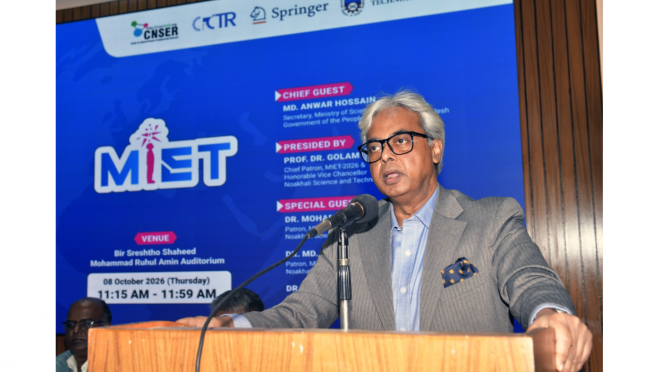
The third International Conference on Machine Intelligence and Emerging Technologies began yesterday (8 October) at Noakhali Science and Technology University (NSTU), bringing together more than 200 researchers to discuss emerging technologies and their practical applications.
The university inaugurated the two-day conference at the Bir Shreshtha Shaheed Mohammad Ruhul Amin Auditorium, with Science and Technology Secretary Md Anwar Hossain attending as the chief guest, according to the press release.
NSTU Vice-Chancellor Professor Dr Golam Rabbani chaired the inaugural ceremony.
Speaking at the event, Anwar Hossain said advances in artificial intelligence were creating enormous opportunities alongside new challenges. Bangladesh therefore needed to move towards an economy driven by technology and innovation, rather than relying solely on traditional industries.
He said the country had significant potential in high-tech sectors, including semiconductors. More than 1,000 innovations were presented at the National Innovation Fair 2026, and the Ministry of Science and Technology was working to turn them into practical products through research and development, then bring them to market.
The secretary stressed the need to identify local problems and develop effective technological solutions. He said that while financing was important, a lack of initiative often posed the greatest obstacle.
He added that coordinated efforts among the public and private sectors and other stakeholders could mobilise the funding needed from domestic and international sources.
Anwar Hossain said the ministry was preparing summaries of the research papers and innovations presented at the National Innovation Fair and working to provide support for their practical application and commercialisation.
In his remarks as chair, Golam Rabbani said emerging technologies, including artificial intelligence, machine learning, cybersecurity and robotics, were bringing profound changes to people’s lives and society.
Research should therefore extend beyond laboratories to address real-life problems and improve people’s quality of life, he said.
He stressed that technological progress in Bangladesh must be inclusive, sustainable and accessible to all. Universities had an important role in developing the next generation of researchers, innovators and technologists, he added.
Golam Rabbani said researchers from nearly 50 institutions participated in the conference, and 24% of the accepted papers involved international institutions.
He said this participation had strengthened the conference’s international reach and created greater opportunities for research collaboration.
Describing the conference as an important platform for researchers, he said such initiatives would help advance research and innovation in Bangladesh and develop skilled professionals capable of meeting the demands of the fourth industrial revolution.
Professor Dr Muhammad Shafiqul Islam, pro-vice-chancellor; Professor Dr Md Hasan Uddin, treasurer; and Professor Dr Md Ashraful Alam, dean of the Faculty of Engineering and Technology, addressed the inaugural ceremony as special guests.
Others present included faculty deans, institute directors, department chairpersons, Conference Organising Chair Md Iftekharul Alam Ifat, teachers, students, researchers, guests and journalists.
Keynote speakers included Professor Dr Latifur Khan, director of the Big Data Analysis and Management Lab at the University of Texas, United States; and Professor Muhammad M Hossain of the Elmore School of Electrical and Computer Engineering at Purdue University, United States.
Professor Sheikh Md Shariful Islam of the Department of Nutritional Sciences at Texas Tech University, United States, and Professor Zhu Han, Moores Professor in the Department of Electrical Engineering at the University of Houston, United States, also delivered keynote addresses.
Invited speakers included Professor Dr Md Shamim Akhter of the Department of Computer Science and Engineering at Ahsanullah University of Science and Technology, and Dr Ahmedur Rahman Shovon, postdoctoral appointee in the Mathematics and Computer Science Division at Argonne National Laboratory, United States.
The conference received 335 research papers, of which 54 were selected.
It aims to give researchers, academics, industry professionals, and experts from various fields opportunities to exchange ideas and present research on emerging technologies. Topics include machine learning, data science, the Internet of things, cloud computing, sensing and security.
More than 200 researchers from Bangladesh, as well as universities and institutions in countries including Italy, the United States, Japan, and Australia, are participating and presenting their research.
The eCentre for Natural Science and Engineering Research, Creative Institutes of Careers, Technology and Research, and Springer are supporting the conference.