The Afternoon Club: Where books bring people together
For a reader like me, books are rarely just to read, finish, and put away. They leave behind questions, arguments, uncomfortable feelings, favourite characters, and an inexplicable urge to talk about it with someone. Perhaps this is the place where the idea of a book club began.
The Afternoon Club: Where books bring people together
For a reader like me, books are rarely just to read, finish, and put away. They leave behind questions, arguments, uncomfortable feelings, favourite characters, and an inexplicable urge to talk about it with someone. Perhaps this is the place where the idea of a book club began.
If you are someone who reads books regularly, you might be familiar with a certain level of loneliness after finishing a book.
You finish a book you loved, sit with the story for a while, and then realise there is no one to ask, “Did you feel that too?”
For a very long time, I had been searching for that kind of space in Dhaka. A few days ago, while scrolling Facebook, I came across The Afternoon Club. They had already held their first session, but the idea of creating a physical space for book discussions caught my attention. I paused and decided to listen to those behind such an idea that brings people together on lazy afternoons for book and film conversations.
The story of The Afternoon Club began with a conversation between two women, Humaira and Sharmeen, who had also been looking for almost the same thing.
Sharmeen, who has worked in communications for a decade, had spent much of her life abroad and had seen how people come together to discuss books. Back in Dhaka, she found herself surrounded by people who were interested in pop culture but were not interested in reading books.
For Humaira, books have always been her companion since childhood. Growing up outside Dhaka with limited resources, she always credited her father for nurturing her love for books. Books and comics became her second home, and she would spend her days in her room visualising the worlds she read about.
The existing book gatherings could not offer what Sharmeen was looking for. “I read so many books, but I had no one to discuss them with,” she said. She wanted a space where books by authors like Elif Shafak and Taylor Jenkins Reid, rom-coms and globally themed stories could be discussed alongside films and their adaptations.
Eventually, one day after returning home from work, an idea stuck with her: why not create the platform herself? And she eventually called her old colleague Humaira, who instantly understood the feeling.
Humaira, too, found it difficult to find people with whom she could talk about books. The two realised that they were not the ones finding such a space, and so The Afternoon Club was born.
Why an afternoon?
The name itself carries a story. Humaira thought of her spending afternoons in her childhood village. She remembered her mother, grandmother and other women who, after finishing their chores, would watch films together or talk for hours on the verandah when there was nothing to watch.
Those afternoons had something that stayed with her deeply. “I also think that when you meet someone in the daylight, you can see their perception very clearly, and you cannot hide your reactions in the daylight.”
Sharmeen sees this from the same cultural lens. Afternoons, for the older generations, have always been the perfect time for gossip, tea, storytelling and everyday conversations. In a city where gatherings often begin after sunset, The Afternoon Club wanted to bring that familiar Bengali tradition into a different setting: adding something new to the afternoon tea and gossip with book- and film-related conversation.
More than a gathering of readers
The founders did not want the space only for “serious readers”.
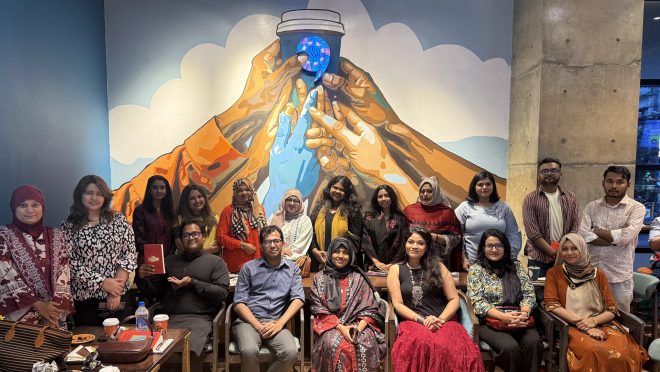
In fact, one of the gaps that they noticed in Dhaka was that some existing book gatherings felt too exclusive, and many others were held online. But the founders wanted something physical, more personal for people coming here, so that someone who has not picked up a book in years could walk in and participate.
Their first session focused on Kazuo Ishiguro’s Klara and the Sun and put the idea to the test. The response was encouraging after the session. Within three days of running advertisements, 20 seats were filled.
The most beautiful example I found of The Afternoon Club is trying to revive the letter-writing competition. The idea came to Sharmeen while she was reading Virginia Evans’ The Correspondent, a novel in which letters become a form of emotional exploration for the protagonist.
The organisers were expected to select five letters, but ended up choosing ten because the letters were so beautifully written that they could not help themselves from selecting more.
Finding a place between BookTok and real life
It might seem strange to arrange a physical book club when reading communities are thriving online.
BookTok has turned reading into a visual culture of its own, and Goodreads allows readers to catalogue every book they have read. The Afternoon Club does not see these platforms as competition.
Sharmeen describes them as dedicated communities with their own creativity and discipline. She believes that a physical gathering can offer something different and encourage readers to read.
Whereas Humaira sees it even more simply. “I think if there’s at least one person who is being influenced by them and starts reading, I would say it’s a win.” That is also the philosophy behind the club itself: if a conversation can make someone want to pick up a book again, The Afternoon Club has served its purpose.
Challenges
For Sharmeen, the biggest obstacle has been time. As a full-time professional and mother of two, she has had to fit the club around an already busy life. For Humaira, the challenge was more social. “Patriarchy,” she said, recalling the questions about the challenges the two women faced while building something of their own.
Yet their successful first two sessions seem to have answered many of those doubts. The founders also complement each other well. Humaira describes herself as impatient, while Sharmeen is the calmer one who brings “calm to my storms”.
For now, The Afternoon Club is keeping things simple with one book a month, alongside film-related activities, workshops and collaborations. The founders also hope to promote more emerging writers and storytellers. They have already interviewed Bangladeshi author P. Paramita about her debut novel Appetite and are planning more author conversations and watch parties, including one around Durga Puja.
Both the founders dream big as they hope to take The Afternoon Club international someday. But for now, they are building it one afternoon at a time, bringing together readers, non-readers, and film enthusiasts under the same roof where they can talk.