Government must ensure better teacher-student ratio
Government must ensure better teacher-student ratio
Bangladesh’s education sector is adopting many new initiatives on paper. Just recently, four new compulsory subjects were announced to be introduced at primary and secondary levels from the 2027 academic year, with Class Four adding sports and culture and Class Six adding technical education and a “learning with happiness” approach.
These steps are meant to pave the way for a full new school curriculum in 2028 with students being encouraged to learn a globally relevant third language. I genuinely hope these plans work. But I have a nagging worry that none of it will matter much unless we deal with something far more basic.
How many children is one teacher expected to teach at the same time?
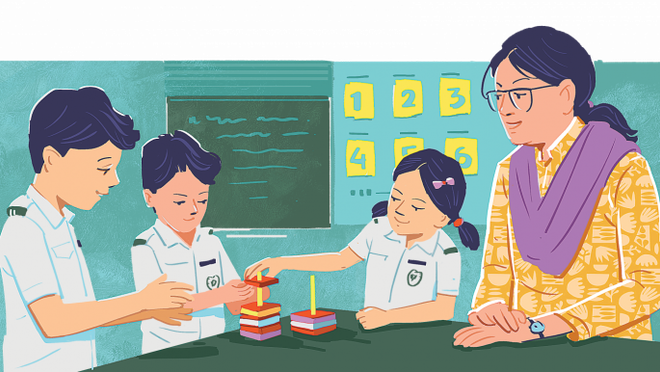
I learnt the gravity of this question from my own experiences. At my school, I once ran a classroom activity on how to prepare food without making a mess.
This was supposed to be a fun and thoughtful learning experience for the children, and naturally they were curious, as children should be, and questions came at me from every direction. I answered as many as I could, but with so many students depending on me, my answers were limited to a few words only.
In my head I had been explaining things non-stop. It was only later that I realised how it must have looked from the other side. Each child had received a few quick words when they deserved a proper explanation. That was the moment I understood how serious this problem is.
A teacher can be working as hard as humanly possible and still not notice how little attention each child is getting.
This is why the teacher-student ratio needs to be manageable in each and every school. The government’s own Bangladesh Education Statistics 2023, published by BANBEIS, puts the average at roughly one teacher for 29 students in primary schools and 34 in secondary schools. Unesco’s Institute for Statistics tells a harsher story, with figures of around 56 pupils per teacher at primary level and 48 at secondary level in 2024.
In some of the government schools, the teacher-student ratio goes up to as high as 1:100. On top of that, when the need for teachers is so high, posts are still vacant in schools.
Media reports in August that 1,459 teacher posts were vacant across 1,623 government primary schools in Tangail and described one school with 112 students and only two teachers for five sanctioned posts. The Daily Star wrote in July about a shortage of 2,842 teachers in government secondary schools.
Teachers pay for this first.
When attention is divided among too many children, it stops being attention at all. Add the heavy workload and the endless piles of copies to check, lessons to prepare, materials to make, and mistakes are bound to happen. There is an emotional cost too, because standing in front of a crowd you cannot properly reach, day after day, wears down even the most dedicated teacher. When a teacher’s performance slips, I think we are too quick to blame the person and too slow to look at the load they carry.
Students pay for it next and for longer.
Personal attention becomes impossible, lessons turn into one-way talking and many children go home unable to say what they studied that day. Some cannot even tell you which chapter was covered in which class. So families turn to private tutors and coaching centres, which have grown into a business of their own. Many schools now run coaching themselves. It eats into children’s free time and puts a real financial strain on parents.
If students must depend on coaching to learn what school was supposed to teach them, what is the point of school?
The government needs to recruit more teachers for government schools. That will be the first step, especially for government schools, where classes are often the most crowded. What matters after is how it is done. Recruitment has to be fair, transparent and based on merit, and new teachers need proper training as well. Because hiring more people through a weak process would only move the problem somewhere else. Without steady action on teacher-student ratios and on the weaknesses in how schools are run and supported, I fear the learning crisis will only deepen.
Bangladesh is a developing country that depends on its young people.
What they learn, who they learn from and how they learn should matter before anything else.