Sisyphus and the outlier
Take a hundred coin flips. Heads pay one dollar, tails pay nothing. You will end up near fifty dollars, and so will almost everyone else who plays. No one gets rich and no one gets wiped out. The luck cancels itself.
Sisyphus and the outlier
Take a hundred coin flips. Heads pay one dollar, tails pay nothing. You will end up near fifty dollars, and so will almost everyone else who plays. No one gets rich and no one gets wiped out. The luck cancels itself.
Height works roughly the same way, and IQ is deliberately scaled that way. Nobody is five times taller than the average person, because biology puts hard limits on the range.
Games like this reward the person who shows up every day and does the same thing well. Restaurants, airlines and hourly labour work like this. If you want to do well there, you cut your mistakes and stay steady.
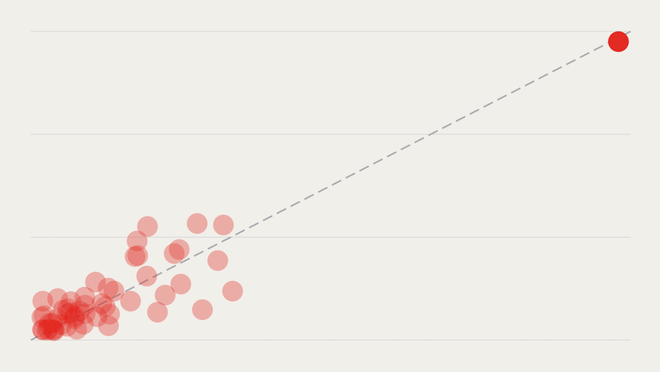
Now change the game. You start with one dollar. Each flip, heads multiplies your money by 1.1 and tails multiplies it by 0.9. On average, nothing changes. But the results stop clustering. Over a hundred flips, most people end up with less than they started with, and a few end up with thousands.
The highest possible result is about fourteen thousand dollars. The lowest is zero. The few big winners pull the whole picture to the right.
In the late nineteenth century, Vilfredo Pareto found that income followed this kind of pattern: a small share of people held a very large share of the wealth. Many systems since have shown the same shape in an even sharper form, called a power law.
Physics found it somewhere else. Heat a magnet to its critical temperature and it stops being orderly or random. Its magnetic regions repeat at every scale, and one flipped spin can pass through the whole system. Different systems, such as magnets, epidemics and sandpiles, share the same exponents. The details of the material stop mattering.
Some systems reach this point on their own. For decades, the US Forest Service followed a rule that every fire should be put out by 10 a.m. The small fires that would have cleared the fuel never happened. In 1988, the fuel had joined up, and Yellowstone burned across about 1.4 million acres. A sandpile behaves the same way. Grains drop one by one, and the same single grain that normally does nothing will sometimes cause an avalanche. Nothing about that grain is different.
Networks do it with attention. A new page links to the page that already has links. A new paper cites the paper that already has citations. The rich get richer, and the distribution that results is a power law.
This changes what advice is good. Top venture funds lose money on more than half their investments. One or two investments produce sixty to seventy-five percent of the profit. Failure there is not necessarily evidence that the method is broken. It is the price of playing a game where a small number of outcomes decide the whole return.
In writing, music, startups and publishing, the upside can be enormous while the cost of making another attempt stays small. In those fields, working to be slightly more consistent is the wrong effort. The better bet is the one where the loss is small and the gain is open.
Now go back to Sisyphus.
The gods did not choose the boulder because it was heavy. They chose it because it never changes. He pushes it up, it comes down, he goes after it. Every cycle is identical to the one before. If you graphed his results, you would get a single point. His consistency is perfect, which is exactly what the normal world asks of a worker, and it brings him nothing. There is no bad day and no good day. No push is ever the one that works, because the hill has no outlier built into it.
A person chasing something in a power-law field is pushing a boulder too, but a different one. Most pushes come to nothing. Some are a little better. Very rarely, one is the cold email, the essay that travels, the pitch someone remembers. The pushes cost about the same, but they do not pay about the same. That is the whole difference between his hill and ours.
Camus asked us to imagine Sisyphus happy because the meaning could reside in the struggle itself. In the normal world, I think that is a fair answer. In the other world, it is worth asking first whether your hill has a tail.
Sisyphus knows exactly what the next push will give him. We do not, and that is the one thing we have that he does not.