Bangladesh must strengthen unified voice at COP31: State Minister
Bangladesh must strengthen unified voice at COP31: State Minister
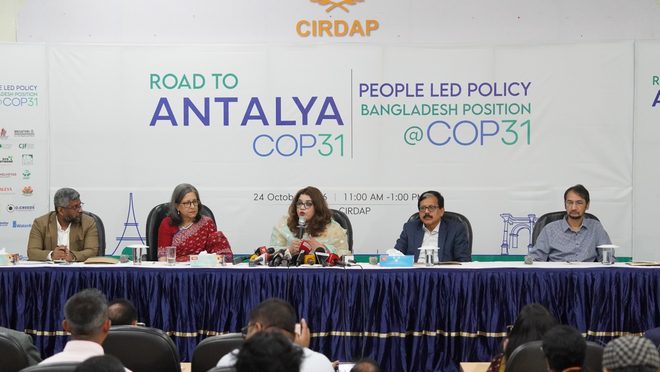
The government, private sector, civil society and experts must work together to strengthen Bangladesh’s position in international climate negotiations, while developed countries must provide climate finance through grants rather than loans, State Minister for Foreign Affairs Shama Obaed Islam has said.
She made the remarks as the chief guest at a national dialogue titled “People-Led Policy: Bangladesh Position at COP31” at the CIRDAP auditorium in Dhaka on Saturday (24 October).
Organised by a coalition of 33 national and international organisations working on climate change in Bangladesh, the dialogue presented key demands and recommendations from a civil society position paper ahead of the forthcoming United Nations Climate Change Conference, COP31.
Shama Obaed Islam said that ten years after the Paris Agreement, it was important to assess progress in implementation alongside commitments. Bangladesh needs adequate climate finance to address the impacts of climate change, while adaptation and mitigation must receive equal attention and transparency in international negotiations must improve.
She said initiatives were under way to strengthen coordination between the Ministry of Foreign Affairs and the Ministry of Environment and Climate Change. She also expressed interest in involving young people working on climate issues in the process.
The state minister highlighted plans to showcase Bangladesh’s environment-friendly jute products at COP31 through a dedicated Jute Pavilion. The initiative could help expand international markets for jute products and improve the livelihoods of rural farmers.
Mirza Shawkat Ali, director of climate change and international convention at the Department of Environment, attended as a special guest. He said initiatives were under way to reduce industrial emissions, stressing that credible evidence and specific plans were essential to presenting Bangladesh’s demands effectively in international negotiations.
In his welcome address, Dr S M Munjurul Hannan Khan, executive director of Nature Conservation Management (NACOM), highlighted the need for coordinated planning on climate finance, the blue economy, waste management and urban heat stress.
Farah Kabir, country director of ActionAid Bangladesh and moderator of the dialogue, stressed the need for collective action to secure grant-based climate finance. She said Bangladesh was among the countries bearing a disproportionate burden of climate change and needed united efforts to secure financial support without increasing its debt burden.
Presentations highlight financing needs and just transition
Presentations at the dialogue examined six key areas of climate action, including climate finance, emissions reduction, energy transition, marine resources and youth participation.
According to figures presented at the event, Bangladesh’s updated Nationally Determined Contribution (NDC 3.0) sets a target of reducing greenhouse gas emissions by 20.31%, equivalent to 84.97 million tonnes of carbon dioxide equivalent, by 2035.
Implementing the plan for 2026–2035 is estimated to require US$116.18 billion, including US$90.23 billion in international support. The National Adaptation Plan for 2023–2050 identifies 113 initiatives requiring approximately US$230 billion.
Roufa Khanum of the Centre for Climate Change and Environmental Research (C3ER) presented figures on global emissions and Bangladesh’s climate risks.
Professor Dr Ahmad Kamruzzaman Majumder, chairman of the Centre for Atmospheric Pollution Studies (CAPS), called for improved waste management and measures to reduce air pollution and industrial emissions.
Mahzabeen Mahfuz of ActionAid Bangladesh discussed a just energy transition, while Chowdhury Abrar Zahin and Helena Khatun addressed marine resources and international finance.
Youth representatives presented demands covering climate finance, education, employment, gender justice and meaningful participation in decision-making.
The discussion also highlighted the need to ensure climate finance reaches affected communities, provide resettlement support for displaced people and involve women, persons with disabilities and other marginalised groups in climate decision-making.
Civil society position paper outlines six key demands
The position paper called for international climate finance, including support for implementing NDC 3.0, to be provided through grants rather than loans.
It also urged the government, civil society, young people and the private sector to coordinate their positions in international negotiations and promote environmentally friendly domestic products, including jute, at COP31.
Other recommendations included reducing industrial and air pollution, ensuring a just energy transition that protects workers, and giving young people, women and climate-affected communities meaningful roles in policymaking and national delegations.
The paper further called for adequate funding for safe housing for climate migrants, improved waste management and measures to address extreme heat in urban areas.
The national position paper was developed through a coalition of 33 platforms representing civil society, international NGOs, academic and research institutions, and young people in Bangladesh.