The kids aren’t alright, because you won’t let them be
The kids aren’t alright, because you won’t let them be
I am getting really tired of being young in this country.
Not because growing up is difficult nor because the future looks uncertain. But because every single day, it feels like Bangladesh finds a new way to make being young feel like a crime.
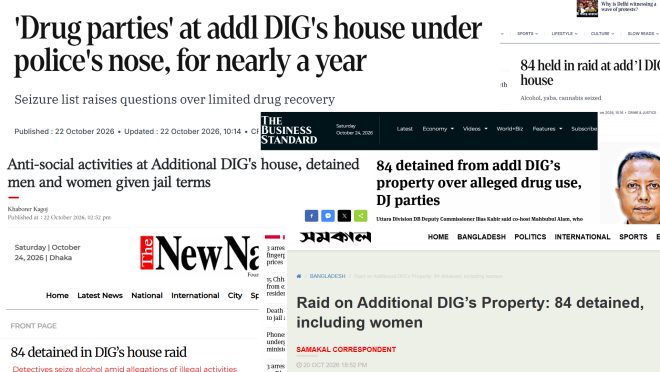
The latest example is the raid in Purbachal, where 84 young people were reportedly arrested at a party over alleged drug use and illegal DJ parties. Before the details could be properly established, the internet had already decided what these people were, degenerates, drug addicts and moral failures.
An entire generation is being called rotten because apparently, a group of young people had the audacity to go somewhere and have a good time.
The celebrations that followed were almost as depressing as the incident itself. People who had never met the ones arrested were suddenly experts on their character. People who knew nothing about what each individual had or had not done were perfectly comfortable deciding what they deserved. And women who happened to be there became the subjects of a particularly disgusting exercise in public humiliation.
Everyone had something to say. Almost nobody seemed interested in asking whether the people they were condemning had actually done anything wrong.
I wish I could say this surprises me but it doesn’t anymore.
Sure, drug abuse is a real problem and if someone broke the law they should be investigated. If there is evidence of a crime, pursue it through the legal system. Nobody is asking the authorities to ignore illegal activity because it happened at a party.
But there is a difference between holding someone accountable for a crime and deciding that everyone found in the vicinity of an alleged crime deserves to have their lives turned upside down. There is a difference between law enforcement and collective punishment. And there is a difference between justice and the kind of public spectacle in which an accusation is enough to make someone guilty in the eyes of thousands of strangers.
We seem to have lost interest in those distinctions.
What makes this particularly infuriating is that these are not abstract arguments about some distant group of people. These are young people, the so-called future of the country. They have friends who are worried about them, parents who are probably terrified, and lives that existed long before their names became part of a news cycle. Some may have broken the law, others may not have.
That is precisely why individual evidence matters.
Yet the public reaction has been less about establishing the facts than about celebrating the humiliation.
And for what? Because they were at a party?
Tell me, where exactly are young people supposed to go and what exactly are they supposed to do in this country? I genuinely want someone to answer that question.
You spend your childhood studying, then you spend your teenage years preparing for board examinations. You get into university, collect certificates, build a CV, look for a job and spend the next several years trying to convince someone that you deserve to earn enough money to survive. And somewhere in the middle of all this, you are apparently supposed to find a way to enjoy being alive.
Except, enjoying yourself seems to be getting increasingly difficult.
Concerts get cancelled, cultural events face restrictions, spaces where young people can gather are limited, nightlife is treated as a moral threat, dancing is suspicious and loud music is a nuisance.
If you want to listen to music, there are people who will tell you what kind of music is acceptable. If you want to dance, there are people who will question your upbringing. If you want to go out at night, there are people ready to assume the worst about what you might be doing.
And if you happen to be a woman, congratulations. You get an additional layer of scrutiny. Your clothes, your friends, your whereabouts and your decision to leave the house all become public property the moment someone decides you have behaved improperly.
We are expected to be educated but not too curious, ambitious but not too demanding, modern but never too different from what our elders recognise. We should have global aspirations while somehow remaining comfortable with a society that seems determined to make the most ordinary forms of self-expression feel scandalous.
So tell me, what exactly is the acceptable way to be young here?
Study, work, go home, keep your head down, repeat. And whatever you do, do not look like you are having too much fun.
The problem is not that everyone has to enjoy parties. If you hate electronic music or believe that nightlife is not for you, you can just stay home.
But why must your preferences become the boundaries of someone else’s life?
Why does every form of recreation have to justify its own existence?
If society cannot distinguish recreation from recklessness, it’s going to have a difficult time understanding its own young people.
And then there is the way we treat women when something like this happens.
The footage, the insinuations, the labels and the relentless speculation about their character. People watch videos of women leaving a property and feel entitled to decide what kind of people they are. Their presence becomes an invitation to sexualise them, ridicule them and drag their reputations through the mud. Apparently, being a woman at the wrong place at the wrong time is enough to make you fair game.
I cannot understand how people participate in this and still consider themselves decent human beings. These are somebody’s daughters, sisters, friends and colleagues. They are people who have to wake up the next morning and continue living in a world where strangers have decided they know everything about them.
Even if an individual is ultimately found guilty of an offence, why should that justify sexual humiliation? Why should an arrest strip someone of their dignity? What does exposing a woman’s face to thousands of people accomplish beyond making it easier for strangers to shame her?
We live in a society where victims of sexual violence struggle to obtain justice, where women have to fight to be believed and where harassment is routinely dismissed. Yet when women are accused of violating some unwritten rule of respectability, the public suddenly discovers a limitless capacity for outrage.
The concern for morality is always loudest when it offers an opportunity to punish someone.
And the media, which should know better, has its own responsibility. Reporting on a police raid is legitimate. But sensationalism, unverified claims and the circulation of footage that exposes private individuals to public ridicule are not necessary ingredients of journalism. There is a line between informing the public and feeding its appetite for humiliation. Crossing that line does not become acceptable simply because the story attracts clicks.
The sad thing is that this is what we have always been.
Perhaps we have always enjoyed watching other people fall. Perhaps the moral outrage is simply a convenient excuse to feel superior to someone whose life looks different from ours.
Someone went to a party, and suddenly we have an opportunity to reassure ourselves that we are better than them. More respectable, more disciplined and more deserving of our freedom.
It is a remarkably cheap way to feel righteous. And it is exhausting to watch.
Because the truth is that this could have happened to almost anyone. You do not have to take drugs to be present at a party where someone else allegedly has. You do not have to organise an event to attend one. You do not have to be guilty of anything for your name, face or reputation to become part of a public spectacle.
Every day, it becomes a little harder to imagine a society that trusts its young people. Every day, it becomes a little harder to believe that people will choose empathy over cruelty when given the opportunity. Every day, I find myself wondering whether the future people keep telling young people to work towards is actually a future in which we will be allowed to live.
We are told to stay in the country and build it. We are told that we are the future. We are told to be creative, to think independently, to be ambitious, to embrace the world.
And then we are punished for looking like they belong to it.
Maybe that is why so many young people feel exhausted before their lives have properly begun. Maybe it is why the idea of leaving Bangladesh has become so deeply entangled with the idea of having a future. It is not simply about salaries or opportunities. Sometimes it is about wanting to exist somewhere without headlining the news and being a public spectacle.
The kids aren’t alright. They are tired and frustrated. They are trying to build lives in a country that seems more interested in disciplining them rather than understanding them. They are watching the spaces available to them shrink, watching their choices become subjects of public scrutiny, watching people celebrate when someone their age gets dragged through the mud.
And they are learning something from all of this.
They are learning that their privacy is conditional, that their dignity can be taken away by a headline, that the public’s sympathy has rules and that the freedom to enjoy life is something they may have to defend, even when they might have done nothing wrong.
Most of all, they are learning not to expect very much from the people around them.
I wish I had something hopeful to end this with. A neat little reminder that things can change, that people can become kinder, that we can build a country where young people have room to breathe.
But I am tired of manufacturing hope just because an ending is supposed to have one.
All I know is that a country cannot keep making its young people feel ashamed of wanting to live and then act surprised when they stop imagining a future here.
The tragedy is not that young people want to have fun. It is that we have made the simple act of being young feel like something they should apologise for. And the longer this continues, the harder it becomes to believe that anyone is interested in letting them be alright.