NCTB to introduce four new textbooks for classes IV, VI in 2027
NCTB to introduce four new textbooks for classes IV, VI in 2027
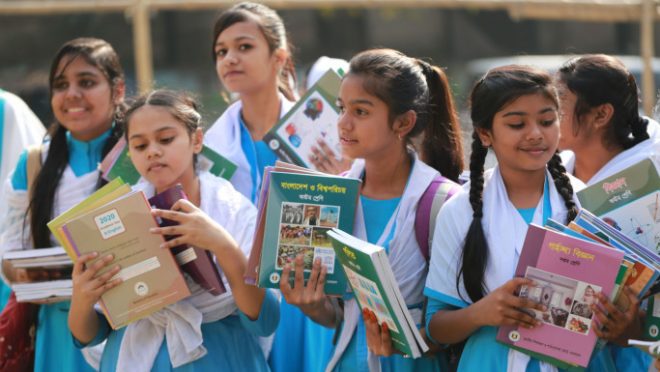
The National Curriculum and Textbook Board (NCTB) plans to introduce four new textbooks for classes IV and VI in the 2027 academic year, aiming to promote practical, skill-based learning and reduce students’ reliance on rote memorisation.
The books are ‘Sports’ and ‘Culture of Bangladesh’ for class IV, and ‘Learning with Happiness’ and ‘My Technical Education’ for class VI.
The textbooks aim to promote physical and mental development, creativity, moral values and practical skills, according to NCTB officials.
Prime Minister’s Adviser for Education and Primary and Mass Education Mahdi Amin said the initiative reflects the government’s vision of making education more practical, enjoyable and rooted in human values.
He said the curriculum would focus on developing students’ social skills, family values, civic responsibilities and employability.
The NCTB has completed drafting and validating the manuscripts, Chairman Professor Mohammed Fakhrul Mawla said. The books are expected to receive final approval at a National Curriculum Coordination Committee meeting on 25 October.
NCTB Member (Textbook) Professor Mohammad Abu Nasher Tuku said preparations for printing were at the final stage, with around 1.5 crore copies expected to be printed by 15 December, subject to final approval.
The framework for the textbooks was presented at a workshop involving four ministries at the International Mother Language Institute on 12 July. Experts and educators subsequently contributed to the development of the manuscripts.
What the new textbooks will cover
Sports
The class IV textbook will introduce students to football, cricket, kabaddi, badminton, swimming, athletics and chess, alongside self-defence techniques such as karate, judo and taekwondo.
Its 14 chapters will also cover first aid, injury prevention, nutrition, social skills and patriotism. Students will learn how to respond to common incidents, including cuts, sprains, nosebleeds and heatstroke.
NCTB Chairman Fakhrul Mawla said the book had been developed to prevent learning from becoming one-dimensional and tedious.
Culture of Bangladesh
The 11-chapter textbook will introduce class IV students to Bangladesh’s history, heritage and folk culture through topics such as language, traditional clothing, arts, food, social customs and the lifestyles of ethnic minority communities.
It will cover activities including practising the Bangla alphabet, school festivals, hoisting the national flag and preparing traditional pitha-puli.
The book will also discuss family cooperation and joint decision-making, as well as the history of ‘Notun Kuri’, a talent competition for children and adolescents launched in 1976 by Shaheed President Ziaur Rahman.
Learning with Happiness
Designed for class VI, the six-chapter textbook aims to make learning more enjoyable and reduce dependence on conventional examinations and memorisation.
It will encourage students to learn through everyday experiences, interpersonal relationships, health, safety, creativity, their surroundings and co-curricular activities.
According to NCTB officials, the approach is intended to help students understand that learning extends beyond textbooks and examination preparation.
My Technical Education
The eight-chapter textbook for class VI will promote hands-on learning, problem-solving and practical uses of technology.
Topics will include technical education, technological developments, small-scale initiatives, innovation and sustainable living.
The book aims to shift the focus from what students know theoretically to what they can accomplish in practice, helping them identify and address real-life problems through technology.
Mahdi Amin said ‘Sports’ and ‘Culture of Bangladesh’ would initially be introduced in class IV before being expanded to classes I–V.
‘Learning with Happiness’ and ‘My Technical Education’ are also planned for classes VI–X.
NCTB Member (Curriculum) Professor Dr AKM Shawkat Ali Khan said the new textbooks would give students opportunities to move beyond rote, textbook-based learning and develop practical skills in a more engaging environment.