
From Garos of 71 to a US PhD: Arunav's journey of telling untold stories
Some dreams begin with a plan. Arunav Das began with a camera his father taught him to use.
From Garos of 71 to a US PhD: Arunav's journey of telling untold stories
Some dreams begin with a plan. Arunav Das began with a camera his father taught him to use.
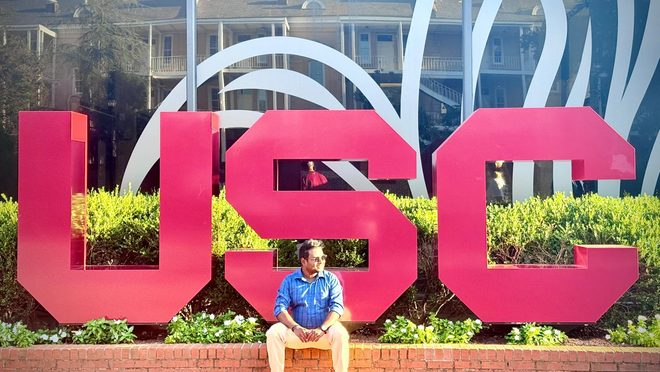
Growing up in Barishal, Arunav had no formal filmmaking education or expensive equipment. He simply enjoyed imagining stories and figuring out how to bring them to life.
At the time, he had little reason to believe that this childhood interest would eventually take him from Bangladesh to India and the United States, where he would pursue a fully funded PhD in English and American Literature at the University of South Carolina.
Today, Arunav is both a filmmaker and an academic researcher. His films have travelled internationally, and his research examines how societies remember some histories while overlooking others. These interests converge most clearly in Garos of 71, his documentary about Indigenous Garo women who participated in Bangladesh’s Liberation War.
His journey, however, has not been a straightforward progression from one achievement to another. It has involved rejected applications, delayed opportunities, years of work on an unfinished film and the difficult experience of living away from home. Through it all, he has continued to pursue literature and filmmaking together, finding in each a way to explore stories that might otherwise be forgotten.
The beginning
Arunav’s interest in filmmaking began at home. His father owned a camera and taught him how to operate it, introducing him to a creative practice that would gradually become central to his life.
In 2015, Arunav took his first serious step into filmmaking by working as an assistant director and actor in a short film called Edur in Barishal. Without any formal training, he was eager to see whether he could turn an idea into something people could watch.
His interest in books and films developed alongside his parents’ encouragement to pursue higher education, including their hope that he would eventually earn a PhD.
Rather than abandoning filmmaking to meet those expectations, Arunav looked for a way to pursue both ambitions.
In 2017, he enrolled in the English and Humanities programme at the University of Liberal Arts Bangladesh (ULAB). Literature gave him a framework for examining stories, while filmmaking allowed him to explore them visually.
His interests began to converge in 2019, when he started collecting oral histories of Bangladesh’s Liberation War. As the founding president of ULAB’s 1971 History Club, he interviewed freedom fighters and documented experiences that had received little attention in formal historical records.
The work changed his understanding of storytelling. Preserving a story, he realised, could be as important as creating one.
Digging into research
While collecting oral histories, Arunav became increasingly concerned about the absence of Indigenous Garo women from accounts of the Liberation War. Bangladesh has an extensive collective memory of 1971, but the contributions of these women had received comparatively little recognition in textbooks, archives and films.
Arunav initially assumed that finding their stories would be relatively straightforward because Garo society is matrilineal. His research soon challenged that assumption.
Meeting Tushi Hagidok, a Garo freedom fighter who had kept her role in the war private for decades, changed the direction of his work.
She shaped the foundation of Garos of 71. The documentary grew from an effort to record oral histories into a wider investigation of how Indigenous women’s contributions to the Liberation War had been marginalised.
For Arunav, the project also clarified the relationship between his two interests. Literature and film were not competing ambitions; they offered different ways of examining the same questions about memory, identity and historical representation.
The project was selected for the Liberation War Museum’s Exposition of Young Film Talent in 2022, receiving encouragement to continue.
Arunav began filming Garo women freedom fighters across different parts of Bangladesh, initially expecting to complete the documentary within a year. Instead, the project continued for years as he moved abroad for further studies, struggled with funding and tried to coordinate filming across remote locations. Many of the women he hoped to document were elderly, making the work increasingly urgent.
“Nearly 80 per cent of the shooting has been completed,” shared Arunav.
Aiming higher
Arunav’s academic journey has required a different kind of patience. In 2021, he applied for a master’s programme in English at the University of Oregon but was rejected. The University of Colorado Boulder subsequently offered him admission without funding, which he could not afford to accept.
He also applied to three Erasmus Mundus scholarship programmes, receiving rejections from all three. An admission offer from the University of Göttingen in Germany seemed to provide another route forward, but visa delays and the uncertainty surrounding post-pandemic opportunities led him to reconsider.
During this period, his supervisor, the Bangladeshi poet Professor Kaiser Haq, advised him not to move abroad without adequate funding and encouraged him to apply again the following year.
Arunav followed that advice. In 2022, he received an Indian Council for Cultural Relations scholarship to pursue a master’s degree in World Literature at Nalanda University in India.
The experience broadened his academic perspective and helped him develop the research interests he would later pursue in the United States.
While completing his master’s dissertation, he applied to doctoral programmes and received an offer from the University of South Carolina. The university admitted him to its PhD programme in English and American Literature with a fully funded teaching assistantship.
The opportunity represented a significant academic milestone, but Arunav’s experience also exposed the less visible costs of pursuing international education.
The work at hand
Arunav’s doctoral research and filmmaking now inform each other directly. His academic interests concern memory, representation and the ways certain people and experiences become visible in historical narratives. His documentaries examine similar questions through the lives of individuals and communities.
In January 2026, he presented a paper titled “Can the Subaltern Be Screened? Visual Counter-archive in Garos of 71” at the Modern Language Association convention in Toronto. The paper examined the documentary as a form of counter-archive, exploring how film can preserve experiences that conventional historical records have neglected.
The connection between his research and filmmaking is also evident in Pandemonium, a documentary that emerged from the COVID-19 pandemic and has travelled to audiences in Bangladesh, India, the United Kingdom, Australia and the United States.
Arunav admits that he once measured success through conventional achievements, including awards, selections and the opportunity to see his name in conference programmes. Those milestones still matter to him, but his work has gradually changed what he considers meaningful.
The story of Tushi Hagidok remains central to that change. Recording the experience of a freedom fighter whose contribution had remained largely unrecognised gave Arunav a tangible sense of what his work could accomplish. The value of the documentary was no longer limited to its completion, reception or festival recognition. It also lay in preserving a testimony that might otherwise have remained outside the historical record.
The camera his father introduced him to, the oral histories he collected in Bangladesh and the documentary he is still working to complete all reflect that commitment.
Before we ended our conversation, I asked Arunav what he would say to young Bangladeshis who feel pressured to choose one interest and leave the others behind.
His advice was not to pursue everything at once, but to stop assuming that every interest must lead to a separate destination. For years, his own pursuits appeared scattered. Only with time did he understand how literature, filmmaking and research could serve the same purpose. He had not wasted years exploring different paths; he had been gathering the tools to pursue a question he had not yet fully understood.
That is perhaps the most encouraging part of his journey. You do not always need to know how your interests will fit together before you begin. Sometimes, the connection becomes clear only after you have given yourself the freedom to explore, the patience to learn and the courage to keep going when the next step is uncertain.


