On Sylvia Plath’s birthday, remembering the woman beyond the tragedy
On Sylvia Plath’s birthday, remembering the woman beyond the tragedy
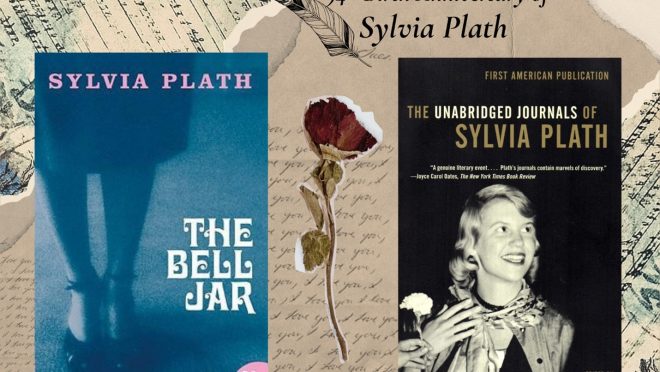
Sylvia Plath is often remembered through her death or her mental illness. But when I read her, I am reminded that her books ask us to remember her through her sentences. The Bell Jar and The Unabridged Journals of Sylvia Plath are the two works through which I have come to know her best. Together, they form an unusually intimate pair: one is a polished novel about a young woman’s mental breakdown, often read as a version of Plath’s own life, while the other is the raw, unfinished record of the mind that produced it.
In her journals, Plath wrote, “I’m both worse and better than you thought.” To me, this sentence works as a warning against every simplified version of her. She was neither merely a doomed woman nor a genius untouched by suffering. She was both, and perhaps much more than that. It shows the contradictions we usually hide.
The Bell Jar, published in January 1963 under the pseudonym Victoria Lucas, follows Esther Greenwood, a gifted nineteen-year-old who wins an internship at a New York magazine and gradually descends into depression. The illness Plath describes is not merely sadness. It is a loss of appetite for the future, a sense that every possible door leads to the same closed room.
Esther’s crisis begins in a world that appears glamorous. She has won a prestigious internship, met writers, attended parties and stood at the edge of adult life. Yet success offers no relief. Plath understands that ambition can become another form of imprisonment when a woman is expected to learn everything but permitted to become almost nothing.
Plath kept a journal from 1950, the year she entered Smith College, until a few months before her death. The Unabridged Journals of Sylvia Plath opens with a teenager in Wellesley, Massachusetts, and closes in 1962 with a mother of two living in a village in Devon. In between are Smith, a breakdown and suicide attempt in 1953, a Fulbright year at Cambridge, Paris, marriage to Ted Hughes, a year teaching at Smith, and a year in Boston.
For me, these journals are not only a diary. They are a workshop. They contain plots for short stories, notes on magazines, reading lists, food, clothes, weather, sex, money, gender, death, womanhood, loneliness, solitude and quarrels. Karen V. Kukil, the editor of the unabridged edition, observed that the book shows Plath’s zest for life as clearly as her interest in death. That is exactly why the journals feel so human to me. Plath was not only writing about darkness; she was also trying, again and again, to live fully.
The fear of becoming useless
One quotation from her journals has stayed with me more than almost any other: “What horrifies me most is the idea of being useless: well-educated, brilliantly promising, and fading out into an indifferent middle age.” I understand this fear personally. Like many students, I often ask myself: what if I fail? What if I never become “something”? Plath gives language to a fear that many young people carry quietly – the fear of having potential but not knowing how to turn it into a meaningful life.
We live in a culture that asks young people to be endlessly productive, visibly successful and emotionally resilient. Plath’s writing exposes the cruelty beneath that demand. A person is not useless because she is tired, uncertain or unable to perform happiness. Yet society often treats her as though she were.
This fear also runs through The Bell Jar. Esther is brilliant, decorated and full of possibility, but she cannot see a future in which that promise becomes a meaningful life. What moves me is that Plath wrote this at a time when only a few privileged women had the chance to pursue higher education or build independent careers. So many years later, women who have far more educational opportunities still recognise her anxiety. That continuity is disturbing, but it is also why her writing still matters.
The writer’s courage
Plath’s journals also offer a defence of writing that feels especially relevant to young journalists, students, writers and creators. “Everything in life is writable about if you have the outgoing guts to do it, and the imagination to improvise,” she wrote. She also reminded herself that “the worst enemy to creativity is self-doubt.”
Every time I try to write, I experience confusion and self-doubt. I question whether my thoughts are important enough, whether my sentences are good enough, whether anyone will care. Plath recognises that feeling. Her journals are full of anxiety about talent, beauty, money, love and time. But she kept writing. Her courage was not the absence of self-doubt; it was her refusal to let self-doubt have the final word.
Two books, one unfinished self
The Unabridged Journals of Sylvia Plath, edited by Karen V. Kukil and published in 2000, covers 1950 to 1962 and was transcribed from Plath’s original manuscripts at Smith College. Its value lies in its incompleteness. Through it, I see Plath before she became an icon: a student, daughter, lover, wife, mother, teacher and poet trying to turn experience into language.
The Bell Jar gives that inner life a narrative shape. The journals give it breath. One book asks, What happens when a promising young woman breaks down? The other asks, What did it feel like to be the person behind that story?
Plath’s enduring relevance is not that she suffered beautifully. It is that she wrote with unusual honesty about the difficulty of becoming a self in a world full of expectations. “If you expect nothing from somebody you are never disappointed,” Esther says in The Bell Jar. But Plath’s journals show that she expected a great deal from life, love, language and, above all, herself.
That expectation is what makes her work still feel alive to me. She wanted, as she wrote, “to taste and glory in each day,” to feel pain without becoming numb, and to keep questioning life. Her books do not offer comfort. They offer recognition, and sometimes, recognition is the beginning of survival.