
Japan launches spacecraft to collect samples from Mars’ moon Phobos
Japan launches spacecraft to collect samples from Mars’ moon Phobos
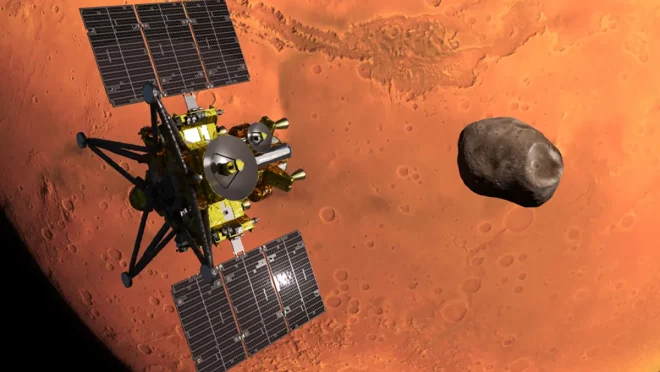
Japan launched a spacecraft on 20 October on a five-year mission to explore Mars’ two moons and bring samples from Phobos back to Earth by 2031.
Led by the Japan Aerospace Exploration Agency (JAXA), the Martian Moons Exploration (MMX) mission aims to land a robotic lander and a rover on Phobos, the larger and closer of the planet’s two moons.
The spacecraft successfully separated from its rocket’s upper stage about an hour after launch from the Tanegashima Space Center in southern Japan, officials said.
The mission involves five space agencies, including NASA, the French Space Agency, the German Space Agency and the European Space Agency. It is designed to collect at least 10 grams of dust, soil and rock from Phobos.
The spacecraft is expected to reach Mars in 2027. A French-German rover, named Idefix, will survey the moon’s surface for about 100 days to help identify a suitable landing site for the Japanese lander.
The lander is expected to collect samples in late 2028 or 2029 before returning to Earth in 2031, with the samples scheduled to land in the Australian desert.
Scientists hope the mission will help determine whether Phobos and Deimos formed from debris following an ancient collision involving Mars or are asteroids captured by the planet’s gravity. The samples could also contain traces of Martian material, offering further insights into the planet’s history.
Japan has previously completed two asteroid sample-return missions. However, no mission has yet returned samples from Mars or its moons.
China is also planning a Mars sample-return mission, targeting a launch in 2028 and a sample delivery in 2031.


