ISU's Textile Engineering Department prepares industry-ready graduates
With industry-oriented learning, modern laboratories and links to textile enterprises, International Standard University aims to help students meet the evolving needs of Bangladesh’s textile sector.
ISU's Textile Engineering Department prepares industry-ready graduates
With industry-oriented learning, modern laboratories and links to textile enterprises, International Standard University aims to help students meet the evolving needs of Bangladesh’s textile sector.
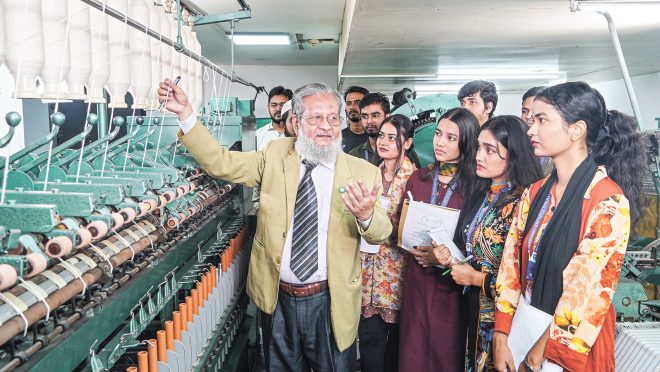
There are bright career prospects and extensive opportunities for textile engineers in Bangladesh’s rapidly advancing garment industry. Textile engineering currently ranks among the most sought-after fields in the country’s job market.
Demand for textile engineers is increasing day by day across technical and managerial positions in different factories in the textile sector, as well as in buying, merchandising and teaching.
However, students often face difficulties because they do not always possess the skills required by employers. Although textile engineering departments exist at many private universities, students are not always provided with adequate opportunities and facilities, which can leave them behind.
Recently, several private universities have been giving greater attention to textile engineering, and International Standard University (ISU) is one of them.
International Standard University (ISU) was established on 3 June 2018, with approval from the government and the University Grants Commission (UGC), in accordance with the Private University Act 2010.
It was founded as part of the social responsibility of Standard Group, one of the country’s leading garment exporters, with the aim of providing quality higher education. The initiative was taken by the two leaders of Standard Group: Engineer Engr. AKM Mosharraf Hussain, Chairman of the ISU Board of Trustees, and Engineer Md Atiqur Rahman, Vice-Chairman. Renowned educationist Professor Dr Abdul Awal Khan serves as the Vice-Chancellor of ISU. Prof Md Abul Kashem, former Vice-Chancellor of Butex, serves as Dean of the Faculty of Engineering and Technology and Chairperson of the Department of Textile Engineering.
After graduating in this important field, students can work in the private sector in spinning mills, weaving factories, dyeing, printing and finishing mills, garment factories, composite mills, denim projects, washing plants, buying houses and merchandising. Opportunities to teach textile engineering are also available at private universities, polytechnic institutes and colleges.
ISU Vice-Chancellor Dr Abdul Awal Khan said, “After completing their education, securing a job is an essential expectation for families. Expanding the job market requires initiatives from the private sector alongside the government. Standard Group is creating employment opportunities at its own establishments as well as providing access to higher education. This creates greater opportunities for textile engineering students. In addition, students have the opportunity to gain practical experience in 19 textile-related industries under Standard Group. Internship and employment opportunities are also available at more than 30 of its establishments. The university is contributing to the rapid advancement of Bangladesh’s textile industry so that it can keep pace with the global textile sector.”
Prof Md Abul Kashem, dean of the Faculty of Engineering and Technology and Chairperson of the Department of Textile Engineering at ISU, said, “The textile industry is a key driving force of Bangladesh’s economy. There is no alternative to modern education and research in developing skilled human resources for this sector. At ISU’s Department of Textile Engineering, we are preparing students to become competent engineers through an industry-oriented curriculum, modern laboratories and hands-on training.”
He added that ISU has a significant distinction from many other private universities. Students of its Department of Textile Engineering have the opportunity to gain practical knowledge and technical skills in textile-related industries under Standard Group. This has created an opportunity for university–industry linkage education. The aim is to produce skilled graduates who will be able to lead the textile sector at home and abroad and make an important contribution to the country’s economic development.
In this technology-driven era, students need practical skills as well as theoretical knowledge. ISU is working to develop its students into world-class engineers through modern technology, research and innovation. Its goal is to combine academic knowledge with real-world industry experience so that students can face future challenges. Professor Kashem further said that young engineers have a vital role to play in taking the country forward technologically, and ISU is working firmly towards that goal. He expressed confidence that ISU’s engineering students would one day demonstrate technological excellence at home and abroad and play an important role in building a “Smart Bangladesh.”
Afsana Akter Mim, a student of ISU’s Department of Textile Engineering, said, “Our department brings together a wonderful learning environment, a highly skilled faculty, modern laboratories and a rich library. Alongside classroom learning, visits to renowned textile factories are arranged every semester, giving students an exceptional opportunity to learn through hands-on experience. The university also regularly arranges seminars and workshops led by skilled faculty members, attended by prominent figures from Bangladesh’s textile industry. They share their extensive professional experience with students. As a result, students strengthen their theoretical foundations while also learning about the current state of the textile industry and its prospects in Bangladesh.”
A visit to the university’s Mohakhali campus in the capital reveals modern facilities throughout the campus, including air-conditioned classrooms equipped with multimedia projectors, CCTV and Wi-Fi connectivity. The university has a well-stocked library with a large collection of books and e-books, as well as a range of necessary journals. With digital facilities, modern arrangements and sufficient seating, the campus provides a student-friendly environment for learning. The air-conditioned library also helps students maintain their concentration while studying.
In accordance with UGC guidelines, ISU follows an internationally standardised Outcome-Based Education (OBE) curriculum delivered by highly qualified and experienced faculty members who have degrees from reputed universities at home and abroad. The faculty includes distinguished academics such as Dr. Monjur Morshed Mahmud, a renowned professor of the University of Chittagong and former member of the UGC, and Prof Md Abul Kashem, former vice-chancellor of Butex.
The university offers 14 different types of scholarships and tuition-fee waivers based on merit, eligibility and entitlement. Alongside a student-friendly campus environment, the university maintains close supervision to support an orderly academic atmosphere.
A safe campus is ensured for female students, and separate hostel facilities are available for both male and female students.
At present, the university has eight departments under five faculties. The Faculty of Business Studies offers the Bachelor of Business Administration (BBA) and Master of Business Administration (MBA). The Faculty of Engineering and Technology offers Computer Science and Engineering, Textile Engineering, and Apparel Merchandising and Management (AMM). The Faculty of Humanities and Social Sciences offers BA (Honours) in English, MA in English Literature and Cultural Studies, and Bachelor of Laws (LLB Honours). The Faculty of Advanced Science and Computing offers the Bachelor of Science in Engineering in Artificial Intelligence (AI) and Data Science programme. The university also offers a Master of Public Health (MPH).
For more information, visit ISU’s website at www.isu.ac.bd or call 01313037070, 01313037071 or 01313037078.