What is pushing Bangladeshi graduates towards foreign universities?
Data from the UNESCO Institute for Statistics show that the number of Bangladeshi tertiary-level students studying abroad more than doubled, from 24,112 in 2013 to 52,799 in 2023
What is pushing Bangladeshi graduates towards foreign universities?
Data from the UNESCO Institute for Statistics show that the number of Bangladeshi tertiary-level students studying abroad more than doubled, from 24,112 in 2013 to 52,799 in 2023
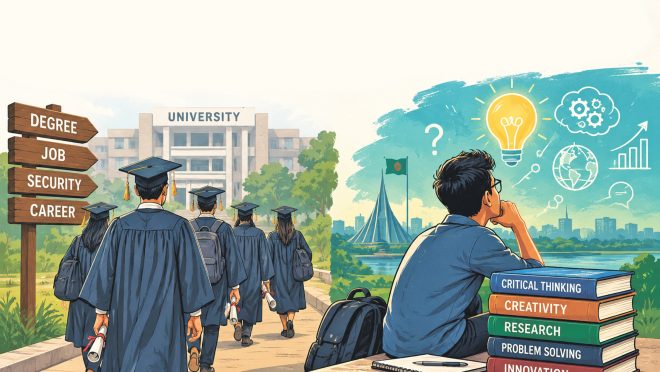
For a growing number of Bangladeshi students, a bachelor’s degree is no longer the final step in their education. Instead, it marks the beginning of a search for opportunities abroad, where they hope to find better research facilities, specialised training and stronger career prospects.
Data from the UNESCO Institute for Statistics show that the number of Bangladeshi tertiary-level students studying abroad more than doubled, from 24,112 in 2013 to 52,799 in 2023. Meanwhile, estimates from education consultancy Mentors’ Education suggest that between 70,000 and 90,000 or more Bangladeshi students leave the country for education each year.
The reasons vary, but many students share a desire for better academic opportunities, international exposure and qualifications they believe will give them an edge in the job market. For some, the decision also reflects concerns about the quality of higher education at home and the difficulty of finding suitable employment after graduation.
Seeking better research opportunities
For Md Shibli Noman Khan, a doctoral student at Lincoln University College in Malaysia, the decision to pursue a PhD abroad came from a desire to become a skilled researcher.
Khan is pursuing a Doctor of Philosophy in Social Science and believes studying abroad has given him better access to the research opportunities he needs.
“Opportunities to conduct internationally standard research in Bangladesh are very limited, so I came here to pursue advanced research. The opportunities for that are much better here,” he said.
He hopes to return to Bangladesh after completing his degree and use his expertise in policymaking or build a career in academia.
“My goal is to develop myself into a skilled researcher and return to Bangladesh to work at the policy level or pursue a teaching career,” he said. “Besides, having a foreign degree can make it easier to advance one’s career in Bangladesh.”
His experience reflects a key motivation for students pursuing postgraduate degrees overseas. Beyond the qualification itself, they are looking for research facilities, academic mentorship and professional networks that can help them develop expertise in their chosen fields.
For those interested in research-intensive careers, access to experienced supervisors, well-equipped laboratories and opportunities to collaborate with international scholars can be particularly important.
Confidence in local degrees
Educationist Dr Manzoor Ahmed said perceptions of educational quality and differences in career opportunities influence students’ decisions to pursue higher studies abroad.
“Degrees from foreign universities are often considered more valuable, while confidence in the quality of degrees offered by our own institutions remains relatively low. Differences in educational standards encourage students to look abroad for higher studies,” he said.
“If the quality of higher education in Bangladesh improves, the tendency to go abroad may decline.”
Ahmed also pointed to the wider employment and career opportunities available overseas as another reason students leave the country.
For graduates who struggle to find jobs relevant to their qualifications, an overseas degree may seem like a way to stand out in a competitive job market. An international qualification can also expose students to different approaches to learning, workplace practices and professional expectations.
However, a foreign degree does not automatically guarantee employment, a higher salary or permanent residence in another country. Its value depends on the quality of the programme, the skills students acquire and the opportunities available to them after graduation.
The question, therefore, is not simply where students earn their degrees, but whether their education prepares them for the careers they want to pursue.
Education as a career investment
The United States remains a major destination for Bangladeshi students. According to the Institute of International Education’s Open Doors report, 20,156 Bangladeshi students studied in the US during the 2024–25 academic year. The United Kingdom, Canada, Malaysia, Germany and Japan also attract students from Bangladesh.
Each destination offers a different mix of opportunities. Students may be drawn by specialised programmes, research facilities, international professional networks or the chance to gain practical experience while studying.
For many, however, studying abroad is a significant financial commitment that requires years of planning and, in some cases, considerable sacrifices by their families.
Figures from Bangladesh Bank show that foreign currency payments through authorised banking channels for overseas tuition and living expenses reached $881.7 million in fiscal year 2025–26, up 32.4% from $665.9 million in FY25.
The cost of an overseas education extends well beyond tuition fees. Accommodation, food, travel, health insurance and visa processing can add substantially to the total bill. Scholarships and funded research positions can ease the burden, but competition for them is often intense.
Students must also weigh the cost against the likely benefits. A programme that offers strong academic training, relevant work experience and access to a suitable professional network may provide a clearer path to a career than one chosen mainly for the reputation of the university or the appeal of living abroad.
Making the right choice requires students to look beyond rankings and consider course content, faculty expertise, funding options and employment prospects in their chosen field.
Should more students stay in Bangladesh?
Educationist Mohammad Kaykobad believes Bangladesh must also confront the wider challenge of providing opportunities for its large young population.
He said students who can finance their overseas education through their own efforts should not be discouraged from pursuing it.
“Bangladesh’s population density is about 24 times the global average, putting considerable pressure on the country’s resources and employment opportunities. If students can pursue higher education abroad using their own resources and contribute to society through their knowledge and skills, there is nothing wrong with that,” he said.
Yet the decision to study abroad does not necessarily reflect a rejection of Bangladesh’s universities. Some students leave because their preferred subjects, specialised training or research opportunities are not readily available at home. Others want to gain international experience before returning to build their careers in Bangladesh.
For local universities, retaining more students will require more than expanding enrolment or adding new programmes. Better-funded research, updated curricula, stronger links with employers and greater opportunities for practical learning could help institutions respond to students’ changing expectations.
The availability of qualified faculty, effective academic supervision and a learning environment that encourages independent thought will also matter. Students need to see that they can develop valuable expertise and build meaningful careers without necessarily having to leave the country.
Ultimately, the growing interest in postgraduate education abroad reflects students’ search for better learning, meaningful work and greater security for their future. A foreign degree can open doors, but it is neither a guarantee of success nor the only route to it.
The challenge for Bangladesh is to ensure that students have compelling reasons to stay, while allowing those who leave to gain knowledge and experience that can benefit them, their families and the country.