
A homegrown dialysis idea puts affordability and engineering to the test
BanglaDialysis is exploring whether a compact, locally adapted peritoneal dialysis system can make kidney treatment more accessible in Bangladesh. The ambition is significant, but its developers still have to prove that the technology can deliver safe, reliable and affordable treatment
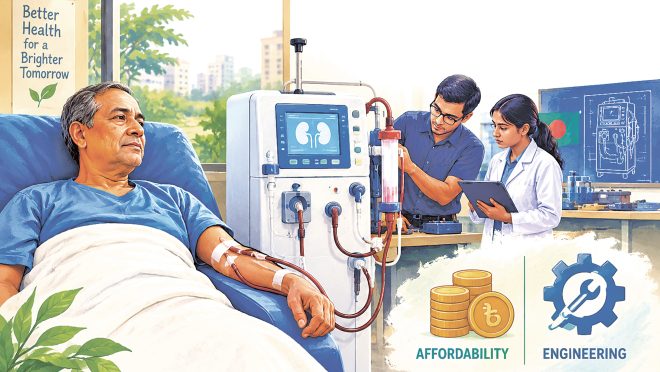
For people living with kidney failure, dialysis is not simply a medical procedure. It is a commitment that can reshape almost every part of daily life, from working hours and family responsibilities to travel, household finances and long-term plans.
In Bangladesh, where access to specialist healthcare remains uneven and treatment costs can weigh heavily on families, the challenge is particularly pressing. Patients who require regular dialysis must find not only the money to pay for treatment but also the time, transport and support needed to keep returning for it.
This is the problem that BanglaDialysis, an engineering initiative associated with North South University, is seeking to address. Its central idea is to explore a compact system for peritoneal dialysis that could eventually be better suited to Bangladesh’s financial, technical and healthcare realities.
The project is being developed around a straightforward question: can established dialysis and sorbent technologies be brought together in a system that is practical to operate, maintain and afford locally?
Md Mansur ul Mulk, Ph.D.
Scientist, Researcher, and Principle Investigator of BanglaDialysis project at North South University, Dhaka, Bangladesh, says the project’s distinguishing feature is a new chemical discovery or a claim to have surpassed existing international products. Instead, the team is concentrating on the engineering needed to make the different components work together under local conditions.
“Our strongest contribution at this stage is the system design work connecting fluid handling, regeneration, monitoring and controls,” he says.
That distinction matters. BanglaDialysis is not yet a clinically validated dialysis device, and the team has not established that its proposed cartridge can regenerate dialysis fluid to the standard required for patient treatment. Its work remains at the proof-of-concept planning and engineering design stage, with a series of technical and safety milestones still to be met.
Nevertheless, the problem it is trying to solve is real. For a country where many people struggle to access sustained kidney care, developing medical technology around local needs could eventually offer an important route towards greater affordability and access.
Making dialysis work closer to home
Dialysis replaces some of the functions of failing kidneys by removing waste products and excess fluid from the body. The two main approaches are haemodialysis and peritoneal dialysis.
Haemodialysis generally involves circulating blood through a machine that filters out waste before returning it to the body. Patients receiving treatment at a centre commonly need several hours per session, often multiple times a week, in addition to the time required for travel.
Peritoneal dialysis works differently. It uses the peritoneum, the membrane lining the abdominal cavity, as a natural filtering surface. A prescribed dialysis solution is introduced into the abdomen through a catheter. Waste products and excess fluid pass from the blood into the solution, which is subsequently drained and replaced.
Depending on the prescribed treatment, peritoneal dialysis can be carried out through manual exchanges during the day or with a machine that automates exchanges, often overnight. It can allow some patients to continue working and managing their daily activities with greater flexibility.
That does not make it a simple or universally suitable alternative. Patients need training, appropriate supplies, careful hygiene and regular clinical monitoring. Infection, fluid imbalance and other complications remain concerns, and treatment must be tailored to individual medical needs.
Still, its potential for home-based treatment makes peritoneal dialysis an attractive area for research in countries where dialysis facilities are concentrated in major cities.
A review published in the Bangladesh Renal Journal in 2022 traced the country’s history of continuous ambulatory peritoneal dialysis (CAPD) and highlighted the difficulties rural and semi-urban patients face in reaching haemodialysis facilities. It also identified considerable potential for CAPD, provided the necessary logistical support is available.
For Bangladesh, the issue is therefore not just which technology can remove waste from the body. It is also which treatment model patients can realistically sustain.
BanglaDialysis is approaching that question through the engineering of a proposed compact system. Rather than relying entirely on the conventional cycle of using fresh dialysis solution and discarding it after treatment, the concept explores whether a sorbent-based process could remove waste from used fluid and restore it for further circulation.
The attraction is clear. If a system could safely regenerate fluid, maintain its required composition and operate reliably, it might reduce the amount of fresh solution needed and make treatment less dependent on bulky equipment or extensive supplies.
But the word if carries considerable weight. Reducing fluid consumption does not automatically make dialysis cheaper, and a system that appears compact on paper may still require expensive consumables, maintenance and clinical support.
For Mansur ul Mulk and his team, the challenge is to establish whether the proposed design can work reliably before making claims about its eventual value to patients.
The challenge lies inside the cartridge
At the centre of the concept is a proposed cartridge containing materials designed to remove different substances from used dialysis fluid.
The design draws on established sorbent research. Different materials would perform different functions, including processing urea, capturing ammonium, targeting phosphate and adsorbing selected organic compounds.
Urea is a waste product that builds up in the body when kidney function is severely impaired. In the proposed process, an enzyme called urease would convert urea into ammonia and ammonium. Other materials would then be used to capture the resulting compounds and remove additional substances from the fluid.
Activated carbon, for example, can adsorb certain organic compounds, while other sorbent materials are intended to target particular ions.
Yet removing waste is only half the problem. The system must also avoid removing substances that the body needs, prevent unwanted chemicals from entering the fluid and maintain the composition required for safe treatment.
This is where the engineering becomes especially demanding.
A cartridge that removes waste effectively under laboratory conditions may behave differently during prolonged operation. Its capacity may decline as it becomes loaded, while competing ions in the fluid may affect what it captures or releases. The materials themselves must also be assessed for unwanted chemical release and the possibility of particles entering the circulating fluid.
The team must therefore establish not only what enters and leaves the cartridge but also how the fluid changes throughout the process.
“The hardest problem is keeping the entire fluid system within defined limits throughout its intended operating period,” Mansur ul Mulk says.
That involves controlling fluid movement, maintaining an accurate balance of volume, restoring the required chemical composition and monitoring the substances the cartridge removes or releases. These requirements must be met together rather than treated as separate engineering problems.
A smaller cartridge may make the device more portable, but it also has less capacity. Stronger pumps, additional sensors and protective mechanisms may improve control while increasing the system’s weight, power requirements and cost.
The proposed design must find a workable balance without compromising patient safety.
Even successful fluid regeneration would not, on its own, establish that the system could deliver adequate dialysis. Treatment effectiveness also depends on the exchange of waste products across the patient’s peritoneal membrane, the duration of treatment and individual clinical factors.
The cartridge is therefore one part of a much larger medical system, not a solution in itself.
From calculations to a working demonstrator
The distance between an engineering concept and a medical device is often greater than it first appears.
A design may look convincing in a computer model. Simulations can help researchers estimate flow rates, identify possible bottlenecks and explore how components might behave under different conditions. But they cannot establish that a physical device will work safely over an extended period.
BanglaDialysis has documented engineering designs, calculations, simulations, concept models, draft control software and proposed validation programmes. These provide a foundation for further development, but the reviewed project record does not establish a completed physical performance demonstration.
The immediate objective is deliberately narrower than a patient-ready machine.
The team plans to demonstrate repeatable circulation and control in a sealed loop containing water and inert media. This would allow it to examine fluid movement, measurement accuracy and control responses without introducing the additional risks associated with active chemical regeneration or patient treatment.
Such a demonstration may seem modest compared with the eventual ambition, but it addresses a necessary first question: can the proposed system reliably move and control fluid under a defined set of conditions?
The test would need a clear protocol, calibrated measurements, recorded deviations and independent review. It should also examine selected faults to establish how the system responds when something goes wrong.
Only after this stage would the project move towards separately validating the chemistry of the cartridge.
That work would require measurements of waste removal alongside sodium, potassium, calcium, magnesium, buffer chemistry, glucose and fluid volume. Researchers would also need to assess chemical release, particulate matter, microbial contamination and endotoxin, a substance associated with certain bacteria that can trigger harmful inflammatory responses.
Measurements of pH and electrical conductivity can provide useful information, but they cannot establish that all these parameters remain within acceptable limits.
The team has proposed monitoring and protective controls, including mechanisms to isolate the fluid path when necessary. These remain design requirements that need testing, rather than demonstrated safety features.
For a device intended to support a medical treatment, the distinction between a proposed safeguard and a verified one is fundamental.
Safety must come before portability
A compact dialysis system could eventually be useful outside specialist facilities. But taking a device into a patient’s home also changes the nature of the risks it must manage.
In a hospital or dialysis centre, trained personnel, established procedures and technical support are available when equipment fails. At home, a patient or caregiver may be the first person to encounter a leak, an alarm, a blocked line or an interruption in power.
BanglaDialysis’s design studies consider several of these scenarios, including power loss, controller failure, blocked flow, leaks, air in the fluid path and contamination.
The proposed protections include stopping pumping and heating when required, isolating the fluid path, using independent supervision and preventing an unchecked restart. These measures are intended to ensure that a fault does not simply allow the system to continue operating outside its permitted limits.
But identifying possible failure modes is only the beginning. Each protection must be tested to establish whether it responds correctly, consistently and quickly enough under defined conditions.
The same principle applies to maintenance. A system intended for local use would need replaceable modules, traceable consumables, reliable spare parts, calibration procedures and trained technical support. Its fluid path and replacement process would also require validated contamination controls.
These are not secondary considerations that can be addressed after the machine is built. They form part of the design itself.
A device that performs well under ideal laboratory conditions but cannot be maintained reliably, or that becomes unsafe when treatment is interrupted, would not meet the needs of the patients it is intended to help.
Mansur ul Mulk says the team wants to make treatment more compatible with ordinary life, but greater independence must not come at the expense of dependable care.
That principle becomes particularly important when considering who might use the technology first.
Affordability means more than a cheaper machine
The financial case for BanglaDialysis will ultimately depend on what patients pay over time, not simply the price of the equipment.
The team has discussed a target equipment price of Tk 1.5–2 lakh. However, this is an aspirational target, not a verified selling price, and it should not be confused with the annual cost of treatment.
The recurring expense could include replacement cartridges, disposable tubing, dialysis fluid, supplementary supplies, maintenance, electricity, clinical monitoring, training and technical support. The frequency of cartridge replacement will be particularly important because it will depend on validated performance under sustained operating conditions.
The team has set an eight-hour minimum and a 12-hour nominal cartridge runtime as research goals. Neither has been demonstrated as an achieved operating duration.
Until the cartridge’s usable capacity and replacement schedule are established, it is difficult to calculate the recurring cost with confidence.
The full financial picture must also distinguish between the initial equipment purchase and the cost of subsequent treatment. A machine that is relatively inexpensive to acquire could still prove costly to operate if it requires frequent replacement parts or specialised consumables.
Conversely, a higher initial cost might be justified if the device can deliver reliable treatment with manageable running expenses over an extended period.
A meaningful comparison would have to examine the total cost of equivalent care through conventional peritoneal dialysis and haemodialysis, including transport, time away from work and the support required to maintain treatment.
The value of a home-based system would also depend on where the patient lives, the availability of supplies and the reliability of local healthcare services.
For families outside major cities, reduced travel could be important. But savings in transport would not compensate for unsafe treatment or unpredictable supply costs.
“Our affordability goal is meaningful only if the recurring costs become manageable too,” is the principle underlying the team’s approach.
For that ambition to become credible, the project will need a transparent cost model based on tested components, realistic replacement intervals and the complete cost of care.
A home treatment model needs a support system
Even if the engineering and chemistry are validated, safe home use would require more than handing a patient a machine and a set of instructions.
Patients and caregivers would need accessible guidance in Bangla, practical training and an opportunity to demonstrate that they can operate the system correctly. They would need to know how to maintain hygiene, handle connections, replace cartridges, recognise alarms and respond to signs of infection or fluid-related problems.
They would also need clear instructions on when to stop treatment and seek medical assistance.
Clinical monitoring would remain essential. Treatment adequacy, fluid status and relevant laboratory results would need to be assessed according to a clinician’s plan. A dependable service would have to provide technical support, reliable consumables, access to clinical advice and an emergency referral route when treatment is interrupted.
These requirements are particularly important for a technology intended to expand access. Patients who already face financial or geographical barriers should not be left to manage unfamiliar equipment without adequate assistance.
The team has not yet established such a clinical support service. Usability studies conducted under controlled conditions would be a reasonable next step, helping researchers understand whether patients can operate the proposed equipment safely and whether its instructions and alarms are clear.
However, usability cannot substitute for engineering and clinical validation. A machine must first be shown to operate safely before training can prepare patients to use it.
The proposed first group for any eventual clinical study would be carefully selected adults already receiving peritoneal dialysis, provided the necessary development, approvals and support arrangements were in place. Their existing treatment and specialist follow-up could allow researchers to compare the new system with established care under closer supervision.
This is a proposed starting point, not an approved recruitment plan.
Beginning in a controlled clinical setting would also help the team identify problems before considering broader use among people who live far from specialist facilities.
The long-term aim is to expand patient choice, not to transfer the burden of an inadequately supported medical technology from hospitals to households.
The road to clinical trials
For BanglaDialysis to progress from an engineering concept to a treatment option, it will need a funded clinical-development programme and collaboration across several disciplines.
Engineering teams can develop and test the fluid-handling system. Chemists and materials specialists can investigate cartridge performance and chemical safety. Nephrologists can establish the clinical requirements, while independent laboratories can verify measurements and assess relevant risks. Manufacturing and quality specialists would be needed to ensure that components are produced consistently.
The project would also need to establish the applicable regulatory pathway with Bangladesh’s Directorate General of Drug Administration (DGDA) and qualified regulatory advisers.
Before human trials could begin, the team would have to demonstrate that the proposed system meets defined engineering requirements, that the regenerated fluid has an acceptable composition, and that chemical, biological and microbial risks have been adequately evaluated. Manufacturing quality, usability, clinical monitoring and emergency arrangements would also need to be addressed.
A clinical protocol would require the relevant ethical and regulatory approvals, along with appropriate arrangements for patient safety.
The reviewed project records do not confirm committed clinical partners, secured trial funding or a regulator-agreed pathway. It would therefore be premature to announce a trial date or suggest that the system is close to clinical use.
The immediate priority remains demonstrating that the basic fluid-handling system works as intended, then establishing whether the proposed cartridge can safely regenerate fluid under sustained, defined conditions.
Each stage will have to produce evidence that can be reviewed independently before the next begins.
A promising idea, with important questions still unanswered
BanglaDialysis reflects a broader question facing healthcare innovation in Bangladesh: how can technologies developed around local needs be made affordable without lowering the standards required for safe treatment?
The answer will depend less on how compact the final device looks than on what it can demonstrate. A successful system would need to remove waste effectively, maintain the required fluid composition, operate reliably, respond safely to faults and remain affordable throughout its useful life.
It would also need a support structure capable of serving patients beyond major urban centres.
None of those outcomes can be assumed from a design, a simulation or an aspirational price target. They must be established through testing, independent verification and, eventually, properly approved clinical research.
For now, BanglaDialysis is an attempt to address a difficult but important problem through locally focused engineering. Its potential lies in the possibility of combining established scientific principles in a system suited to the country’s circumstances.
Whether that possibility translates into a safe and affordable treatment option remains to be seen. The next milestone is not a promise of widespread home dialysis, but evidence that the proposed technology can do what it is designed to do.
For patients and families who must organise their lives around long-term treatment, that evidence will matter far more than the promise alone.


