Savior: Can a man find his humanity after losing it?
I had finished watching Savior back in 2020 with very little sense of having watched a war film. What remained instead was something much uglier and much more nearby. The sensation of having spent 103 minutes inside a world where the vocabulary of morality has gradually been stripped away.
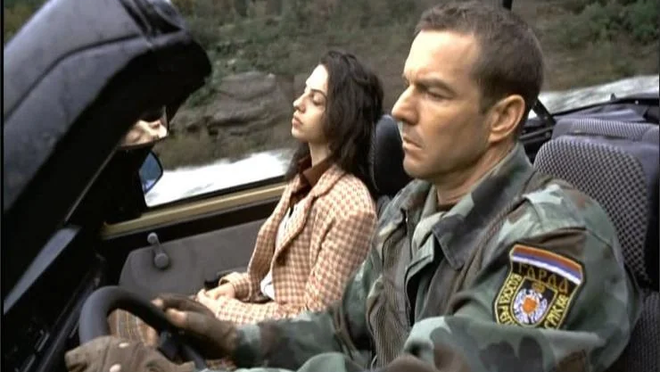
There is no clear distinction between the righteous and the wicked, no convenient hero waiting to restore order, and certainly no war presented as an arena where courage automatically makes sense.
Directed by Predrag Antonijevic, the film places Dennis Quaid at the centre of the Bosnian conflict as Joshua Rose, an American whose personal grief mutates into hatred before the war slowly begins to dismantle the hatred he has built his identity around.
And that is what makes Savior so unsettling. It is not really the story of a man becoming a hero. It is the story of a man discovering, almost against his will, that he has become something he can no longer recognise. The beginning is almost brutally simple: Joshua Rose loses his wife and young son in a terrorist bombing in Paris. His grief does not make him reflective; rather, it makes him vengeful. He responds by killing Muslims and eventually disappears into the French Foreign Legion, taking the name Guy. Years later, he is fighting as a mercenary on the Serbian side of the Bosnian War.
What fascinates me is how deliberately the film refuses to romanticise this transformation. Guy is not introduced as a complicated intellectual struggling with geopolitics. He is a man who has reduced his grief to an enemy.
That is perhaps the most frightening thing about hatred. Instead of asking, “Why did this happen to me?”, Guy finds a much easier question, “Who should I hate for it?” And once he has an answer, the tragedy is that the direction is wrong. Dennis Quaid’s performance is almost entirely built out of absence. Quaid does something remarkably restrained here.
There is almost no trace of the warm, accessible screen persona associated with so many of his other roles. His Guy is hollowed out. That is precisely why the performance works.
Guy is not angry. He is numb. Guy commits terrible acts. He participates in a system of violence that has almost completely erased the distinction between soldier and murderer. The film does not allow his personal tragedy to become a moral exemption.
Instead, it asks something more uncomfortable. How does an ordinary human being become capable of extraordinary cruelty?
And perhaps the answer is not that he becomes less human. Perhaps it is that he begins to believe that some humans are less human than others. Then Vera enters the story.
She is a pregnant Serbian woman who has been ra*ped by a Muslim soldier. Her pregnancy becomes a source of shame and violence within her own community, and Guy eventually finds himself responsible for getting her and her newborn child to safety.
What makes this relationship so powerful is that it does not develop into the sentimental Hollywood bond one might expect. There is no sudden transformation. No speech. No miraculous revelation. No convenient declaration that Guy has found his humanity.
Instead, something much quieter happens. He begins to see a person where he previously saw categories. That is the central movement of the entire film.
Muslim. Serb. Enemy. Ally. Traitor. Victim. These words have become weapons. But Vera cannot remain a category once Guy has to carry her. A newborn cannot remain an abstraction once you are responsible for keeping it alive. And this is where the film’s title becomes interesting.
Who exactly is the Savior? Guy? Vera? The baby? Perhaps none of them. Perhaps the title is ironic!
Guy thinks he is saving Vera and her child. But in another sense, Vera and the baby save him, not physically, but morally. They force him back into the uncomfortable territory of individual human attachment, where hatred becomes much harder to maintain.
Roger Ebert identified this movement particularly well when he argued that Guy’s responsibility for the infant forces him back towards more civilised values and that empathy becomes an enemy of tribal hatred.
That idea stayed with me. The film understands something terrifying about tribalism.
A man can look at another human being and see nothing but religion. A woman can be punished for something that was done to her. A child can become an extension of a conflict he did not create. A corpse becomes scenery, a rifle becomes a profession, and hatred becomes routine.
The film’s politics are deliberately uncomfortable because it does not give the audience a simple side to inhabit. Ebert noted its even-handed treatment of the competing sides, while the Los Angeles Times similarly described its argument as one in which the conflict had descended beyond meaningful moral simplicity.
That does not mean every historical or political dimension of the Bosnian War can be reduced to ‘everyone was equally guilty.’ History is more complicated than that.
The baby changes everything. There is something almost unbearable about the contrast between Guy’s relationship with violence and his relationship with the baby.
A man who has become comfortable with death suddenly becomes terrified of something as simple as keeping a newborn alive. And that change is the film’s real narrative. But I don’t think Guy is redeemed. This is perhaps my biggest reservation with readings of Savior that describe it simply as a redemption story.
The film does not conclude with the reassuring feeling that everything has been repaired. Its ending is cathartic, but deliberately refuses to become conventionally happy. That felt right to me.
A film about war that ends with complete emotional restoration would almost be betraying its own argument. Being saved from the terrible simplicity of believing that another human being can be hated before they are known. The film is not asking whether Guy can become a savior. It is asking whether, after everything he has done, he can become human again.
As such, instead of saying I ‘loved’ the movie, perhaps I ‘judged’ the movie back then and even today.