A lifetime behind bars for two rescued leopards
A lifetime behind bars for two rescued leopards
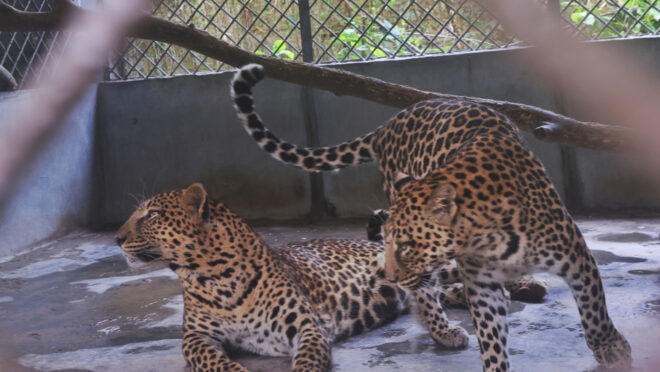
Rescued from wildlife traffickers in 2018, two African leopards have spent the past eight years confined to a cramped room at Gazipur Safari Park. As authorities pursue a costly domestic enclosure, questions remain over institutional accountability, animal welfare and why a viable alternative has yet to be considered.
At first glance, it looks like an ordinary single-storey building. It has a few rooms and a sign bearing the word “Wildlife Hospital” hanging outside. It looks like any ordinary place built for people to live or work in.
Except it is not. Two leopards, a female and a male, live inside a small cage, sharing the building with the people who look after them.
The building was originally meant to serve as a veterinary hospital for animals at the safari park. It still does, but it has also become a place of confinement for the two trafficked leopards. For the past eight years, the animals have been confined to a damp, cramped room measuring just 150 square feet.

The building was originally meant to serve as a veterinary hospital for animals at the safari park. Photo : TBS
The room reeks of urine and animal faeces. The leopards appear exhausted at times, agitated at others. Plaster has fallen away from the ceiling, not because of age or neglect, but because the animals keep clawing at it, desperate to be free.
The caretaker tasked with looking after the leopards has no prior training or professional background in managing large wild carnivores. In practice, the routine comes down to dumping feed into the room, while the park’s lone veterinarian, who is responsible for every animal across the entire safari park, occasionally checks for acute signs of illness or infection.
The story dates back to 2018, when the Special Response Battalion (SRB), then known as the Rapid Action Battalion (RAB), rescued the two cubs from wildlife traffickers in Narayanganj.
They were around two years old at the time. Brought from Africa, they were reportedly being moved through Bangladesh as part of an international trafficking route.
Initially, the cubs were supposed to remain under observation for three weeks because of the risk of infectious diseases. After that, they were expected to be moved to the park’s main enclosure.
Since then, 418 weeks have passed. The cubs have grown into fully developed leopards, but their confinement has not changed. They still live in the same cramped room, separated from the world.
A three-week quarantine has become an eight-year confinement.
A temporary solution
Tarek Rahman, assistant conservator of forests (ACF) at Gazipur Safari Park, acknowledged the improvised nature of the arrangement.
“It is not a rescue centre, but we are acting like one,” Rahman said. “When these animals were brought to us, we were not prepared to keep them. Still, they were kept here because we have an expert doctor. For rescued animals, we don’t have a designated or separate space.”
Under the Convention on International Trade in Endangered Species (CITES), leopards are listed in Appendix I, the highest level of protection against international commercial trade. When a member country confiscates a live Appendix I specimen, the state’s Management Authority is legally bound to initiate a formal disposal review.
International guidelines dictate that authorities cannot take arbitrary or unilateral measures; they are required to consult scientific authorities and international bodies to decide whether repatriation or placement in a recognised overseas rescue centre is the most viable course.

Infograph: TBS
In the case of the two Gazipur leopards, no such formal consultation was ever initiated.
Instead, the Forest Department moved forward with a domestic project to construct an enclosure measuring roughly 1,000 to 1,200 square feet, at an estimated cost of Tk67.5 lakh. The plan has been presented by park officials as a significant upgrade, but conservation standards suggest otherwise.
Guidelines from the Global Federation of Animal Sanctuaries set a minimum baseline of 1,200 square feet of outdoor space for a compatible pair of big cats, alongside mandatory vertical platforms, structural enrichment, and opportunities to display natural behaviours. Other international standards for captive felids demand far more. India’s Central Zoo Authority mandates a minimum of 500 square meters, nearly 5,400 square feet, of open paddock area for a pair of leopards.

The cubs have grown into fully developed leopards, but their confinement has not changed. Photo : Mehedi Hasan
Dr Mokhlesur Rahman, professor of Zoology at Dhaka University, warned that the prolonged confinement has already inflicted severe damage on the animals.
“It is very upsetting that we haven’t been able to make a proper sanctuary for this animal in eight years,” said Dr Rahman, pointing directly to the claw marks on the ceiling. He added that repeated scratching against concrete is a sign of profound psychological distress and hormonal imbalance, while warning that long-term restriction inside a small room breaks an animal’s reproductive cycle.
“Eight years have passed, a male and female leopards have been living together and they haven’t been able to breed. Breeding is not possible under such conditions,” he said. Given that captive maintenance of endangered species is fundamentally justified by conservation breeding, the current setup serves no conservation purpose.
They might look somewhat healthy on the outside, but their wild instincts are gone after spending their entire adult lives — from ages two to ten — trapped in a box. The most alarming shift is the onset of Zoochosis; this stereotypic condition manifests as repetitive, purposeless movements born from a desperate plea to escape, including crawling up to the ceiling, bouncing off walls, and compulsively biting the cage bars.

The two leopard cubs rescued from wildlife traffickers in Narayanganj in 2018 have spent the past eight years confined at Gazipur Safari Park.
A trail of contradictions
Asked why the animals had remained in such a confined space for so long, Sanaullah Patwary, wildlife conservator with the Forest Department, said the authorities had no other option.
“There was no other arrangement. For this swift animal, we didn’t have any other accommodation. We considered all this, accommodated them for the project, and now we are making a proper shed for them, which will be around 1,000 to 1,200 square feet. The current shed is probably only 150 to 200 square feet for both of them.”
Patwary also rejected the argument that Bangladesh lacks the capacity to care for such animals, comparing captive wildlife management to national living standards.
“Bangladesh’s capacity isn’t up to the mark, well, that’s your opinion,” Patwary said. “We think that in terms of education, culture, human resources, and medical care, looking at our overall standards, we are still doing fine. Look, just like the amount of water we use, the amount of food we consume, and the space we utilise, our animals will also be scaled accordingly. Bangladesh is a densely populated country. We live with limited resources, so our animals will also have to manage with fewer resources.”
About DNA tracing he claimed, “We tried to do DNA sequencing in 2024. Back then we tried to do it through the marker we had for the tigers, later we had to bring the marker for the leopard. And the process is not done yet. So we cannot really tell if the leopard is from Africa or India.”
Official departmental records, however, tell something different.

Both rescued cubs are confirmed to belong to the subspecies African Leopard (Panthera pardus pardus).
A formal report signed on 28 September 2025, by Mohammad Mizanur Rahman, director of the Wildlife Crime Control Unit (WCCU), shows that Patwary himself initiated the verification. The document notes, “The Conservator of Forest Mr. Md. Sanaullah Patwary, Wildlife Nature and Conservator Circle requested confirmation of species and subspecies identity for two previously rescued feline cubs suspected to belong to a leopard species.” and the test result recorded on the same document said, “Both rescued cubs are confirmed to belong to the subspecies African Leopard (Panthera pardus pardus).”
Similarly they also dismissed the possibility that international sanctuaries had offered to take the cats. Dismissing the possibility of an overseas transfer, he claimed that no legitimate government agency or party had formally requested the leopards.
Animal welfare organisation Obhoyaronno, which spent months coordinating with foreign sanctuaries, received a formal letter of intent from Panthera Africa NPC, an accredited big cat sanctuary in South Africa, on 5 October 2026.
In the letter, the sanctuary confirmed its readiness to take both animals into a natural habitat enclosure measuring 4,646 square meters, roughly thirty times the size of the enclosure planned at Gazipur.
On 6 October, Obhoyaronno officially submitted the sanctuary’s consent letter and proposal directly to the Department of Forest. They have not heard back yet, but Rubaiya Ahmad, the founder of Obhoyaronno, said they hope a response will go directly to the sanctuary, if not to them.
Eight years after their rescue, the leopards are still waiting for a permanent home. The question is whether that home will be a new enclosure in Gazipur or a sanctuary abroad — and whether the authorities are willing to consider both options.