BRAC University holds Silver Jubilee Research Conference 2026
BRAC University holds Silver Jubilee Research Conference 2026
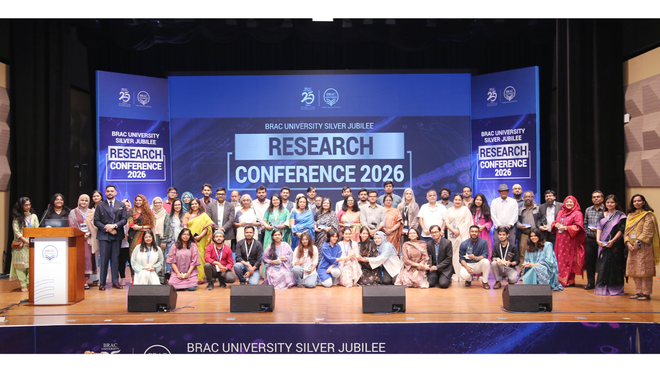
Researchers presented 165 papers at BRAC University’s Silver Jubilee Research Conference, held at its Merul Badda campus in Dhaka on 14 and 15 November, 2026. The event brought together researchers, faculty members, students and representatives from government, industry and BRAC to share findings and explore opportunities for collaboration.
The conference marked the university’s 25th anniversary under the theme “25 Years of BRAC University: Research for Innovation and Impact”. Papers were presented across four tracks.
- Engineering, Technology, Data Science, Architecture and Environment
- Health, Life Sciences and Pharmacy
- Business, Economics, Policy, Law and Governance
- Social Sciences, Arts, Humanities and Education
The programme featured an exhibition of research and innovations from all of BRAC’s academic and research units, along with workshops to develop practical skills. Forums explored ways to strengthen research collaboration, improve how findings are communicated and expand work in fabrication laboratories. Participants also discussed the use of artificial intelligence and the role of young scientists in driving social change.
At the Industry-Academia Collaboration Forum, speakers discussed how universities could better align their research and curricula with industry needs. They also urged businesses to set aside dedicated budgets for research.
The BRAC-BRAC University Synergy Session explored opportunities for joint research in agriculture, development, public health, education, climate, poverty alleviation and social innovation.
The Government-Academia Collaboration Forum examined research funding, student-led projects and ways to access external grants. Participants also discussed product development and commercialisation, as well as how to apply research findings to policy and practice.
Dr Hossain Zillur Rahman, chairperson of BRAC’s governing body, attended the inaugural session as chief guest. He urged researchers to keep human wellbeing in mind and approach people’s lived experiences with humility.
Special Guest Dr Sultan Hafeez Rahman, a professorial fellow and former executive director of the BRAC Institute of Governance and Development at BRAC University, called for greater investment in the humanities and social sciences as technological advances reshape society.
In his keynote address, BRAC University Vice-Chancellor Professor Syed Ferhat Anwar said meaningful research begins with identifying a real-world problem.
“If we want to be leaders in the Global South, people will ask: What can you offer that others cannot? Identifying a problem is the first step. Without a problem, research is useless,” he said.
Sadaf Siddiqi, a member of BRAC University’s board of trustees, also spoke at the inauguration, alongside Pro-Vice-Chancellor Professor Arshad Mahmud Chowdhury, Treasurer Ariful Islam, Registrar Dr David Dowland and Professor Malay Kanti Mridha, director of the Central Research and Innovation Office.
On the second day, Dr Imtiaz Ahmed, executive director of the Centre for Alternatives and a retired professor of international relations at the University of Dhaka, delivered the plenary keynote address.
In a separate session, Professor Dr Kaosar Afsana, lead of the Humanitarian Hub, and Professor Dr Syed Masud Ahmed, director of the Centre of Excellence for Health Systems and Universal Health Coverage at the BRAC James P Grant School of Public Health, presented examples of the university’s research. Professor Dr Md Golam Rabiul Alam of the Department of Computer Science and Engineering also presented at the session.
At the concluding ceremony, the university recognised outstanding contributions by individual researchers and academic and research units. It also recognised outstanding research stalls, oral presentations and poster presentations. Treasurer Ariful Islam formally closed the conference.
BRAC University said the conference aligned with three United Nations Sustainable Development Goals – Goal 4 on quality education, Goal 9 on industry, innovation and infrastructure, and Goal 17 on partnerships for the goals.