How Ashfaqur secured a fully funded PhD at Syracuse University
For many students in Bangladesh, pursuing a fully funded PhD at a prestigious university in the United States often feels like a distant ambition, constrained by financial limitations, academic competition, and a lack of access to reliable information.
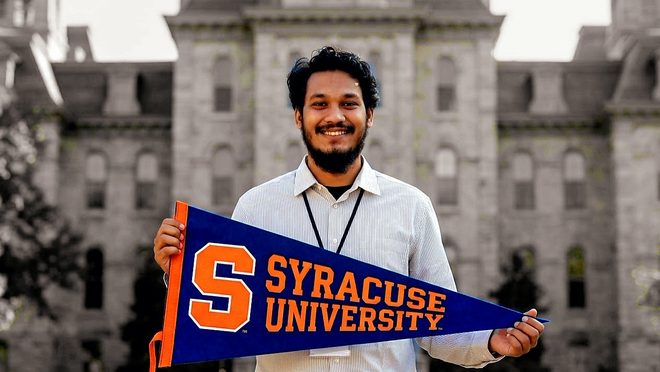
The journey of S M Ashfaqur Rahman, a PhD student in Sociology at the Maxwell School of Citizenship and Public Affairs, Syracuse University, offers a different perspective on what is possible.
From his early research experiences at the University of Chittagong to working with internationally recognised organisations such as Johns Hopkins, BRAC University, and BBC Media Action, Ashfaq gradually built an academic profile grounded in research, fieldwork, and intellectual curiosity.
In 2024, he moved to the United States on a fully funded scholarship to pursue his second master’s degree at Minnesota State University, Mankato, before securing a five-year funded doctoral opportunity at Syracuse University, with a funding package valued at nearly Tk5 crore over the programme. His journey, however, is not simply a story of academic achievement or financial success.
Why? Here’s his journey.
Ashfaq’s foundation was built in the Department of Sociology at the University of Chittagong, where he completed his bachelor’s and master’s degrees. In his third year of undergraduate study, he joined the Johns Hopkins Center for Communication Programs in Bangladesh as a research assistant.
From 2019 to 2022, he worked on its USAID-funded Ujjiban project, which aimed to improve health behaviours among people in Bangladesh. That work gave him direct experience with both qualitative and quantitative research and showed how sociology applies to real problems, especially in public health.
Ashfaq later worked on several projects at BRAC University’s James P. Grant School of Public Health, along with part-time research for other organisations.
“During my first master’s at Chittagong, I joined BBC Media Action Bangladesh as a research assistant. My work focused on the Rohingya camps in Cox’s Bazar, studying how better communication systems could improve service delivery and living conditions for Rohingya communities.”
In 2024, Ashfaq moved to the United States for a second master’s in Sociology at Minnesota State University, Mankato, with full funding. There, he adjusted to an education system very different from the one he had trained in, presented his work at regional conferences, and built an academic network.
“I believe this combination of theory, fieldwork, and U.S. training is what prepared me for Syracuse.”
A PhD is a marathon anywhere in the world. Ashfaq chose the United States because of the quality of its doctoral training, which he believed would help him become a true expert in his field.
“I chose Syracuse for three reasons. First, its Sociology Department is part of the Maxwell School of Citizenship and Public Affairs, which U.S. News & World Report ranks No. 1 in the nation for public affairs. Second, as an R1 university, the highest category of U.S. research universities, Syracuse offers substantial research funding and specialised centres. I am a graduate affiliate of the Aging Studies Institute and a training affiliate of the Policy, Place, Population Health and Aging (P3HA) programme, a training programme funded by the U.S. National Institute on Aging, which gives me access to research labs, workshops, and the Center for Policy Research,” he said.
Third, the faculty. Syracuse sociologists are leading scholars in their areas, so he learns directly from them. Academic genealogy also matters in research. Training is passed from teacher to student across generations. If someone traces the training lineage of founding figures of modern sociology such as Robert K. Merton and Talcott Parsons, they find connections to faculty there. Ashfaq wanted to be part of that tradition. On a lighter note, Syracuse’s history added to its appeal: former U.S. President Joe Biden earned his law degree here.
“I first learned about Syracuse during my master’s at Minnesota State. I was working as a research consultant at the university’s Center for Excellence in Scholarship and Research, and my supervisor and teacher, Dr Aaron Hoy, is a Maxwell School alumnus. Through him, I came to know the school well.”
Apart from this, Ashfaq searched continuously. Every university has strengths and limits, so he looked closely at which departments matched his research, what their faculty study, which datasets they specialise in, and which methods they used. These fine details matter a great deal, and they shaped both his shortlist and Statement of Purpose (SOP).
Before applying, Ashfaq emailed the graduate director or coordinator of each shortlisted department with his CV and a short research statement, asking whether he would be a good fit. Generic replies are easy to recognise. Although sociology departments like Syracuse’s fund students centrally, he also contacted potential faculty mentors.
“I applied only where I received a genuinely positive response.”
Upon being asked whether the GRE was required, he said that the GRE was not required when he applied, and because he holds a U.S. degree, Syracuse waived the English proficiency test. As requirements change from year to year, applicants should always check each department’s website.
Syracuse offered Ashfaq five years of funding, the Maxwell Fellowship in his first year, followed by four years as a graduate teaching or research assistant. The university will spend about USD 80,460 on Ashfaq each year, which comes to nearly Tk5 crore over the programme. No single factor earned this. Several worked together.
The first was sustained research experience, built step by step since Ashfaq’s undergraduate years in Bangladesh and continued in the United States. The second was research fit.
“I applied only where my interests, data, and methods matched the faculty’s work.”
The third was early contact with graduate directors and faculty, who advised him where his application had a real chance. The fourth was the U.S. master’s, where he earned a 4.0 out of 4.0 GPA, learned how American academia works, and built relationships with faculty who could write strong recommendation letters.
With his teacher Dr Mohammad Mohiuddin, Ashfaq co-authored an article on the Rohingya influx and Bangladesh’s security challenges, published in the Hull Law Review in 2025. As an undergraduate, he also received a merit scholarship from the University Grants Commission of Bangladesh.
In Minnesota, he continued his research under the guidance of his teachers and presented it at several U.S. conferences. He went on to win first place in the graduate division of the Sociologists of Minnesota’s Caroline Rose Student Paper Award in 2024 and in the Midwest Sociological Society’s Student Paper Competition in 2025. In 2025, he also received the Lynn Wetherbee and William C. Weese MD Aging Studies and Dementia Research Scholarship, the David and Darlene Janovy Summer Research Award from the Chesley Center on Aging, a Graduate Student Research Grant, and several conference travel grants.
Working as a full-time graduate teaching assistant across several sociology and leadership courses, building skills in RStudio, SPSS, and Tableau, and serving as president of the Bangladesh Student Organization also helped.
“One result makes me especially happy: the master’s thesis paper I submitted as my writing sample later won the State Society on Aging of New York’s Master Student Paper Award, after I had been admitted. I owe much of this to my teachers and colleagues.”
Ashfaq wrote his Statement of Purpose as his own story rather than a generic essay.
“I kept it free of clutter and irrelevant detail, and engaging from start to finish. After the first draft, my teachers reviewed it several times. Each brought a different perspective, which helped me make it sharper and more precise.”
Not every university asks for a separate research proposal, but the research plan can be woven into the SOP. Ashfaq framed his interest in cognitive decline among older Americans as a problem: the older population is growing while birth rates fall, so older adults will become an increasingly important population socially, economically, and politically. If a large share of them lose cognitive capacity to Alzheimer’s disease, dementia, or other causes, the economy and health system will come under serious pressure. He then explained what he wants to study, why and how this happens, its key drivers, and how research can help address it.
For the writing sample, he used his master’s thesis paper, as it was closest to his interests. For his CV, Ashfaq followed the common format of U.S. faculty CVs, which he studied on university websites.
Recommendation letters are written by faculty, and nearly all letters praise the student.
“In my understanding, committees also weigh how well they know and trust the recommender’s work and training, so it is best to ask faculty who have seen your work closely and are established in their fields.”
Talking about challenges, the biggest challenge was competition. Applicants come from all over the world, and many have studied in the United States or China, hold perfect 4.0 GPAs at both undergraduate and graduate levels, and have several publications. In Bangladeshi universities, and especially in sociology, a perfect GPA is almost unimaginable no matter how talented the student is. In the United States, by contrast, Ashfaq found that consistent hard work can earn one.
This difference in grading puts Bangladeshi applicants at a disadvantage.
To make up for it, Ashfaq relied on his strengths: years of research experience, competitive awards and grants, and regular conference presentations. Feedback from faculty and researchers at other universities during those conferences sharpened his thinking as a researcher, which helped him compete.
The financial support was essential for Ashfaq.
“For someone from a middle-class family like mine, a self-funded PhD in the United States is nearly impossible. At Syracuse, tuition, housing, food, health insurance, and other costs come to about Tk1 crore a year. Without funding, I could not have come.”
Students on an F-1 visa also cannot work off campus without special authorisation. A PhD is not just coursework. It involves one’s own research, professional development, lab work, and teaching or research assistantships, often teaching classes alongside one’s own. With an added financial burden on top of all this, finishing would be extremely difficult. This is why most PhD students at U.S. research universities study with institutional funding.
“Thanks to mine, I can give my full attention to study and research without taking money from my family or becoming a burden to them. That is the greatest relief of all.”
In his first year, the Maxwell Fellowship, awarded to selected incoming students, requires no teaching or other service, so he could focus entirely on coursework and research. From the second to the fifth year, he wished to work as a graduate teaching or research assistant.
The package covers full tuition for all required coursework and provides a monthly stipend for living expenses. The university also covers most of his health insurance, preventive dental insurance, and the mandatory health fee, which gives him access to campus medical and counselling services. In the assistantship years, the graduate employees’ union agreement adds benefits such as paid parental leave and childcare support for eligible students.
The funding is renewed each year as long as he remains in good academic standing and makes satisfactory progress. So alongside the opportunity comes responsibility, and that keeps him motivated to do well.
In terms of his family, teachers, and mentors who contributed to his academic journey, he started with his mother.
“My father was often busy with work and could not give us much time, though his contribution matters too. From my earliest years, my mother was not only a mother but also my teacher. She still asks about my studies regularly, and that kind of guidance is invaluable.”
He also added, “My wife, who also holds a master’s in Sociology from the University of Chittagong, has been a great support. I can discuss sociological ideas with her, and she understands that my work sometimes keeps me from giving the family enough time. That understanding gives me peace of mind. When I left for my master’s in the United States in August 2024, our child was only three months old, and she raised our child in Bangladesh on her own. Without these sacrifices, I could not have pursued a PhD.”
Ashfaq’s teachers have been his mentors.
“At the University of Chittagong, my teacher Monirul Hasan and Dr Mohammad Mohiuddin first guided me into research. At Minnesota State, I received constant advice and support from department chair Dr Sarah Epplen, Dr Aaron Hoy, and Dr Afroza Anwary, a University of Chittagong alumna who serves there as a Distinguished Professor. Each of them has a share in where I am today.”
Ashfaq’s interest lies in cognitive decline among older adults, especially how public policies affect their cognitive health and conditions such as dementia and Alzheimer’s disease. His central goal is to evaluate policies and investigate how they connect to the cognitive health of older people.
The world’s population is ageing. In countries such as Japan and South Korea, a large share of the workforce is reaching retirement age. When a country’s working-age population shrinks, economic growth comes under pressure, and the effects ripple through internal and international migration and the wider demographic structure. Every state therefore needs to track its demographic transition and plan policy accordingly.
This raises questions he wants to answer: should the retirement age be raised, and if so, how can older people stay healthy and able to work? How can they be protected from financial vulnerability, and what social safety nets should the state provide? Ashfaq hopes to build expertise in these areas and one day apply it to help Bangladesh prepare for its own ageing population.
In terms of misconceptions among Bangladeshi students, Ashfaq stated a few.
“It takes a lot of my own money.”
It does not. Each U.S. application usually costs about Tk7,000 to Tk10,000, but many universities waive the fee, some on the basis of financial need. Many hesitate to contact universities abroad. Students should overcome that hesitation and email the department’s graduate coordinator or director to ask about a waiver. After admission, the main costs are visa-related fees and airfare, roughly Tk2 lakh in total, which many families in Bangladesh can manage.
“I cannot work off campus, so I cannot pay my way.”
Funded programmes are designed for exactly this. Universities waive tuition, pay a monthly stipend, cover all or part of health insurance, and some even offer childcare support. Few people in Bangladesh know about these benefits.
“I need a professor to fund me.”
Many students do not understand the difference between central and professorial funding. In sociology, departments usually fund students centrally, so admission does not depend on persuading one professor. Contacting faculty still helps, but it is not the only path.
“Only students from top public universities get in.”
Not true. Students from any university can succeed if they develop an interest in research early and pursue it.
“I must apply through an agency.”
For master’s and PhD programmes, one must prepare their own SOP, CV, and writing sample, which no agency can write for the applicant. One can find programmes online, contact universities, and apply themselves. Paying an agency adds an unnecessary cost that becomes a barrier for many students. Even undergraduates can apply on their own.
After completing his PhD, Ashfaq wants to remain in academia, teaching and doing research at a university, and to advise on policy at the national level.
“My goal is to help evaluate and improve policies so that a growing older population can stay able to work, have their mental and cognitive health protected, and rely on effective social safety nets. This would reduce older adults’ vulnerability and help keep a country’s economy and social structure stable.”
He is already working to serve the wider discipline. He currently sits on the Advisory Board of the American Sociological Association’s Student Forum for 2026 to 2028 alongside the co-chair of its Awards Committee for 2026 to 2027.
“In the future, I hope to bring this experience home. Sociological associations in Bangladesh do not yet have the visibility or impact they could, and I would like to help strengthen them as platforms for research, mentoring, and public engagement. Alongside that, I hope to contribute to the well-being of older people in Bangladesh,” he concluded.