Remembering Sufia Kamal
Remembering Sufia Kamal
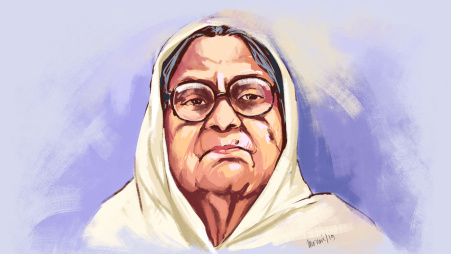
Outside, on the road, a scooter backfired and I spilled some tea. The 4th grade Amar Bangla Boi is safely tucked in my tin trunk at home. The Bangla Academy version of Sufia Kamal’s poems is splayed across my desk, but there is a large tear running along the bottom of the staples.
Her name is listed right below the titles. At the bottom is a small bio in a tight font. Back in class, we used to shout ‘Itol Bitol’ and ‘Jonmechi Ei Deshe’ countless times in class on scarred wooden benches, until our voices were hoarse. With our pencils, we wrote down that she was the first Muslim woman within the Indian Women’s Federation, first editor of Begum, first president of Bangladesh Mahila Parishad, first woman to be given a state funeral in the country. I underlined every line (since we may be tested on it in a quiz on a Tuesday); however, I had long forgotten the information by the time I left the room.
There is a power cut in the road outside my flat in Dhaka. I have opened this paper-backed book, and am reading from its pages under the blue light of my phone. There is a mosquito coil burning beneath my desk. From the next roof over, there is a meowing sound from a stray greyish cat. This afternoon there was heavy traffic near the crossroads, and a driver’s horn blared loudly for 10 minutes. Everyone around us was absorbed in the glowing screens of our devices. This kind of sound would have been unheard of in Sufia Kamal’s time. Despite many Bengali books containing difficult Sanskrit words, very little noise would have echoed from the streets. It seems quiet compared to this modern noise.
Sufia Kamal wrote the way people actually spoke at home. Growing up in a traditional and religious household in Barishal, Sufia Kamal learned the alphabet from her mother. When her brothers attended lessons, she would press her ears to the bamboo divider separating the rooms and listen in. “We were kept inside like caged birds, yet my mind kept searching for the open sky through books.” Her early writings remained private until they were discovered by Kazi Nazrul Islam and Begum Rokeya, who encouraged Sufia Kamal to publish. She was one of the poets my nanu loved dearly. In fact, she taught me a few of those poems herself long before I ever saw them printed in a school syllabus, reciting the stanzas with the pride of a woman who knew what it took for someone like Sufia Kamal to claim a public voice in the first place.
Rivers and rain define whether people in this family eat in “Sanjher Maya”. As Sufia Kamal was growing up by the Kirtankhola river, the amount of rain and drought meant that meals depended on the weather. In “Jonmechi Ei Deshe”, she writes, “এ দেশে জন্ম, এ দেশেই যেন মরি।” During the Bengal famine and Liberation War, the true situation in the country wasn’t apparent from radio announcements or censored newspapers. Sufia Kamal’s writings give truth to the reality of submerged villages and empty pans, however state media attempted to downplay the severity of the situation.
Sufia Kamal’s poetry is not the only element of determination in her life. Long before social work was defined as such, she set up literacy classes for adults and shelters for women who had been kicked out of their homes in narrow lanes throughout Dhaka. She also opened legal aid centres for poor women who had been abandoned by their families, and sang the songs of Rabindranath Tagore from the front row of Ramna Botomul, in defiance of the government banning them.
I paused on the page mentioning “Sanjher Maya”. During the war, there were curfews, meaning the roads in Dhaka were much emptier for the most part. Checkpoints were set up at all main junctions, and friends persuaded her to leave the city to stay safe.
Despite this, she left her front gate unlocked. Rice sacks and notes requesting freedom fighters were discreetly passed between the rooms of her house. Nervous students from college and mothers searching for their missing children sent her letters. She answered each of them using a fountain pen. I am reading this passage again as it is difficult to imagine how she could have remained in her house, with armoured trucks passing by her gate.
As smoke rises from Dhaka outside her window, she writes in “Ekatturer Diary”: “মৃত্যুর ভয় আমরা হারিয়ে ফেলেছি, অসম্মানিত জীবনে আমরা শতবার মরেছি।”
Sufia Kamal wrote these words with her fountain pen, in her house in Dhanmondi. On the street some miles away from her, a siren suddenly sounds and stops. As the power returns, I close the book.