AI-based Applied ICT course to prepare students for future jobs: NU VC
AI-based Applied ICT course to prepare students for future jobs: NU VC
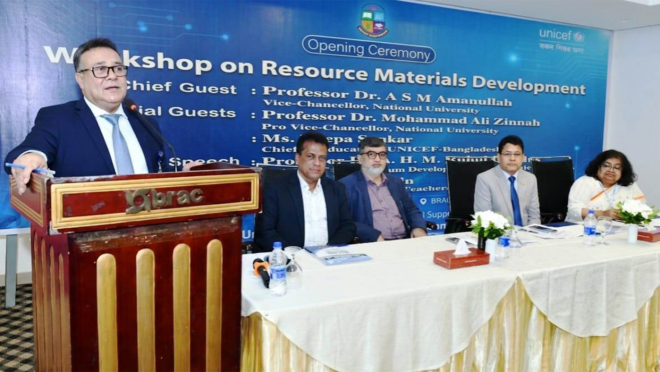
Artificial intelligence-based “Applied ICT” education could become a game changer in the future job market, National University Vice-Chancellor Professor Dr ASM Amanullah said on Sunday.
He said the university had made the course compulsory across all subjects in the second year of its bachelor’s honours programmes to equip students with practical digital skills and prepare them for emerging employment opportunities.
“The central objective of higher education is to produce skilled, creative and responsible people capable of leading in a rapidly changing world,” Professor Amanullah said.
He made the remarks while inaugurating a four-day workshop titled “Resource Materials Development” at BRAC CDM in Savar on 19 July. National University organised the workshop with technical assistance from Unicef Bangladesh.
Professor Amanullah said digital competence, technological proficiency and practical problem-solving abilities had become essential for every student.
He acknowledged that Bangladesh had yet to develop a sufficiently advanced and contemporary curriculum despite more than five decades of independence.
“Although there has been considerable discussion about the quality of National University education and certificates, many of its graduates have established themselves in important positions at home and abroad through their own abilities,” he said.
However, he said, a lack of skills-based curricula had prevented many students from acquiring the capabilities demanded by the job market. He attributed the shortcoming to policymakers rather than students or teachers.
The university’s ongoing reforms aim to prepare students for their future careers, according to the vice-chancellor.
He said practical ICT education covering cybersecurity, digital marketing, the gig economy and freelancing could prepare students for higher education and employment in both domestic and international markets.
National University is also working to strengthen its ICT teacher-training programme. Training modules and resource materials developed by specialists will be further improved and distributed among affiliated colleges, he said.
The materials are expected to serve as standard references and guidelines for teachers and students.
Referring to his recent visits to educational institutions in Rajshahi, Bogura, Naogaon and other areas, Professor Amanullah said students and teachers were continuing their work despite shortages of resources and teaching staff.
“In some colleges, a teacher has to conduct an average of 16 to 17 classes. Even where there are no ICT laboratories, teachers are conducting classes using projectors,” he said.
He added that the university had informed the relevant authorities about these constraints and received assurances of prompt action.
National University has undertaken significant investment and several initiatives to improve students’ ICT skills from the 2026–27 academic year, he said.
The second-year ICT syllabus contains highly practical material intended to help students build expertise in areas such as cybersecurity and digital marketing. To support its implementation, the university is preparing standardised resource materials and detailed guidelines for every college.
Professor Amanullah said students were already familiar with smartphones and social media and had shown strong interest in the digital economy and online businesses.
“Our students are not digitally blind. What they need now is appropriate and systematic guidance,” he said.
Citing research he conducted a decade ago, Professor Amanullah said digital literacy among university students stood at only 19% at the time. Although the situation had since improved, he said significant gaps remained in responsible digital-media use.
He expressed concern about online trolling of senior citizens and the adverse effects of digital platforms on the social development of adolescents and young people.
“Young people must be guided away from this undesirable culture. Extensive awareness-building is needed to promote responsible behaviour in digital spaces,” he said.
The success of the Applied ICT course would depend on the quality of its implementation, supported by updated training modules, learner-friendly materials, skilled trainers and modern teaching methods, he added.
“This workshop is more than a training programme. It is an important step towards making National University’s education system more skills-based, technology-driven and innovation-oriented,” Professor Amanullah said.
He added that the materials developed through the workshop could improve the learning experience of millions of students and make their education more practical and internationally competitive.
Academic knowledge alone was no longer sufficient for professional success, he said, highlighting digital literacy, data-analysis capabilities, effective communication, teamwork and the creative use of technology as essential workplace skills.
National University Pro-Vice-Chancellor Professor Dr Mohammad Ali Jinnah and Unicef Bangladesh Chief of Education Deepa Shankar addressed the workshop as special guests.
National University Dean of the Centre for Curriculum Development and Evaluation Professor Dr AHM Ruhul Quddus delivered the welcome address, while National University Director of Teacher Training Salma Parveen moderated the programme.
Subject specialists, curriculum experts, pedagogy and training specialists, online course-design experts, facilitators and representatives of National University and Unicef Bangladesh attended the workshop.