BRAC University conclave calls for responsible AI use in academia
BRAC University conclave calls for responsible AI use in academia
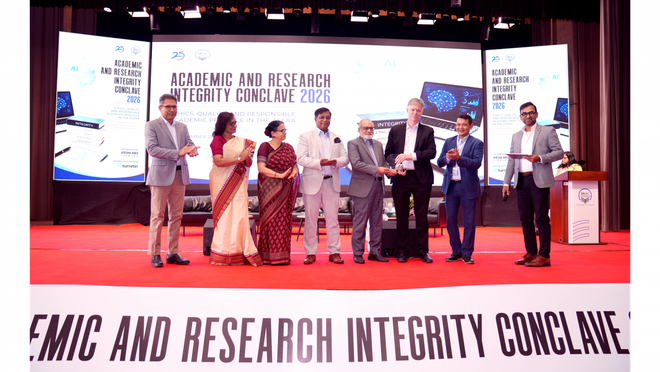
Academics, policymakers, and higher education leaders are proposing a national academic and research integrity framework to address ethical, institutional, and educational challenges posed by the growing use of artificial intelligence (AI).
The initial recommendations emerged at the Academic and Research Integrity Conclave 2026, organised by BRAC University’s Ayesha Abed Library at the university’s Merul Badda campus on 9 September, according to a press release.
Held under the theme “Ethics, Quality, and Responsible Academic Practice in the AI Era”, the conclave brought together policymakers, academics, researchers, librarians and higher education leaders to discuss key integrity issues.
Participants discussed academic integrity, research ethics, responsible AI use, publication ethics, authentic assessment, institutional accountability and integrity frameworks for higher education in Bangladesh.
University Grants Commission (UGC) of Bangladesh Chairman Professor Dr Mamun Ahmed attended the event as the chief guest.
He emphasised clear institutional AI guidelines, reforms in academic promotion systems, mandatory ethics education and greater investment in technological tools.
BRAC University Board of Trustees Member Rasheda K Choudhury highlighted the importance of promoting ethical values within families and wider society.
“We dreamt of a society with human values such as ethics… yet sometimes parents are not practising these values,” she said.
Rasheda also observed that AI was creating a new form of inequality between people who could use the technology effectively and those who could not.
Speaking at the inaugural session, BRAC University Pro-Vice-Chancellor Professor Arshad Mahmud Chowdhury said the institution viewed AI as an opportunity rather than a threat.
“At BRAC University, we believe that AI should not be feared; it should be understood and used responsibly… while maintaining academic standards and protecting the integrity, authenticity and trust that are essential to education and research,” he said.
University of Dhaka Professor Emeritus AFM Yusuf Haider highlighted the importance of preserving human judgement in an AI-enabled world.
“We must learn to use AI responsibly as an assistant, a catalyst and a powerful intellectual tool, not as a substitute for human judgement, creativity and scholarship,” he said.
Providing a global perspective on the impact of generative AI, Turnitin Regional Director for South Asia Chaitali Moitra said journal submissions had risen by 42% since ChatGPT launched in late 2022.
She added that submissions containing more than 70% AI-generated text had more than doubled between early 2024 and February 2026.
BRAC University Office of Communications Director Khairul Basher moderated the opening session and underscored the broader significance of academic integrity.
“Academic integrity is not simply about preventing plagiarism or complying with rules and governance. It is about protecting the trustworthiness of knowledge and fostering a culture where honesty, responsibility and intellectual curiosity can thrive,” he said.
Sayeed Choudhury, Associate Dean for Digital Infrastructure and Director of the Open Source Programs Office (OSPO) at Carnegie Mellon University Libraries and Executive Director of the Open Forum for AI, joined the conclave virtually.
He delivered a keynote address titled “Responsible AI and the Future of Academic Integrity in Higher Education”.
During his presentation, Sayeed explained how students were studying, modifying and sharing AI technologies through the open-source, multi-large language model Dietrich Analysis Research Education (DARE) platform.
Another session, titled “Beyond Compliance: Building a Culture of Academic and Research Integrity in the AI Era”, examined how higher education institutions could move beyond regulatory compliance and build a broader culture of integrity.
University of Liberal Arts Bangladesh Vice-Chancellor Professor Shamsad Mortuza emphasised the need for universities and their partners to create environments where credible knowledge could be produced at scale.
He said such environments required clear provenance, robust methodologies, responsible data use, transparency, independent judgement and meaningful scrutiny.
At the same session, Independent University, Bangladesh Vice-Chancellor Professor M Tamim proposed an institutional framework for academic and research integrity.
The proposed framework would include accessible, clearly defined policies, along with tools and training to help educators monitor and guide students effectively.
The conclave also featured a plenary session titled “Strengthening Academic and Research Integrity through Policy, Practice, and Technology in the AI Era”.
BRAC University Proctor and Assistant Professor in the Department of Economics and Social Sciences, Rubana Ahmed, moderated the plenary session.
During the session, BRAC James P Grant School of Public Health Lead of Humanitarian Research Professor Kaosar Afsana discussed five key dimensions of integrity in public health research.
Those dimensions were scientific rigour, data integrity, transparency, responsible publication and accountability.
Addressing plagiarism prevention, Bangladesh University of Engineering and Technology Department of Physics Professor Mohammed Abdul Basith said prevention was more effective than detection.
He recommended teaching students proper citation and attribution practices while helping them develop stronger note-taking and source-management skills.
BRAC University Department of Computer Science and Engineering Professor and Institutional Quality Assurance Cell Deputy Director Swakkhar Shatabda highlighted the importance of cultivating metacognition, adaptability and practical skills.
He said these capabilities would help students become lifelong learners and adapt to changing academic and professional environments.
Representing Ayesha Abed Library, BRAC University Librarian Hasina Afroz discussed the evolving role of academic libraries in promoting integrity.
She also introduced a framework centred on AI literacy, critical inquiry and responsible scholarship.
The day concluded with a roundtable discussion titled “Building an Integrity Culture: Institutional Challenges, Policy, and Practice”.
BRAC University Central Research and Innovation Office Director Professor Malay Kanti Mridha moderated the discussion.
As a key outcome of the roundtable, participants proposed initial recommendations for developing a national academic and research integrity framework.
The recommendations will be compiled and submitted to the relevant government authorities for consideration in future policy and regulatory development.