Daffodil International University hosts Bangladesh–Malaysia dialogue on higher education quality assurance
Daffodil International University hosts Bangladesh–Malaysia dialogue on higher education quality assurance
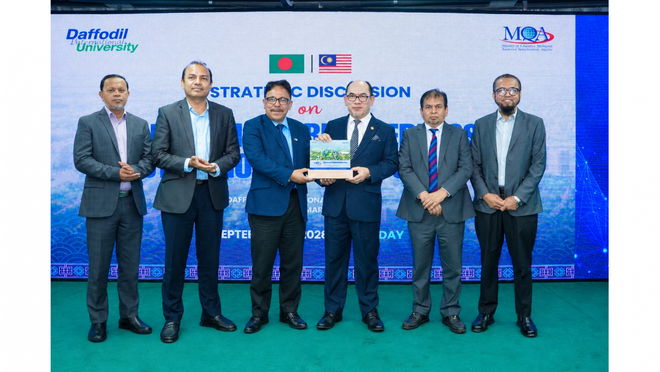
Daffodil International University (DIU) hosted a programme on higher education quality assurance and accreditation on 14 September 2026 during a visit to Bangladesh by Malaysian Qualifications Agency (MQA) Chief Executive Officer Dato’ Professor Dr Mohammad Shatar bin Sabran.
The programme brought together senior representatives of MQA, the Bangladesh Accreditation Council (BAC) and DIU to exchange experiences on international standards, accreditation practices and institutional quality assurance.
Dato’ Professor Dr Mohammad Shatar bin Sabran attended as the chief guest and delivered the keynote presentation. In contrast, BAC Chairman Professor Dr Md Akhtar Hossain Khan attended as the special guest.
Association of Private Universities of Bangladesh Chairman, DIU Founder, and Board of Trustees Chairman Dr Md Sabur Khan presided over the programme.
Other speakers included BAC Member Professor Dr Md Wakilur Rahman; DIU Vice Chancellor Professor Dr Mr Kabir; DIU Pro Vice Chancellor Professor Dr Mohammad Masum Iqbal; MQA Director Abdul Saman Bin Tai; and DIU Institutional Quality Assurance Cell (IQAC) Director Professor Dr Mostafa Kamal.
In his presentation, titled “Quality Assurance and the Future of Higher Education in the Global Era”, Mohammad Shatar bin Sabran discussed the evolving role of quality assurance in strengthening higher education systems worldwide.
He explained MQA’s responsibilities, including maintaining the Malaysian Qualifications Register, developing qualification frameworks, conducting accreditation, assuring the quality of higher education providers and programmes, and facilitating qualification recognition.
He emphasised that quality should remain the highest priority for higher education institutions in an increasingly global environment.
The keynote also covered the evolution of the Malaysian Qualifications Framework, accreditation cycles, outcome-based education, continuous quality improvement, global rankings and international visibility.
He discussed emerging approaches such as micro-credentials and flexible learning pathways, noting that higher education was entering a borderless, interconnected era in which collaboration, trust, and quality assurance were essential to institutional development.
BAC Chairman Professor Dr Md Akhtar Hossain Khan said the council had begun accreditation activities for higher education institutions in Bangladesh and that several academic programmes had already received accreditation.
He said challenges arising from artificial intelligence, automation and climate change had increased the importance of quality assurance and accreditation.
Universities needed to assess whether they were developing a strong quality culture and ensuring continuous improvement, he said. He added that BAC aimed to support universities through the accreditation process rather than pressure them.
He also highlighted the importance of international collaboration, strengthening quality assurance capacity and promoting academic mobility.
The BAC chairman suggested that the council and MQA could work together to build a culture of quality and strengthen institutional capacity.
He stressed that quality assurance was not IQAC’s responsibility alone. Deans, heads of departments, faculty members and other stakeholders also needed to contribute actively to improving institutional quality.
Dr Md Sabur Khan highlighted emerging educational trends, particularly micro-credential courses, as a way to respond to changing industry and professional requirements.
He discussed DIU’s efforts to strengthen industry engagement through Professor of Practice positions and its plan to establish an industry zone to expand students’ practical learning opportunities and improve employability.
DIU said the programme aimed to strengthen international collaboration and its institutional quality culture while supporting Bangladesh–Malaysia knowledge exchange on accreditation and quality assurance.
The university said the dialogue would help deepen understanding of global accreditation practices and support the continued development of quality assurance in Bangladesh’s higher education sector.