IUBAT, Health Economics Unit launch AI-driven primary healthcare research initiative
IUBAT, Health Economics Unit launch AI-driven primary healthcare research initiative
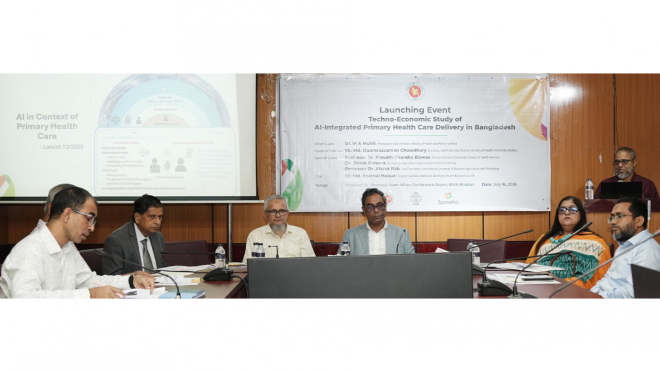
A study has been launched to assess the technical, economic and operational feasibility of integrating artificial intelligence into Bangladesh’s primary healthcare system.
The Health Economics Unit under the Ministry of Health and Family Welfare is leading the study, titled “Techno-Economic Study of AI-Integrated Primary Health Care Delivery in Bangladesh”.
The International University of Business Agriculture and Technology (Iubat) and Spreeha Foundation launched the initiative on 16 July, according to a press release.
Spreeha Foundation is funding the study, while Iubat’s Department of Public Health is serving as the academic partner.
Dr MA Muhit, State Minister for Health and Family Welfare, inaugurated the project as chief guest.
He said the study could serve as an initial step towards reshaping Bangladesh’s healthcare sector through technology and artificial intelligence, in line with the government’s priorities.
“This is an ideal setting—a collaboration among the government, academia and non-profit organisations to achieve a shared goal,” he said.
The state minister expressed hope that the study’s findings would be discussed at a dissemination event next year.
Professor Dr Abdur Rab, Vice-Chancellor of Iubat, attended as special guest.
“You may love or hate AI, but you cannot ignore it. The new generation can play a vital role in leading and implementing technology, as they are more accustomed to it,” he said.
He said researchers and students from Iubat’s Department of Public Health were actively involved in the study and could continue working in the field after the project ends.
Dr Md Enamul Haque, Director General (Additional Secretary) of the Health Economics Unit, chaired the launch event.
The study will bring together experts from government, academia, healthcare, economics and technology to develop evidence-based recommendations on the potential use of AI in primary healthcare delivery.