Japanese delegation visits DIU to discuss jobs, skills and language preparation
Japanese delegation visits DIU to discuss jobs, skills and language preparation
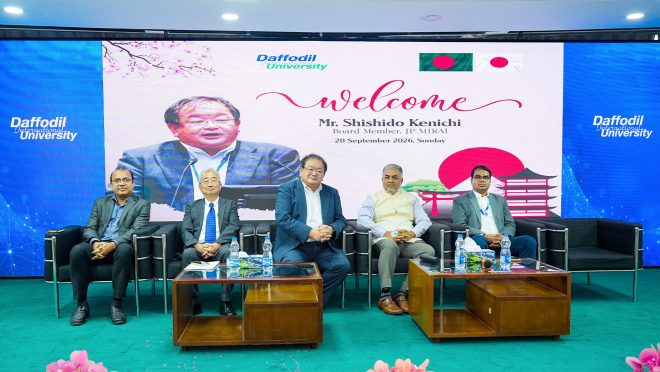
A Japanese delegation visited Daffodil Group and Daffodil International University (DIU) today (20 September) to explore opportunities for expanding employment prospects in Japan for Bangladeshi youth and connecting skilled workers, engineers and technology professionals with the Japanese job market.
The visit took place at Daffodil Smart City, where discussions focused on employment opportunities in Japan, required skills, preparation, Japanese language proficiency and cultural understanding, according to the press release.
A seminar titled “Employment Opportunities in Japan: Pathways and Essential Guidance for Bangladeshi Graduates” was also held, with around 300 students and university officials in attendance.
Following the seminar, the Japanese delegation held a meeting with the senior management of Daffodil Group and DIU.
The delegation included Kenichi Shishido, board member of the Japan Platform for Migrant Workers towards Responsible and Inclusive Society (JP-MIRAI), and Shinichi Okubo, senior programme officer of JP-MIRAI.
Professor Dr Mohammad Masum Iqbal, pro-vice-chancellor of Daffodil International University, and Dr Mohammad Nuruzzaman, group CEO of Daffodil Group, attended the seminar along with university officials, faculty members and students.
Professor Dr Mohammad Masum Iqbal delivered the opening remarks.
The main session was conducted by Kenichi Shishido, who highlighted employment opportunities in Japan, different pathways for building careers, workplace expectations, necessary preparation and the importance of responsible and inclusive approaches to international employment.
In his closing remarks, Dr Mohammad Nuruzzaman, group CEO of Daffodil Group, said, “Bangladesh can be an important source of skilled and professional human resources for Japan. Japan needs skilled manpower, while Bangladesh has a large pool of talented young people.”
“Our challenge is to build an effective bridge between the two through Japanese language proficiency, necessary skills, cultural and workplace preparation, responsible recruitment and direct connections with the needs of genuine employers,” he added.
Daffodil already has experience in developing human resources for the Japanese market.
Daffodil Global Recruiting Agency (GRA) has been working to create employment opportunities under Japan’s Technical Intern Training Program (TITP) and Specified Skilled Worker (SSW) programmes.
Building on this experience, Daffodil is now exploring new pathways for qualified graduates of Daffodil International University in engineering, information and communication technology and other relevant disciplines to pursue professional careers in Japan.
Through the initiative, Daffodil aims to develop an integrated and continuous skilled workforce pipeline to meet manpower demands across different levels of Japan’s labour market.
The initiative will include not only skilled and technical workers but also university graduates, including engineers and technology professionals.
The proposed framework will place emphasis on talent identification, Japanese language training, technical and professional skills development, cultural orientation, workplace preparation, employer engagement, responsible recruitment and post-placement career support.
Under the proposed initiative, talent identification based on the requirements of Japanese employers, Japanese language and cultural preparation, technical and professional skills development, employer engagement, responsible recruitment, employment in Japan and subsequent career development will be integrated into a structured pathway.
Through this approach, Daffodil aims not only to create overseas employment opportunities but also to contribute to building a sustainable skilled workforce bridge between Bangladesh and Japan.
Following the seminar, the Japanese delegation participated in a high-level meeting with the senior management of Daffodil Group and Daffodil International University.
The meeting was attended by the vice-chancellor and pro-vice-chancellor of Daffodil International University, the group CEO of Daffodil Group, the registrar and other senior officials.
The meeting discussed various aspects of deeper cooperation with Japan’s labour market, graduate employment, skilled manpower in engineering and technology sectors, Japanese language education, industry-specific skills, cultural preparation, responsible recruitment and communication with employers.
Particular attention was given to the possibility of developing a “Japan Graduate Engineer Employment Pathway” to connect qualified and appropriately prepared graduates of Daffodil International University with Japanese companies.
The discussions also explored the potential for developing a talent pool through academic education, language and cultural preparation, employability enhancement and career support.
They also focused on establishing employer connections with relevant stakeholders in Japan, identifying labour market demands and creating suitable employment pathways.
Through the initiative, Daffodil has outlined a long-term vision of positioning Bangladesh not only as a source of overseas workers but also as a source of skilled, qualified and internationally competitive human resources.
By leveraging university education, skills development initiatives, the Career Development Center, Japan-focused programmes and recruitment experience, Daffodil aims to establish an integrated system to prepare Bangladeshi youth for employment opportunities in Japan.
During the visit, the Japanese delegation paid a courtesy call on the vice-chancellor of Daffodil International University, visited the Japan Study Center, toured the Daffodil Smart City campus, attended a cultural programme and participated in a tree-planting initiative.
The delegation also interacted with students and university officials.
The visit is expected to create opportunities for future cooperation and continued dialogue towards developing a sustainable model that connects Bangladesh’s young and increasingly skilled workforce with the demands of Japan’s labour market.