Stamford University hosts symposium on labour mobility to MENA
Stamford University hosts symposium on labour mobility to MENA
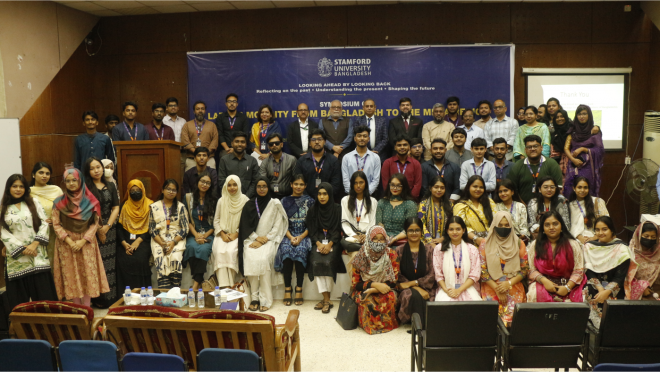
The Department of Public Administration at Stamford University Bangladesh hosted a symposium titled “Labour Mobility from Bangladesh to the MENA Region” at the university’s Siddeswari campus in Dhaka on 5 September 2026.
The symposium brought together academics, students and policymakers to discuss challenges facing Bangladeshi migrant workers, migrant safety and potential policy measures for labour mobility in the Middle East and North Africa (MENA), according to a press release.
Stamford University Bangladesh Vice-Chancellor Professor Dr Sharif Nafe As-Saber delivered the welcome remarks.
Reflecting on human migration throughout history, he highlighted people’s persistent pursuit of opportunities and the vulnerabilities migrants face.
“Birds and butterflies move across borders without visas, yet human migration remains bound by systemic barriers and complex state lines,” he said, emphasising the need to approach labour migration with empathy and structural reforms.
Bangladesh Ambassador to Libya Major General Md Habib Ullah (SGP, SPP, ndc, afwc, psc, MPhil) delivered the keynote address.
He discussed the economic importance of labour migration and the severe risks associated with irregular migration to the MENA region.
He identified five critical pillars for sustainable labour-migration governance: prevention, protection, prosecution, partnership and reintegration.
“Our migrant workers are our primary brand ambassadors and the true face of Bangladesh abroad,” he said.
Addressing the dangers of human trafficking and undocumented migration routes, he said, “When ambition turns into irregular migration, it becomes a trap of exploitation where human beings are reduced to mere commodities. No dream is worth a human life.”
He also introduced the “SWORD” test for young people and prospective migrants, encouraging them to assess whether migration pathways are safe, worthy, orderly, regular and dignified.
“Just like navigating a dinghy boat, we cannot look ahead without looking back. Understanding the root causes of exploitation is the first step towards building safe pathways for future generations. This is not merely a migration issue; it is a vital national concern,” he said.
The ambassador also discussed diplomatic initiatives in Libya, including community-welfare programmes for Bangladeshi expatriates and embassy-managed schools.
Referring to incidents such as the 2020 Mizda tragedy, he stressed the urgency of stronger measures against human trafficking.
Academic Adviser and Honorary Chairman of the Department of Public Administration, Professor Dr Aka Firowz Ahmad, delivered the concluding remarks.
He urged researchers and future policymakers to examine institutional gaps affecting labour migration.
“Migration is deeply interwoven with human civilisation and development. When nation-state borders restrict human movement while markets globalise, personal freedoms and human rights are often compromised,” he said.
“To solve these systemic challenges, our scholars must first understand the issue with the head, feel it with the heart and then execute policy solutions with the hands,” he added.
The symposium concluded following an interactive question-and-answer session involving students and faculty members, the presentation of a souvenir, and a commemorative group photograph.