ULAB hosts literary conversation with Dilruba Z. Ara on women and creative expression
ULAB hosts literary conversation with Dilruba Z. Ara on women and creative expression
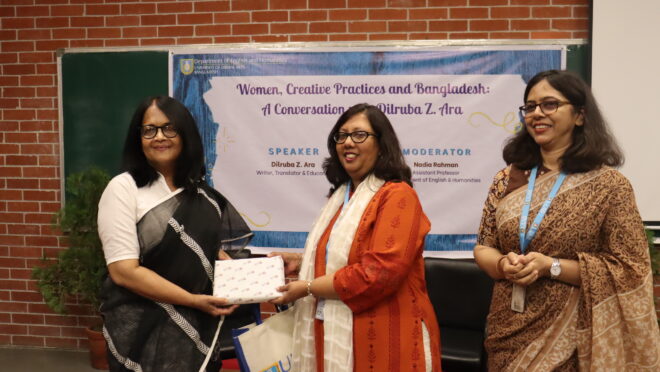
The Department of English and Humanities (DEH) at the University of Liberal Arts Bangladesh (ULAB) organised a literary conversation with Swedish-Bangladeshi writer, translator and educator Dilruba Z. Ara on Tuesday, 3 November, focusing on women’s experiences, cultural identity and creative expression.
Titled “Women, Creative Practices and Bangladesh: A Conversation with Dilruba Z. Ara”, the session was moderated by Nadia Rahman, assistant professor at the department.
During the discussion, Ara reflected on her literary journey, her connection with Bangladesh and the challenges of pursuing a career in creative writing.
Raised in a family closely connected to literature, Ara said storytelling had been an integral part of her life from an early age. Her father, renowned Bangladeshi writer Shahed Ali, and her mother, a writer and former professor of Bengali language and literature, played significant roles in nurturing her interest in literature.
Having lived in Sweden for nearly four decades, Ara said Bangladesh continued to be a major source of inspiration for her writing. She noted that living away from her homeland had not weakened her connection with it, but had given her a different perspective on its people, culture and social realities.
The conversation also covered her work as a translator, particularly her experience of translating Swedish literature into Bengali. Through her engagement with both languages and cultures, Ara has sought to build a literary connection between Bangladesh and Sweden.
Reflecting on her works, including the novels A List of Offences and Blame, and the short-story collection Detached Belonging, Ara discussed how social conventions, gender expectations and restrictions on women’s autonomy shape her fiction.
Her debut novel, A List of Offences, follows Daria, a village girl whose experiences expose the social norms and taboos that influence women’s lives.
The moderator also read an excerpt from one of Ara’s short stories, giving the audience an insight into her literary style. The discussion further explored a story inspired by the Covid-19 pandemic and how contemporary experiences can inform creative writing.
Speaking about the challenges of publishing creative writing in Bangladesh, particularly in English, Ara recalled facing resistance from a prospective publisher over the portrayal of a character as a good Muslim man in A List of Offences. She said she remained committed to her original characterisation rather than compromise her creative vision.
The experience highlighted the tensions writers may face between creative freedom, publishers’ expectations and prevailing social sensitivities, she said.
Asked about pursuing a career in writing, Ara said literary ambition required patience, perseverance and hard work. A sustainable career in writing could be difficult to build, she noted, advising aspiring writers to remain practical while continuing to develop their creative abilities.
The discussion also touched on the future of literature in Bangladesh and the growing role of technology in creative work. Advising students to approach artificial intelligence thoughtfully, Ara said, “Make AI your slave. Don’t become its slave.”
She emphasised the importance of independent thinking, originality and human creativity while engaging with emerging technologies.
The conversation concluded with reflections on women’s representation in literature, the responsibilities of writers and the relationship between personal experiences and creative expression.