HSC exams begin Thursday for 1.26 million candidates
The Higher Secondary Certificate (HSC) and equivalent examinations for this year will begin on Thursday (2 July), with more than 1.26 million candidates set to sit the tests nationwide.
HSC exams begin Thursday for 1.26 million candidates
The Higher Secondary Certificate (HSC) and equivalent examinations for this year will begin on Thursday (2 July), with more than 1.26 million candidates set to sit the tests nationwide.
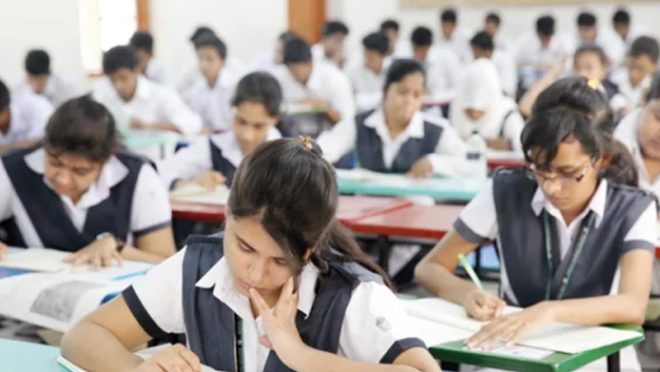
On the first day, Bangla First Paper will be held under the country’s nine general education boards. At the same time, Alim candidates under the Bangladesh Madrasah Education Board will sit the Qur’an Majid paper, while candidates under the Bangladesh Technical Education Board will take the HSC (BMT) Bangla-II exam.
Across all boards, examinations will run from 10:00am to 1:00pm. Candidates have been instructed to enter their centres at least 30 minutes before the start of the exam.
Over 1.26 million candidates across 11 boards
A total of 1,267,486 regular and irregular candidates have completed registration to sit the HSC and equivalent examinations under 11 education boards this year. Exams will be conducted at 2,697 centres across the country.
The highest number of candidates is under the Dhaka Board, where 300,393 students will sit the exams at 310 centres.
Under the Rajshahi Board, 140,830 candidates will appear at 208 centres, while the Dinajpur Board has 113,479 candidates at 212 centres. The Jashore Board will host 117,210 candidates across 240 centres.
In Chattogram, 99,688 candidates will sit exams at 114 centres, while Sylhet has 71,711 candidates at 96 centres. The Cumilla Board has 94,802 candidates at 193 centres, Mymensingh has 73,037 candidates at 111 centres, and Barishal has 58,664 candidates across 142 centres.
In addition, 92,905 students will sit Alim examinations at 461 centres nationwide under the Madrasah board, while 107,964 candidates will appear at 610 centres under the Technical Education Board.
Measures to prevent malpractice
Education boards have issued detailed instructions to ensure a fair, transparent and malpractice-free examination process. These cover centre management, question paper security, candidate entry procedures, seating arrangements and digital surveillance.
Under the guidelines, one invigilator must be present for every 20 candidates in an exam room, with no room allowed to operate with fewer than two invigilators. Seating arrangements have also been standardised: two candidates may sit on a 5-by-6-foot bench, while only one candidate is permitted on a 4-foot bench.
Candidates will be allowed to enter examination centres from 8:30am, but all must be seated in their designated rooms at least 30 minutes before the exam begins. In exceptional cases, late arrivals may be allowed entry, with details recorded in the register.
Multi-layered question paper security
Multiple layers of security have been put in place for handling question papers. According to the directives, question packets stored in treasury or police station lockers must be checked three days before the exam in the presence of designated officials.
On exam day, question papers will be transported to centres under police escort and in the presence of tag officers. Papers may only be opened after receiving the designated set code via mobile communication. Any deviation from the assigned set will result in departmental action against those responsible.
CCTV mandatory at all centres
Technology-based monitoring has been made compulsory at all examination centres this year. CCTV cameras must remain operational at all times, and centres have been instructed to submit camera IDs, passwords, brand details, device serial numbers and DVR/NVR connection information to the respective education boards.
Centres are also required to ensure uninterrupted internet connectivity for real-time monitoring. Immediate action will be taken if CCTV systems are found to be non-functional or if any lapse in security is detected.
Except for the centre superintendent, no one will be allowed to enter exam centres with mobile phones or electronic devices. Candidates are also prohibited from carrying any electronic items, apart from simple analogue wristwatches.
Additional measures include restricting unnecessary movement within centres during exams, conducting toilet checks, ensuring police involvement in the transport of question and answer scripts, and separately securing answer sheets of candidates with special needs.