
PM urges teachers to keep educational institutions above political and personal conflicts
PM urges teachers to keep educational institutions above political and personal conflicts
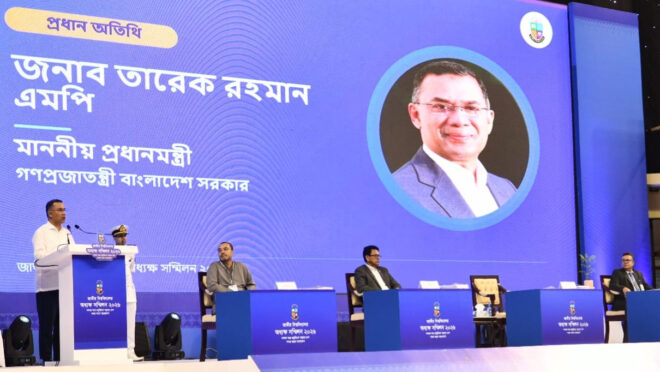
Prime Minister Tarique Rahman has urged teachers to keep educational institutions free from conflicts, clashes of political views and personal interests, warning that differences of opinion must not disrupt the learning environment, academic activities, administrative discipline or student safety.
“Political differences in opinion and beliefs are natural in a democratic society. However, teachers must remain alert and conscious so that these differences do not disrupt the educational environment, teaching activities, administrative discipline or students’ safety,” he said, according to a press release.
The prime minister was speaking as the chief guest at the National University’s ‘Principal Conference-2026’ at Shaheed Suhrawardy Indoor Stadium in Mirpur, Dhaka, yesterday (28 November). The event was attended by principals of 2,318 colleges affiliated with the university and held under the theme ‘Building the country through skills and technology, Bangladesh comes first’.
National University Vice-Chancellor Professor Dr A S M Amanullah chaired the programme. Education Minister Dr ANM Ehsanul Hoque Milan, Education Adviser Mahdi Amin and Senior Secretary of the Secondary and Higher Education Division Abdul Khaleque attended as special guests.
Describing principals as more than administrative heads, Tarique said they were institutional leaders, moral guides and key figures in shaping future generations. The overall progress of an educational institution, he said, largely depended on their competence, judgement, decisions and vision.
Recalling former prime minister Khaleda Zia’s contribution to education, he said she established the National University on 21 October 1992 to expand access to higher education for people in both urban and rural areas. Although the number of affiliated colleges and students had grown to nearly 2,500, he called for self-assessment of whether educational quality had improved at the same pace.
The prime minister said the education sector, like other sectors, had suffered during the previous 17 years and stressed the need for collective efforts to make the system modern, standardised and relevant to contemporary needs. The government was taking necessary steps, but principals would have to play a leading role in implementing those plans.
He called for a shift from teacher-centred education towards student-centred and research-based teaching, emphasising the need for teacher training. He suggested that the Training of Trainers programme could play an effective role in this transition.
Without adapting to modern technology, teachers and students risk producing more certificate-holders every year without reducing unemployment, he said. The lack of practical and technical skills alongside academic qualifications was one of the reasons educated young people struggled to find jobs.
Referring to the challenges of the Fourth Industrial Revolution, Tarique urged higher education institutions to move beyond conventional teaching methods. Artificial intelligence, robotics, big data, the Internet of Things, blockchain, automation, genetic engineering, cybersecurity and 5G technology were transforming the future of work, he said, creating new employment opportunities while making some traditional professions obsolete.
He stressed the need for technology-driven, innovation-oriented and skills-based education that prepares students for employment.
Highlighting the importance of stronger links between education and industry, the prime minister said educational institutions should provide the foundation of knowledge, while industries should help turn that knowledge into practical skills. He suggested considering opportunities for experienced industry professionals to teach as guest lecturers at colleges and universities.
He also called on business leaders to expand internship programmes, industrial attachments and hands-on workplace training for students. Acquiring practical experience and targeted skills during their studies would help young people become entrepreneurs rather than simply wait for jobs, he said.
Tarique further stressed the need to combine technical education with the humanities. Literature, philosophy, history, science, sociology and cultural activities could help students develop human values, creativity, critical thinking and leadership skills.
He also called for opportunities to learn internationally востребed languages, including Arabic, Mandarin, Japanese, Korean, French and German, alongside English. Colleges should also expand career counselling, internships, skills development, language clubs and entrepreneurship initiatives.
On institutional development, the prime minister called for coordinated action to identify teacher shortages, fill vacant posts, recruit and deploy teachers, and improve their training and skills. He urged the Ministry of Education, the Directorate of Secondary and Higher Education, the Non-Government Teachers’ Registration and Certification Authority (NTRCA) and the National University to take necessary steps.
He also called for greater use of renewable energy in educational institutions, suggesting that colleges with suitable rooftops install solar power systems. He urged institutions to maintain clean campuses and surrounding areas and expand tree-planting programmes. Around 200,000 trees have already been planted at National University-affiliated institutions, he said, calling for the initiative to be expanded.
The prime minister urged college authorities to take a positive approach towards financially disadvantaged students, marginalised communities and students with special needs. He said the government wanted to build a country that was rich in knowledge, self-reliant in work and advanced in human values.
Education minister calls for accountability
Speaking at the event, Education Minister ANM Ehsanul Hoque Milan said the education system had been pushed backwards over the past 17 years. He said the government would now have to be accountable for its work and demonstrate what changes had been made and what results had been achieved.
He said the prime minister was prioritising improvements in educational quality over infrastructure development. Restructuring technical education and equipping the country’s large population with employable skills were also among the government’s priorities, he added.
Education Adviser Mahdi Amin said principals played a crucial role in improving the quality of education, as the implementation of policies formulated by the government and the Ministry of Education largely depended on institutional leadership.
He pointed to disparities in the quality of National University-affiliated colleges. While some were large and prestigious institutions, others struggled to attract students. Some colleges had students but lacked teachers, he said, stressing the need to address these gaps by ensuring teacher training, institutional capacity development, and adequate laboratory and library facilities.
Mahdi said the National University could serve as a major institutional foundation for the prime minister’s vision of a Bangladesh where every student had the opportunity to fulfil their aspirations. He said the university’s budget had been increased under the prime minister’s directives and steps had been taken to decentralise and activate the institution.
He also praised initiatives such as third-language education, technical skills development, ‘Learning with Happiness’, sports and cultural activities.
Senior secretary criticises teachers’ protests
Secondary and Higher Education Division Senior Secretary Abdul Khaleque said the government had taken several initiatives concerning the pay scale, transfer and nationalisation of MPO-listed teachers.
He said the government had initiated the process of including non-government teachers in the new pay scale and had provided Tk4,500 crore for their pensions. However, he questioned why teachers were still protesting for nationalisation.
“Nationalisation will be undertaken by the government when necessary. It requires financial resources and policy decisions. You cannot expect everything immediately and take to the streets,” he said, adding that the government had already provided teachers with various facilities, including computers, laboratories and new textbooks.
He also said principals and university vice-chancellors should not participate in politics. Politicians would provide advice and set out their manifestos, while officials were responsible for implementing the government’s decisions, he said.
National University outlines reform initiatives
Presenting the keynote paper, National University Vice-Chancellor Professor Dr A S M Amanullah outlined the university’s initiatives to improve higher education. He said the institution was working to introduce employment-oriented courses, expand third-language education and develop green campuses under the prime minister’s guidance.
The university was also taking steps to strengthen industry-academia collaboration and make higher education more employment-focused, he said.
Amanullah said the National University should become more than a degree-awarding institution and serve as a centre for developing skilled, humane, creative and productive human resources. He stressed the need for greater coordination among colleges, quality monitoring, research opportunities and stronger links with industries.
The programme also included a minute of silence in memory of martyrs of the Liberation War and the 2024 mass uprising. A disaster preparedness app titled ‘Durjog Theke Shosti’, developed by National University student Shajahan Molla, was unveiled. The app provides emergency alerts and information on assistance, essential commodity prices, transport and health services during disasters and earthquakes.
The university’s Pro-Vice-Chancellor Professor Dr Mohammad Ali Jinnah delivered the welcome address, while Treasurer Professor Dr Md Nazmul Hossain outlined the objectives of the conference. Principals Professor Md Mahfuzul Islam of Government Azizul Haque College in Bogura and Professor Sultana Mahmuda Yasmin of Lalmatia Women’s College also spoke at the event.
Members of the cabinet, the chief whip and whips of parliament, lawmakers, parliamentary standing committee members, the attorney general, the chairperson and members of the Public Service Commission, members of the University Grants Commission, diplomats, academics and vice-chancellors and other senior university officials attended the conference, along with principals of National University-affiliated colleges.