A school born between poverty and possibility
When one thinks of teaching children living in poor slums, people usually assume it is some kind of charity work, something hopeless, something not really expected to be fruitful or bring any meaningful impact.
A school born between poverty and possibility
When one thinks of teaching children living in poor slums, people usually assume it is some kind of charity work, something hopeless, something not really expected to be fruitful or bring any meaningful impact.
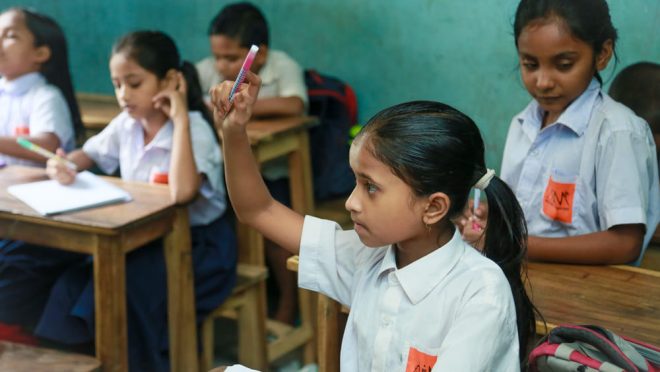
Md Sayed, Tahiya Islam, Subrina Habib, and the team at Aim Initiative Foundation challenged that stereotype and built an English version school, run under NCTB Curriculum for the children of Meradiya slum. Students from their earliest batch are now in grade nine, managing academics and extracurriculars in a way that puts them on equal footing with regular school-going kids.
To hear more about their story, I sat down with the team, and the takeaway I got was nothing short of inspiring.
It was 2015, Md Sayed’s last year of university. A boy walked up to him outside his university campus, touching people’s clothes weirdly as he passed, asking for money. Everyone else was shooing him away. Sayed asked why he needed it. The boy replied that he wanted to study.
Why not just go to a government school? Sayed asked, since primary education is free. No school would take him, the boy said. He had already sat for his PSC and had the certificate to prove it. It had been three years since he dropped out after passing PSC.
Sitting at a tea stall in front of the university, Sayed and some juniors decided they would try to get him admitted somewhere.
But it was not that simple. The boy was three years past the usual age for his level, and schools flagged it immediately. Something about the way he looked and walked also made people assume he had special needs, and school after school hesitated to take him in among regular students, no matter how many times Sayed and his friends explained he was completely normal.
The big, established schools got them nowhere. So they went smaller, to a private school near Meradiya in Banasree. The administrator there gave information too bitter to digest. The boy had already studied up to class five, she said, but there were fifty or sixty children in that area who had never been to school at all. She suggested an open school instead of a regular one.
The boy did not take that well. He wanted a regular school and a uniform, to be like other children his age. He left that day visibly hurt.
The next day he was gone. Not at the tea stall, not on campus. Sayed and his friend spent two weeks looking for him before the man who gave him shelter to sleep told them he had packed his bags and left the night before. He had four bags with him. Three were full of books.
“That incident hurt us,” Sayed says. “He wanted to study. We tried for weeks. We had gotten emotionally attached to him by then, and we could not do anything for him in the end. There was guilt in that, that we could not get one child into school.”
That guilt is where Aim started. Not with a perfect plan, just the thought that if they could not help this one boy, maybe they could help the fifty or sixty others the administrator had mentioned. They went to the slum near Meradiya. Around fifty-three families lived there, and not a single child among them was in school. Most collected plastic for a living, earning ten or fifteen taka a day. Sayed asked them what future they imagined for their children. But to them, the future was a distant word. The concern was surviving today.
So Sayed and the team started going to the slum to teach the children there every week, went from door to door trying to explain why school mattered when the world immediately around these children only rewarded rickshaw pulling or plastic collection.
Eventually, a person of authority from the community made an offer. If they wanted to teach, they could teach right there, inside the slum. Parents would not send their children elsewhere, but they could come to them. Sayed pointed out these same families sent their children out all day to collect plastic anyway. “School just felt unfamiliar,” came the reply. So the team agreed and were given a single room to start in.
From informal lessons to a real school
For the first six months, it stayed loose. Then Sayed and his team realised that if this was going to mean anything long-term, it needed a proper curriculum and a certificate the Bangladeshi education system would actually recognise. Teaching started properly in 2016 and ran through 2017, even as Sayed had just finished his own graduation and was expected to go find a job like everyone else.
It took until 2018 for the families to fully trust them and for Aim to secure two rooms and formally start what could be called a school. It has since moved twice, adding rooms each time, and now runs out of about ten.
They started with forty students. The number now stands at two hundred and ten, from nursery through class nine, with the first batch set to sit for their SSC exams in 2027.
While Sayed built the school on the ground, Tahiya Islam, now vice chairman, was in Malaysia doing her master’s, unable to be there for Aim’s early years and, by her own account, unhappy about it.
“My background is pharmacy, bachelor’s, master’s, and then I chose to become a development professional, a nonprofit leader, I started in the media and publications sector, and now serve on the board as vice chairman. My day-to-day role is to bring in more meaningful partnerships and funds in a sustainable manner, especially for school.”
Once she returned, she began building the organization’s credibility through digital and print media, running its social media, and later handling formal registration paperwork, at a point when Aim needed funds to hire its first student teachers, an expense that until then had come straight out of the founders’ own pockets.
Subrina Habib, the general secretary, joined a year later, in 2017, answering the very first call for volunteers while in her second-to-last semester of university. Like Sayed and Tahiya, she studied pharmacy, and like them, she left that career path to follow this instead.
“It requires a lot of courage to leave something so dear to you, an undergrad or postgrad career at its peak,” Sayed says of both women’s decisions. “We are fortunate they took that turn.”
Why an English version school
Running the school in English was not an obvious call, and Sayed admits people around him thought it was reckless. English version schools need specific teachers, specific training, and resources most underprivileged schools do not have.
The decision traces back to a meeting Sayed sat in on during an early app development project. Two people were arguing over payment, one accusing the other of taking home most of the money despite doing less work. The one taking the larger portion of money could communicate better in English, so he was the one bringing in clients, while his partner, who did most of the actual design work, only got thirty percent.
“That hit me,” Sayed says. “I realised that if these children I was trying to educate eventually will be ready for employment and without adequate communication skills in English, their biggest barrier would be communicating in English. So we decided the school would run in English.”
People warned him it would need four or five specifically trained teachers and far more money than a regular Bangla medium setup. Aim had no institutional backing, no precedent to follow. Curriculum experts, they reached out to assumed resources Aim did not have: private tutors, high salaries, and established systems. None of it applied to a school running out of a slum.
Still, the reasoning held. These were children already behind by every conventional measure, and the bare minimum was not going to close that gap. So the team built the school around three components, quality academic education, skill development activities, and healthcare support, aiming to give children financial independence, especially since many come from homes dealing with poverty, addiction, and instability.
“Most of these children come from families where both parents leave the house by seven in the morning for work, as housemaids, rickshaw pullers, or van pullers, and the children are left unattended,” Sayed says. “That is when they become vulnerable to mistreatment by society, by circumstance. We wanted to give them a way out through education, skill, and English so their families could eventually move out of that low-income phase altogether.”
What Covid took away
The pandemic hit Aim harder than almost anything else in its history. All the schools elsewhere had the infrastructure to shift online, but Aim’s students did not, as they did not have access to smart devices and the internet, nor could they afford to purchase those. They were also struggling with earning their daily wages.
As the schools were closed for almost two years due to lockdown, students lost two complete academic years, and as a result, their learning took a pause. “We literally lost two years,” Sayed says. The teachers called students over the phone and went from door to door delivering worksheets, but there was often no one at home who could guide a child through their learnings. When classes resumed, the gap was so obvious that Aim had to reteach material from earlier years before students could move forward.
Even so, Sayed says a good number of their older students today are strong public speakers. The younger batches are seeing the benefit of a system that has had time to mature. Nursery and kindergarten students now sit with a teacher and answer questions entirely in English, an early exposure the pandemic era students never got.
Children they could not save
Not every story from Aim ends the way Sayed wants it to. Child marriage is one of the hardest things they deal with, mostly because it tends to hit right around the ages their students are at now, grades six through nine. Aim handles most cases through counselling and workshops, and there have been real successes. There have also been failures.
“When you raise a child for eight, ten years, you are practically their parent in that time, when a parent cannot protect a child from something like this, that feeling of failure is the same for us.”
He recalls two students Aim lost from grade eight, girls who had studied with them for nine years, the first- and second-ranked students in their class, capable of competing with students from any regular school.
One of the girls had her father in jail. Aim had been supporting her education. Her mother worked as domestic help for years to support her. But pressure from her paternal side of the family kept building, with relatives insisting she be married off since there was no father around to provide for her. In February, while the family was away in the village, her grandmother and uncle arranged and completed the marriage in a single day and sent her off to a different area entirely before Aim even knew what was happening.
By the time they found out and tried to step in, contacting local authorities and even the national emergency line, it was already done. Local officials showed a birth certificate that said she was nineteen. Aim showed the real one, which said otherwise, but by then the marriage had already taken place elsewhere and could not be undone.
“These kinds of situations, if they happen in Dhaka, it’s still manageable,” Sayed says. “Once you’re outside the city, there is genuinely very little you can do in time.”
Sayed also points to something he keeps noticing in these communities. In these households, he says, it is often the women effectively running the family financially, even while the husbands make the decisions, sometimes after losing household income to gambling. These women carry the practical weight of the household and still get no say in it, and often absorb both the decisions and the abuse that comes with them.
How Aim actually runs
Aim currently has nine paid, trained teachers and prioritises hiring both freshers, who go through a long training process, and experienced teachers. Apart from school staff, Aim has an active volunteer pool. Volunteers commit for a minimum of six months, after which they can continue or step away, and in return Aim offers professional development training, certificates, and recommendation letters.
Funding mostly comes through one sponsor, one child programme, Aim’s main source of income, where an individual, company, or sponsor takes on the cost of one child’s education for a fixed one thousand five hundred taka a month, covering everything from teacher salaries to electricity and other facility costs.
Beyond that, Aim runs periodic health camps with hospitals and pharmaceutical companies, gives students new clothes every Eid, and holds a communal iftar where sponsors are invited to see where their support goes.
Aim also runs livelihood projects funded partly through zakat: buying a cow for a family to raise and sell, setting up an electrician with the tools he needs for home visits, rebuilding a home for a flood victim, or helping someone start a small vegetable stall, all meant to give families a sustainable way to earn money.
“Our children are not just getting free education,” Sayed says. “They get stationery, books, uniforms, school bags, everything, so studying does not cost their families anything extra.”
Alongside academics, Aim has built up extracurricular activities shaped around what individual students are into, from painting and crafts to a newspaper club still taking shape, where students will eventually put together their own school magazine. Some of Aim’s older students, Sayed says, paint well enough now that the foundation auctions their work and puts the money straight back into an education fund.
“We have realised education is that one thing that can change the entire lifestyle of a family through just one student,” Subrina says.
Beyond academics and extracurriculars, Aim has also been quietly working on something harder to measure: the moral grooming of its students. Subrina says that working with underprivileged communities for this long, they kept noticing gaps in basic manners and ethical grounding, things children from more stable homes tend to pick up without anyone really teaching them. So Aim made a deliberate effort to build that foundation early, helping children understand the world immediately around them, how to be kind to nature, how to treat people, and the kind of grounding that is supposed to come from home but often does not when parents are gone from morning to night just trying to survive.
What comes next
Aim’s benchmark for success is simple. Their first batch of students, the ones who joined as toddlers in nursery and kindergarten, will sit for their SSC exam around 2027. Right after that, they will start replicating their model.
“People often say all children deserve equal education,” Tahiya says. “In the years we have spent doing this work, there were times we felt hopeless, because of the way the world is currently set up. But every time we felt that, we found some ways to push back and find a solution instead. That is why we do this work and why we will keep doing it. Ideologically, fundamentally, practically, we all believe every child deserves equal education.”
Subrina adds to it: “We believe that too,” she says, “but at the same time, we also believe education is something that, through just one student, can touch and change an entire family’s life.”
Nobody at Aim knows what became of the boy with the three bags of books. But his dream lives on. Today, in Meradiya, 210 children are learning in the school he never had the chance to attend, turning one child’s hope into opportunities for hundreds.