At ULAB, Earth Day is more than just a celebration
ULAB has always positioned itself as a liberal arts university, but events like the Earth Day programme bring that philosophy to life
At ULAB, Earth Day is more than just a celebration
ULAB has always positioned itself as a liberal arts university, but events like the Earth Day programme bring that philosophy to life
When I stepped into the role of Vice-Chancellor at ULAB, one of the first things I wanted to understand was: what are we truly capable of as a university? Not just on paper, but in practice—through our students, our faculty, and the culture we are building.
Interestingly, this year’s Earth Day programme became the perfect lens to explore that.
What began as a commemorative event quickly evolved into something far more meaningful. For me, it was a strategic exercise—a way to take stock of our internal strengths within a short span of time. By bringing together different clubs, departments, and individuals, I was able to observe how ideas take shape, how teams collaborate, and how creativity emerges when given the right space.
And what stood out most was how much of it was organic.
One student from Environmental Science, for example, volunteered to carry out GIS-based mapping of our campus. That allowed us to analyse sunlight exposure, soil conditions, and approach plantation in a far more scientific manner. It was a simple initiative, but it reflected something deeper—a willingness to think, to contribute, and to take ownership.
In many ways, that is exactly what we want to nurture at ULAB.
ULAB has always positioned itself as a liberal arts university, but events like this bring that philosophy to life.
Education, in its traditional form, often follows a linear path—you specialise in one discipline and move towards a defined career. But the world today does not operate in straight lines. It demands flexibility, adaptability, and the ability to think across domains.

Sketch: TBS
At ULAB, we encourage what I often describe as a “π-shaped” approach. Students develop depth in their chosen field, but also expand into complementary areas. During the Earth Day programme, this became clearly visible.
You had students working with natural materials to create soap using flowers and neem leaves—blending environmental awareness with hands-on creativity. At the same time, members of the Business Club developed software to measure carbon footprints, applying technical and analytical skills to a sustainability challenge.
This intersection of disciplines is where real learning happens. It moves education beyond theory and into lived experience.
Our General Education (GED) programme supports this approach structurally, making up about 35% of the curriculum and spanning natural sciences, social sciences, and the arts. But during Earth Day, you could see that philosophy in action—not in classrooms, but across the campus.
More than just a celebration
We also made a conscious effort to ensure that the programme was not purely academic.
If it were limited to seminars and lectures, the impact would have been far narrower. Instead, we tried to create a balance between learning and engagement—something that would resonate with students at a deeper level.
We invited international experts to share insights on sustainability, artificial intelligence, and even the environmental footprint of data centres. One particularly interesting discussion explored how countries like China are experimenting with underwater data centres to manage heat more efficiently.
At the same time, we encouraged student-led initiatives that were interactive and tangible. Because often, it is through participation—not just observation—that ideas begin to stick.
Another important outcome was the way we were able to document these activities and align them with the Sustainable Development Goals (SDGs). Too often, such efforts remain scattered. This programme helped us bring them into a more structured and measurable framework.
One of the most encouraging aspects of the programme was the mindset of our students.
I find this generation to be significantly more aware of environmental and social issues than before. They see themselves as part of a global community, and that perspective shapes their actions.
During a recent heatwave, for instance, a student wrote to me suggesting that we place water bowls for stray dogs around the campus. It was a small gesture, but it reflected empathy and awareness—qualities that are just as important as academic achievement.
At the same time, it is interesting to reflect on how sustainability has evolved. In many ways, earlier generations practised it out of necessity. Recycling and reuse were part of everyday life. Today, sustainability is being rediscovered, often through global narratives. Perhaps the challenge is to bridge these perspectives—to combine traditional wisdom with modern understanding.
Moments that defined the programme
There were several moments that captured the spirit of this year’s Earth Day.
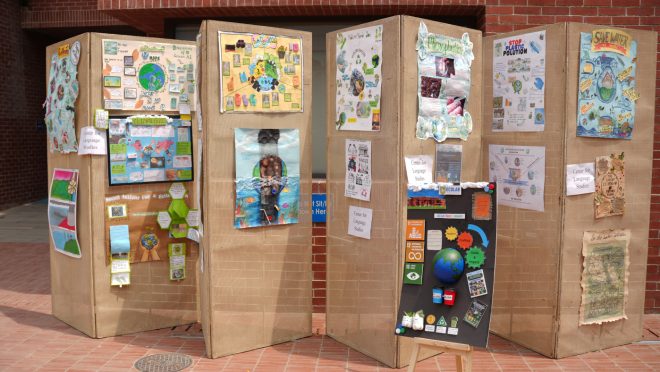
We consciously reduced the use of traditional alpana due to its environmental impact and instead encouraged students to create designs using dried leaves. The result was both visually striking and environmentally responsible.

A creative poster made by students on the climate crisis. Photo: Courtesy
There was also an interactive graffiti installation—a scavenger bird set against a green backdrop—that served as a powerful reminder of waste and ecological imbalance.
Another highlight was a student-led visit to a nearby river, where participants took an oath to protect it. That sense of connection—to a place, to an idea—cannot be taught in a classroom. It has to be experienced.
Beyond a single event
For me, the most important question is what happens after the event ends.
Sustainability cannot remain confined to a few days of programming. It has to become part of everyday behaviour.
One initiative we are planning is to give each incoming student a tree sapling. Over the course of their time at ULAB, they will nurture it and document its growth. The idea is simple, but powerful—it creates a personal relationship with the environment.
Because ultimately, lasting change comes not from large gestures, but from consistent, everyday actions.
The Earth Day programme also reaffirmed something important about the direction we need to take.
As a university, we must prepare students for a future that is uncertain and constantly evolving. This means integrating emerging areas like artificial intelligence into our academic ecosystem, while also strengthening interdisciplinary learning.
Our recent move to a new campus adds another layer of responsibility. We are not just building an institution; we are shaping an environment—one that can stand as a model for what a university space should feel like.
Rather than focusing solely on rankings, my priority is to build a strong foundation—one that is future-ready, inclusive, and grounded in purpose.
A culture of belonging
If there is one idea that I hope students take away—not just from Earth Day, but from their time at ULAB—it is a sense of belonging.
When individuals feel connected to their environment, they begin to take responsibility for it. Whether it is the campus, the community, or the planet at large, that sense of ownership shapes behaviour in meaningful ways.
And perhaps that is what this year’s Earth Day ultimately demonstrated—that when people feel they belong, they do not need to be told to care. It comes naturally.
That is the culture we hope to build at ULAB.
Prof Shamsad Mortuza, PhD, is the Vice-Chancellor of the University of Liberal Arts Bangladesh (ULAB). This interview was conducted by Tanveer Mohiuddin. TBS Graduates was the media partner for ULAB’s Earth Day programme.