Building careers before the first job: The story of LinkedIn Community Bangladesh
LinkedIn is mostly seen as a platform for senior professionals and job seekers in Bangladesh. Most students think about opening an account only when a job application asks for it.
Building careers before the first job: The story of LinkedIn Community Bangladesh
LinkedIn is mostly seen as a platform for senior professionals and job seekers in Bangladesh. Most students think about opening an account only when a job application asks for it.
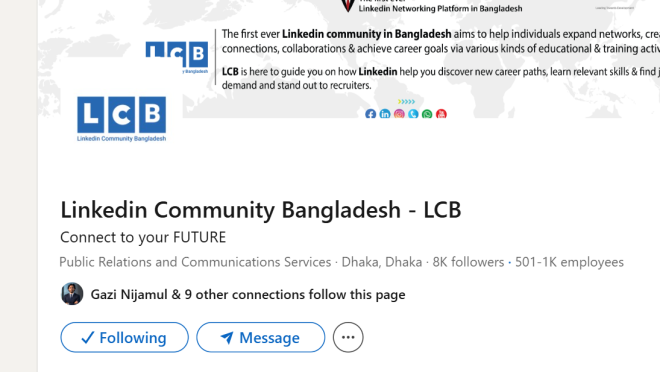
LinkedIn Community Bangladesh (LCB) was built on the belief that this could change. Altaf Hossain Raju, the founder, wanted the same platform to become a space where students learn to network, brand themselves, and lead, years before graduation.
LCB was founded on 14 May 2017, without funding and without any real proof that the idea would work. “When we started, LinkedIn was often perceived as a platform only for senior professionals, corporate executives, or job seekers,” Altaf says. “Students rarely considered it important.” What he saw instead was a gap where talented students were doing genuinely impressive work, with no idea how to present any of it professionally. Altaf thought of using LinkedIn as a medium to mitigate that gap.
Nearly a decade on, that gap has been filled on an impressive scale. LCB now counts more than 24,000 entrepreneurs, students, and professionals within its network, with campus ambassadors across 51 public and private universities nationwide. Additionally, 194 sessions have been conducted across 82 institutions to date.
The yearly years
The first phase of LCB was almost entirely educational. It started with explaining to students why building a professional identity mattered before graduation, running basic sessions on profile optimisation, and slowly building trust one student at a time.
Recruiting the first campus leads was, by Altaf’s own account, the hardest part. There were no success stories to point to yet, no numbers to show. “The first few campus leaders joined because they believed in the vision rather than the results,” he says. Early operations mainly relied on online meetings, shared documents, constant follow-ups, and volunteers juggling recruitment, event planning, and member support all at once.
Growth beyond LinkedIn
What began as a LinkedIn-specific push has since expanded well past it. Members now run workshops, manage teams, mentor newer recruits, and organise their own events. Altaf realised the impact of his vision when members began creating opportunities for each other without being asked. “It was no longer just a platform,” he says, “it had become a movement.”
Altaf is candid that the actual difficulty of community-building isn’t the visible part — the events, the growth charts; rather, it was keeping volunteers motivated, managing burnout, and holding a team together through stretches when engagement drops.
A shift from purely online activity to in-person programming was one response to this: online reach builds awareness, but face-to-face interaction is what turns casual members into long-term contributors.
Opportunities for members
Beyond networking, LCB offers leadership development opportunities, mentorship and peer learning, project and event management experience, public speaking platforms, career development workshops, and skill-building sessions. Members also get access to recommendation and endorsement opportunities, along with recognition platforms for standout contributions.
One initiative that stands out is providing official Letters of Recommendation for standout members, a rarity among student communities in Bangladesh. Students routinely put in real leadership and project work that never gets formally recognised anywhere, Altaf says, which puts them at a disadvantage when applying for internships, scholarships, or further study. The letters are meant to close that gap.
Voices from inside LCB
Md Junayed Islam Mahi, a fourth-year BBA student at Dhaka University, now serves as Senior Executive of HR and Talent Acquisition — a role that had him working directly alongside Altaf on Project LCB Nexus 130, designing nationwide recruitment strategies and sitting in on interviews himself. “This hands-on experience of evaluating top talent and scaling a national team provided insights no classroom could ever replicate,” he says.
For Ongkon Kumar Saha, a marketing student at Jagannath University, the appeal was specific: “Most platforms focus on general skill development, but LCB is built entirely around the LinkedIn community itself,” he says, calling it “unique and far more specialised.” He points to corporate networking as the biggest benefit. “I don’t think any other platform connects you with this many professionals from top MNCs and local conglomerates.” The more personal shift was in confidence. Describing himself as an introvert by nature, he says LCB “made me comfortable approaching and networking with top professionals — something I never thought I’d be able to do so confidently.”
Anisha Islam, Executive of Operations, points to something more concrete than confidence talk: winning the internal LCB Star Award for two consecutive months and helping launch “LCB Beyond the Screen,” the community’s first in-person networking meetup series, which launched in mid-June. She names the skills gap directly too: “ATS-friendly CV, LinkedIn Optimisation, Advanced Excel data management,” describing them as the kind of practical toolkit academic coursework alone doesn’t cover.
The recruitment process
Behind the recruitment posts that drew in members like Ongkon is a surprisingly structured process — something Junayed, as the Senior Executive overseeing it, describes in near-corporate detail. Applications come in through Google Forms, and from each university, a maximum of four candidates get shortlisted and moved into an internal master sheet, each given a strict five-minute interview slot. Invitations go out over email, followed up with WhatsApp reminders to confirm attendance.
The interviews themselves run in stages — an LCB executive or “Catalyst” handles the introductions before handing off to senior LCB professionals, who score each candidate out of ten immediately after the session ends. Selected candidates receive a formal appointment letter with a two-day window to accept. Once they do, they’re added to the community’s WhatsApp groups, sent an onboarding checklist, and handed over to the Campus Lead Catalyst Team to begin their roles.
Risk and ambition
LCB’s entire structure runs through a platform it doesn’t own. Altaf doesn’t dodge that. “Any platform-dependent initiative carries some level of risk,” he says. But he’s quick to locate LCB’s actual value somewhere else entirely. “LCB’s true strength is not the platform itself; it is the community, knowledge-sharing culture, and leadership ecosystem that has been built around it.”
Altaf’s stated ambition for LCB is for it to become Bangladesh’s most impactful student and young-professional development community, the one that isn’t limited by which university someone attends or where they’re based.
His advice to anyone hoping to build something innovative: “Very few focus on consistency,” he says. “There will be periods when nobody notices your work… Keep going anyway.”
Joining LCB
For students wondering where they fit into this, Altaf’s answer is fairly open-ended. “Students can join by following LCB’s official communication channels, participating in recruitment drives, attending events, engaging in community activities, and applying for available volunteer or leadership opportunities,” he says. Academic background isn’t a filter. “We encourage students from all academic backgrounds to participate.” In LCB, what matters instead, in his words, is “a willingness to learn, contribute, collaborate, and grow.”