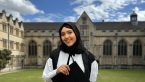
Shehneela Naz: How staying true to herself led her to a Fulbright Scholarship
Some might have a misconception that there is one rigid application format that ensures success in higher studies abroad. But Shehneela Naz proved this wrong.
Shehneela Naz: How staying true to herself led her to a Fulbright Scholarship
Some might have a misconception that there is one rigid application format that ensures success in higher studies abroad. But Shehneela Naz proved this wrong.
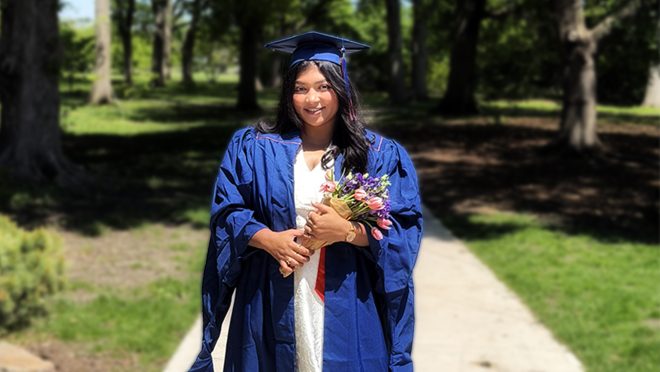
She built a profile that directly depicts her vision and goal; she did not build an over-the-top ECA profile. Instead, she chose to build a carefully thought-out application that represented her as an individual.
With this method, she did not just secure any scholarship; she secured one of the most coveted ones, the Fulbright Scholarship. I reached out to her to learn about her whole journey towards Fulbright.
Growing up
Naz grew up watching her mother teach. Her mother was a full-time teacher at Dhaka Residential Model College. She was also a full-time mother and a full-time homemaker. She saw her mother’s job as too demanding, and because of this, Naz decided that teaching was not for her.
But fate brought her to the Department of English at Dhaka University (DU). Her father, also a DU graduate, told her the department was so elite that people would look twice at anyone who walked by it, and she complied.
Today Naz is an ITE Scholar with Alpha Delta Kappa and a senior lecturer at BRAC University, alongside being a Fulbright Grantee.
The same Naz says today, “education is so deeply embedded in who I am that I cannot imagine pursuing any other path.”
Naz always wanted to do something meaningful. She did not want to prove anything to anyone. She felt she owed it to herself to reach her full potential. So, she kept up with scholarships such as Fulbright, Chevening and Commonwealth.
She was surrounded by bright minds. She had good relations with two previous Fulbright grantees, Tamoha Siddiqui and Mitul. With their help, her friends’ help and the sources available online, Naz prepared her application all by herself.
Writing the application
She believes applications opened sometime in April, and the deadline was 31 May. The application required her to submit essays, an SOP and a writing sample.
She did all of it while working full-time. She does not use this as an excuse. Instead, she described it to show how much effort it takes to gain something meaningful. “I burned the candle at both ends,” she says.
Her connection with previous Fulbright grantees helped her understand how to structure her answers. She believes reading other people’s essays is a mistake, because it pulls you towards their structure and ideas.
“Be unapologetically you in your essays.” Authenticity is what matters most.
For her own statement of purpose, she simply tried to present herself. She wrote about her Dhaka University teachers, who made her think more deeply about life. She wrote about volunteering at the Dhaka Lit Fest, where she worked alongside great minds.
As for letters of recommendation, her advice is simple: reach out to those who know you well, not people with impressive titles. In her own case, she asked two Dhaka University professors and her department head at Brac Institute of Languages. She got their approval first, then emailed them her CV and a draft letter.
For the IELTS, she did not have to go through much hassle because she already had an 8.5 from a year before she applied for Fulbright.
And lastly, her CV does not have an extraordinary ECA profile, and she does not believe one needs a long list of extracurricular activities. What mattered was a clear story about what she had done, what she wanted to learn and how she would use it afterwards.
The interview
In mid-August, she got an email inviting her to an interview, about a week before the date. She searched the interview blog, Reddit and Facebook. She also turned to Tamoha apu and Mitul apu, the two former Fulbrighters. Two dear friends, Srabosti and Peuly, held a mock interview with her two days before.
She had to attend one interview, which was conducted by the Fulbright Commission Bangladesh. Most questions came from her application and essays.
Here she says it is essential to have a clear vision of purpose. For Fulbright especially, she emphasises that you need a clear vision of how you will benefit and how you will serve your community afterwards. Fulbright is also a cultural exchange programme, she adds, so you should think about how you will represent your country.
The final stage
The result came two days after the interview. She was selected. And selected candidates were required to take the GRE and TOEFL.
She carried a GRE vocabulary list on her phone everywhere. She tried to memorise words in class, at hangouts, in meetings and in bed before sleep. For final preparation, she took a week of leave.
She took no coaching for any test. She bought books, used free online resources and took every free mock test she could find. She recreated exam conditions in her room, with strict timing and no distractions. “Alhamdulillah, I secured decent scores on both my tests,” she says.
In the first week of April the next year, she learned she had been placed at the University of Illinois Urbana-Champaign. Only the pre-departure steps were left, such as the visa and medical requirements. The Fulbright Commission Bangladesh also held a thorough orientation to prepare her for life in the US.
Life at Illinois
At the University of Illinois Urbana-Champaign (UIUC), she did her master’s in Curriculum and Instruction. Her focus was digital environments for learning, teaching and agency, known as the DELTA programme. It taught her to see education from different angles and to question assumptions she had taken for granted. She also served in the Fulbright Student Association on campus.
Her growth reached beyond the classroom. She received the International Teacher Education scholarship from Alpha Delta Kappa and the DKG World Fellowship. These let her travel across the US and connect with teachers from many backgrounds. At the ADK International Conference, she shared her journey with hundreds of participants. She calls her point of view limited and still growing, as a teacher, a student and a lifelong learner.
She says these trips mattered as much as her studies. They gave her a wider view of the US than campus life could. They also made her more independent, open-minded and confident. Today, she continues her doctoral studies at the University of Illinois.
Advice for applicants
For Bangladeshi students who are preparing for fully funded scholarships, her message is simple. Start early. Do not put everything together at the last minute. Understand why you want this and how it connects to your goals. Let your application tell an honest story about who you are, what you want to learn and what you hope to give back.
“You don’t need to have a perfect profile; you need to be able to clearly communicate your journey and what you hope to do with the opportunity.”
Behind this entire journey is Shehneela Naz, who was once determined not to pursue teaching as a career. Today she proudly says, “It’s probably in my genes.”