Can an app solve Dhaka's loneliness? The story behind TixerX
University campuses have thousands of students. Making friends is often harder than it sounds. Social circles are fixed early, groups close quickly, and most people do not reach out beyond what they already know.
Can an app solve Dhaka's loneliness? The story behind TixerX
University campuses have thousands of students. Making friends is often harder than it sounds. Social circles are fixed early, groups close quickly, and most people do not reach out beyond what they already know.
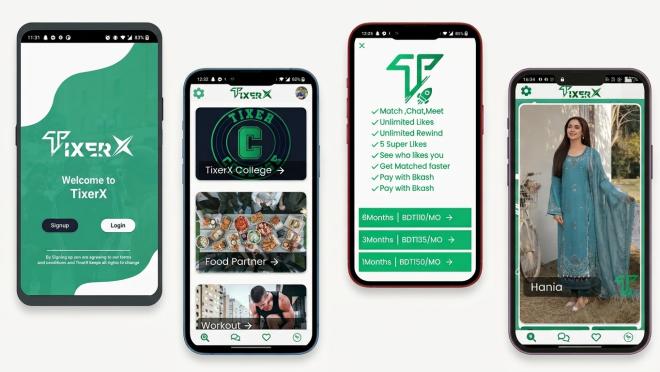
Two students from Bangladesh University of Professionals, Abrar Amir Hussain and Shahariar Hossain, noticed this in 2021 and started building TixerX, an app designed to connect people around a shared purpose, whether that is food, fitness, university life, or office networking.
The problem at hand
There is a broader argument underneath TixerX about what is happening socially among young people in Dhaka. Young people are increasingly moving away from the networks they grew up in. University life, despite the sheer number of people packed into it, tends to be lonely. Many interactions happen online but do not lead to real friendships. People are looking for companions for specific activities, eating, working out, studying, attending events, rather than just adding to a social network.
The founders believe TixerX sits in that gap. They acknowledge that the technology can make it easier to discover people, but whether people actually use it depends on a cultural willingness to reach out in the first place. They see TixerX as addressing both sides of that: the product and the habit it is trying to build.
What it is
TixerX is a product of Tixer Tech, a registered software company the two co-founded. TixerX is the company’s social product and currently has around 1,800 users.
It is not a dating app, though the founders acknowledge the interface occasionally draws comparisons to Tinder. They say the similarity is coincidental. Unlike Tinder or Bumble, TixerX is not built around romantic interest. It is built around real-life meet-ups among people with a shared intent.
Two users need to match before they can have a conversation. If both like each other’s profile, they get connected. Beyond matching, users can also post an invite, something along the lines of going to a cafeteria on a specific date. Someone they know, or someone new, accepts the invite. The two then have a short conversation, confirm the plan, and meet.
The app is organised around specific purposes: food, fitness, university connections, and office networking. The idea is that people communicate more easily when there is already a concrete activity to anchor the conversation.
From idea to the App Store
The first version of TixerX, including the app, website, and backend, was developed in 2021. There was early investor interest at the time, but the app was not released. Work on the project resumed in 2025, and the Android version launched that year. Getting onto iOS took considerably longer.
Apple rejected TixerX more than fifteen times before finally approving it. Apple took around six months to review how the app stores data, how it functions, and the reasoning behind every permission it requests. Finally, the iOS version was approved and launched on 20 June 2026.
The payment gateway presented a similar challenge. Obtaining a Bangladeshi payment gateway required significant paperwork and a process the founders describe as quite difficult. These are the kinds of infrastructural obstacles that rarely come up in conversations about building apps in Bangladesh, but they are very much part of the reality.
Privacy
TixerX has built several privacy features into the app. Conversations disappear automatically after 24 hours. If a user deletes a chat from their side, it is deleted on the other side as well. The app also sends notifications when someone takes a screenshot of a conversation. The founders say these features were planned from the beginning, grounded in the idea that people change over time and should not be permanently tied to conversations they had years ago.
On the question of in-person safety, the co-founders point out that the nature of the app naturally steers meet-ups towards public settings. Users are meeting around food, fitness, or work, contexts that already imply familiar, populated places rather than private ones.
Pricing and business model
The app is free to use, and the founders say it will remain free. The business model works similarly to other platforms, where basic access is free and additional features are available through a paid plan. All core functionality is accessible on the free plan. For an exclusive user experience, the app offers a Gold plan priced at 299 taka per month and a standalone profile boost option that costs 119 taka for 24 hours.
The team has received investment offers but has turned them down, choosing to handle finances personally for now. The current focus is on growing the user base rather than monetising aggressively.
Users and growth
Currently, the core users are university and college students, though professionals have started joining as well. For promotional activities, TixerX has collaborated with eight to nine university student bodies, several influencers, and various Facebook communities. As shared by the co-founder, a new update is in development which will address design issues and bugs identified through user feedback.
Coming from a business background rather than software engineering, the two founders had to learn how to work with developers, gather user feedback, and improve the product continuously. They say they believe Bangladesh has significant potential to build products that address local problems and eventually reach a wider market.
TixerX is now on both the App Store and Play Store, with around 1,800 users and more joining. The harder question, whether enough people in Bangladesh are willing to reach out to a stranger for a coffee, is one the app cannot answer on its own. That part is up to the users.