From Cuet to Microsoft: The journey of a Bangladeshi AI researcher
In an era where technology is reshaping every aspect of human life, Bangladeshi professionals are increasingly proving that geographical boundaries are no barrier to global excellence.
From Cuet to Microsoft: The journey of a Bangladeshi AI researcher
In an era where technology is reshaping every aspect of human life, Bangladeshi professionals are increasingly proving that geographical boundaries are no barrier to global excellence.
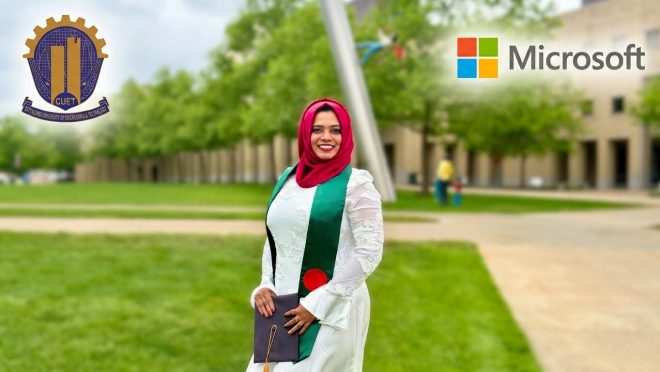
Among those inspiring stories is the remarkable journey of Dr Nadia Nahar, who made her transition from studying Software Engineering at Chittagong University of Engineering and Technology (Cuet) to becoming a Senior Research Scientist at Microsoft.
While many know her today as a successful researcher, the path behind that achievement is a story of perseverance, continuous learning, and the courage to embrace challenges beyond familiar surroundings. To understand that journey beyond headlines and social media recognition, I conducted an in-depth interview with Dr Nadia Nahar.
“At DU, I initially thought I would follow a more conventional software engineering path. I landed a job as a software engineer, and I also became involved in teaching and mentoring. Over time, I realised that the questions I was most curious about were not just How do we build this? but Why are people struggling to build this? and How can we make these systems work better for real people? That curiosity gradually pulled me towards research.”
Some of the biggest milestones that shaped her journey were getting her first research experiences, learning how to ask good research questions, publishing at strong venues, receiving recognition for her work, and eventually doing a PhD at Carnegie Mellon. Each phase opened the next door.
In terms of strategy, Nadia tried to focus less on chasing a particular title or company and more on becoming very good at something she genuinely cared about. She invested heavily in writing, research methodology, communication, collaboration, and building relationships with people whose work she respected.
“Going from DU to CMU and then to Microsoft felt much more like continuously building evidence that I could do meaningful work than following a fixed roadmap.”
As an engineer, she enjoyed building things, but became increasingly interested in the problems behind the systems they were building. Nadia wanted to understand why certain engineering practices worked, why teams struggled with certain problems, and how they could design better ways of working.
Her transition into research was gradual. It started by working with professors and getting involved in research projects, and she very quickly realised that research is a completely different way of thinking.
“You are not just trying to solve a known problem. You have to identify a problem that actually matters, understand what is already known, design a rigorous way to study it, and then produce evidence that can withstand criticism.”
When Nadia started publishing, she didn’t begin with the mindset of needing to write a Q1 paper. She focused on doing rigorous work around questions, alongside learning to read a lot of papers, identify gaps, develop research questions carefully, collect strong evidence, and, most importantly, accept criticism. According to her, a good paper is usually the result of many rounds of failure, feedback, rewriting, and refinement.
So, for students who want to get into research, she said not to start by thinking about the ranking of the journal or conference. Start by finding a question that genuinely bothers you and learning how to investigate it rigorously. The quality of the publication is a consequence of the quality of the research.
“My mindset has changed quite a bit. Earlier in my academic journey, I was very focused on doing things correctly and producing strong research contributions. As I have become more experienced, I have started thinking much more about what happens after the research is published.”
In a university setting, students have the luxury of spending a lot of time deeply understanding one problem. In an industry setting, students also need to understand scale, constraints, timelines, users, business context, and whether something can actually be adopted.
Talking about today, Nadia thinks about both rigour and relevance. She still cares deeply about asking the right questions and generating credible evidence, alongside asking, “Who is going to use this? What changes because of this research? Can we actually move this from an idea into practice?” That combination of scientific rigour and real-world impact is something she continues to develop.
Her research mainly sits at the intersection of software engineering, human-computer interaction, and machine learning. She is particularly interested in how people and organisations build AI and ML systems in the real world, not just whether a model is accurate, but whether the overall system is reliable, responsible, understandable, and useful.
A lot of Nadia’s work has focused on the human and organisational challenges around AI. For example, how software engineers and ML practitioners collaborate, how teams evaluate systems that use large language models, how people communicate about responsible AI, and how they can design tools and interventions that actually help practitioners make better decisions.
In short, Nadia studied the intersection of people, software engineering, and AI. “I think the bridge starts by working on problems that are important in the real world in the first place,” she said.
At Microsoft, she is able to work much closer to the people and systems that actually deploy technology at scale. That gives researchers an opportunity to see problems that may not be obvious from an academic setting.
At the same time, she brought the research mindset, i.e., being systematic, questioning assumptions, designing studies, and asking whether the evidence actually supports the conclusion. The most exciting part for her was when two things meet: when an academic idea can be tested in a real environment, and when real-world challenges lead to new research questions.
“I think that feedback loop is extremely powerful.”
The emerging areas of AI or computer science Nadia believes will have the greatest impact over the next decade involve enormous changes from AI agents and systems that can reason across multiple steps and interact with tools, software, and other systems.
But the important question is not just how intelligent these systems become. It’s whether people can make them reliable enough to use in situations where mistakes actually matter, which means areas like AI evaluation, safety, human-AI collaboration, responsible AI, AI-assisted software engineering, and the engineering of complex AI systems are going to become increasingly important.
One of the biggest challenges of the next decade will be understanding how humans should work with increasingly capable AI. The technology is advancing incredibly quickly, so engineering practices, organisational processes, and social understandings need to catch up.
For Nadia, a publication is an output, not the final measure of impact, impact in terms of whether the research changes how people think, what they build, or how they make decisions. Sometimes it means a tool gets adopted. Sometimes it means practitioners change a process. Sometimes another researcher builds on the work. And sometimes the impact is simply helping people recognise a problem that they previously hadn’t noticed.
“I’m also very interested in educational impact. If something I develop helps a student, engineer, or researcher approach a problem differently, I consider that meaningful impact.”
Ultimately, Nadia wants her research to exist beyond the paper, to influence practice, people, and the way people think about technology.
When someone works across software engineering, HCI, machine learning, social science, or other disciplines, people bring different assumptions, methods, and definitions of what a ‘good’ solution looks like. Initially, that can be frustrating because one may feel like everyone is speaking a slightly different language.
One of the most important skills Nadia developed is learning to slow down and really understand how another person is framing the problem before trying to convince them of her own perspective. Good interdisciplinary collaboration isn’t about making everyone think the same way. It’s about combining different ways of thinking to understand something more completely.
An excellent engineer is very good at solving problems under constraints. An excellent researcher is very good at identifying which problems are worth solving, asking questions for which the answer isn’t obvious, and generating new knowledge. Both require curiosity, persistence, strong technical skills, and the ability to deal with failure.
The biggest distinction Nadia draws is that engineering often starts with a problem that needs a solution, whereas research often starts with uncertainty. A researcher has to be comfortable saying, “I don’t know, and I need to figure out how to find out.”
AI systems are increasingly being used in areas that affect people’s opportunities, privacy, safety, and everyday lives. Researchers therefore need to think beyond whether a system technically works. It is incumbent on us to ask: who could be harmed? Who might be excluded? What assumptions are built into the system? Can people understand or challenge its decisions? What happens when it fails?
“I also think researchers have a responsibility to be honest about limitations. There can be a lot of pressure to make AI look more capable than it actually is, but responsible research means being very clear about uncertainty, limitations, and unintended consequences.”
Ultimately, technological progress and responsibility cannot be separated. The more powerful the technology becomes, the more important that responsibility becomes. From experience, the first thing Nadia said is not to convince oneself that being in Bangladesh means one has to think in close narrative. There is an enormous amount of talent in Bangladesh. The challenge is often access to mentorship, research opportunities, networks, and information about how these systems work.
On this behalf, Nadia recommends starting as early as possible. Finding professors or researchers whose work genuinely interests the researcher. Reading papers even when they seem difficult, alongside trying small research projects. Besides, learning to write well, and building strong technical fundamentals are also highly essential.
“Don’t wait until you feel completely ready before applying for internships, scholarships, conferences, or research opportunities.” Most importantly, Nadia said not to define someone’s potential based on where he or she started.
“Keep learning, keep trying, and keep putting yourself in rooms where you have something to learn,” she believes. Nadia is particularly excited about the challenge of making increasingly capable AI systems genuinely reliable and useful in the real world.
We are moving from models that simply generate information towards systems that can reason, act, use tools, and participate in complex workflows. That creates enormous opportunities, but it also creates much more complicated engineering and human challenges than before.
She is excited about contributing to research that helps people to understand how to evaluate these systems, how humans should collaborate with them, and how they can build them responsibly at scale.
“For me, the exciting question is not just, how intelligent can we make AI? It’s about how do we make AI systems that people can actually trust, work with, and depend on?”, concluded Nadia.