From exam anxiety to confidence: The rise of Chorcha
Imagine being a chess player. You are given a bunch of books on the best openings, the middlegame, and a subscription that offers access to endless grandmaster lessons.
From exam anxiety to confidence: The rise of Chorcha
Imagine being a chess player. You are given a bunch of books on the best openings, the middlegame, and a subscription that offers access to endless grandmaster lessons.
Then the day comes when you sit for your first game at the tournament. The clock ticks, and all the books start floating around in your mind, and you sit there wondering which one to pluck out of the air and apply. Before you know it, the game you should have won slips out of hand, and you are out of time.
People focus on the preparation, but often miss out on something that is just as important: practice.
The founders of Chorcha, who during their time faced similar problems, knew that they were not the only ones. There was a massive gap between the preparation and the actual exam. Traditional study methods did not provide students with a simulated experience of the real exam, meaning that they were well prepared but never really comfortable.
“Chorcha started with the idea of solving this problem. We wanted students to move beyond traditional study methods, overcome their fear of exams, and learn through regular practice. Through gamified and personalised learning, students can confidently prepare for any exam, anytime and from anywhere, at their own pace,” said Raihan Ul Islam Sanzid, the CEO of Chorcha.
Serving around 2.5 million learners, and with 40,000 students using Chorcha as their main practice tool, the platform is growing beyond just a simple question-practice app into an entire self-learning ecosystem and a one-stop solution. The challenge of creating a product in the education sector is that it needs to be accurate, engaging, and understanding of a student’s needs. The development journey was not easy.
“We had limited resources, and many of us are still students. We had to collect and verify a large amount of academic content and build a platform for a growing user base,” the CEO told us.
The journey almost came to a halt, with uncertainty looming over its future, when the app was suddenly removed from the Google Play Store. Despite losing connection to countless students, the team launched a completely new app. The motivation came from the belief that their platform could improve lives.
“Our students are our biggest motivation. Their messages, success stories, and trust remind us why we started Chorcha. During difficult periods, our team also works beyond individual roles, with everyone contributing wherever needed. The shared belief that our work can improve students’ lives keeps us focused and helps us move forward together,” said Nafis Pial, Co-founder and CMO of Chorcha.
Each student is a source of motivation for Chorcha, as they receive thousands of success stories. When asked which story had stayed with them the most, Pial talked about an HSC student from a remote village in Gaibandha.
“She maintained a streak of more than 360 days in Chorcha and later secured admission to the University of Dhaka. Her journey showed us how consistent practice can create opportunities, regardless of a student’s location.”
Another memorable moment occurred when he was travelling, when he overheard a girl telling her mother that she had completed her entire exam preparation through Chorcha. They did not know that the person sitting next to them was the founder himself, which made the moment even more memorable.
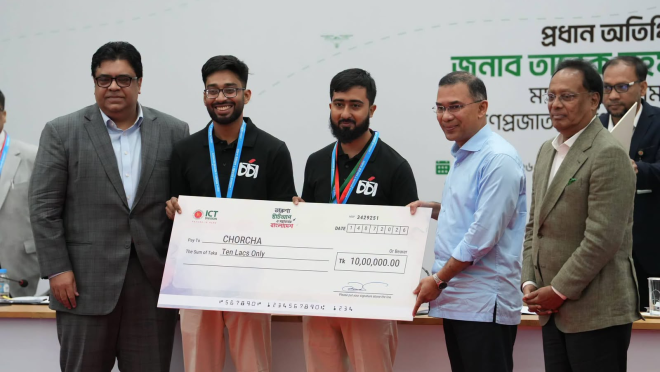
Recently, the government, too, recognised the team for their efforts, as they received a grant of Tk1 million.
“The grant is more than financial support; it is recognition of the problem we are solving and the impact Chorcha can create. Personally, it was a proud and emotional moment. Chorcha began as a small idea based on a student’s personal struggle, so receiving national recognition showed us how far that idea had come. Professionally, it strengthened our belief that technology built in Bangladesh can solve major educational problems. It also increased our responsibility to serve students more effectively. For our team, it is both an encouragement and a responsibility. It motivates us to improve the product, invest further in research and technology, and make quality learning opportunities accessible to more students across Bangladesh.”
Success for team Chorcha is not defined by downloads, revenue, or rankings, but by every single student who overcomes exam fear, recognises their weaknesses, and succeeds in life.
Lastly, Pial did not shy away from mentioning the importance of work-life balance for aspiring entrepreneurs.
“I would tell myself (if I could go back in time) to dream big, but not ignore health, family, and personal well-being while building the company. Hard work and sacrifice are part of entrepreneurship, but burnout should not be treated as success. Building strong systems, trusting the team, and maintaining balance are equally important for creating something sustainable.”