UrbanSentinel: Nervous system for an urban water network
The idea of the AI-based rapid water-testing system is ambitious: detect contamination, predict how it may move through an urban water network, trace possible sources, treat the water and then check whether the treatment worked
UrbanSentinel: Nervous system for an urban water network
The idea of the AI-based rapid water-testing system is ambitious: detect contamination, predict how it may move through an urban water network, trace possible sources, treat the water and then check whether the treatment worked
A sensor can tell you that water is contaminated. But what happens if you do not know where the contamination came from, what direction it is moving in, or what should happen next?
That question is at the core of UrbanSentinel, a water-monitoring system Zabeer Zarif Akhter has been developing over the past year. A year ago, he was testing and improving things through trial and error. There was a high-voltage plasma system made partly from electronic waste, followed by an AI-based system designed to rapidly test water quality.
Now, technology is only part of the story.
Zabeer is less interested in demonstrating that something can work and more interested in finding out how reliably it works, where it can fail and what the evidence actually allows him to claim.
“The biggest change was that I stopped thinking about water pollution as only a treatment problem,” he said.
His earlier work had started with purification. But while working on it, he ran into another problem: even if contaminated water could be cleaned quickly, determining exactly what was in it—and whether the treatment had worked—could require expensive laboratory equipment and, in some cases, days of testing.
That led to his AI-based rapid water-testing system. The idea is ambitious: detect contamination, predict how it may move through an urban water network, trace possible sources, treat the water and then check whether the treatment worked.
Zabeer describes it, rather nicely, as “something like a nervous system for an urban water network.”
The system uses several kinds of signals to examine water, including UV-visible absorption, infrared spectroscopy, Raman-based information and electrical properties such as capacitance and resistance. A lightweight deep-learning model then interprets those signals and estimates parameters such as BOD and COD.
At the network level, data from monitoring nodes could be combined with rainfall, water levels and flow to predict whether contamination will reach downstream points. If one node detects clean water and another contamination, the timing, location, spectral fingerprint and hydraulic model could help trace the pollution back to its likely source.
Zabeer is quite deliberate about an important caveat here. UrbanSentinel is not supposed to point at a factory and announce that it caused the pollution. It is meant to produce probability-ranked possible sources based on several pieces of evidence. Any actual enforcement decision would still require the appropriate regulatory and legal process.
Zabeer is currently working as a Research Assistant in the Institute of Appropriate Technology (IAT) at Buet. This experience has had a lot to do with that. He still builds things the way he always has, but he now thinks much more about calibration, control samples, reference methods, repeatability, and uncertainty.
But now there is another question at every stage: Where can this fail?
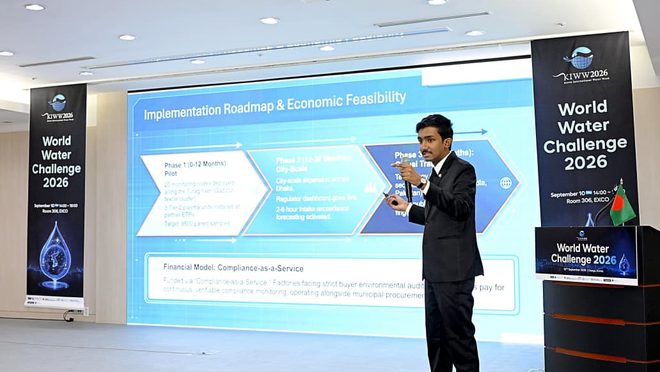
This became clear at the World Water Challenge 2026, co-organised by the Ministry of Climate Energy and Environment, South Korea and Korea Water Forum (KWF). Zabeer had to explain UrbanSentinel to researchers and industry professionals. The challenge was showing not just what the system could do, but what it could already do.
The sensing system, the treatment system, the network-level source attribution and the future forecasting system are not all at the same stage. Some have experimental evidence behind them. Others are still being developed.
Questions about dataset size, scalability and computing limits on an ESP32 forced him to define the system’s capabilities more carefully. The current labelled dataset contains just 28 laboratory-paired samples. The sensing subsystem showed 96.4% average agreement with lab results, with 92.9% of readings within 10% of the laboratory values.
The results are encouraging but not enough to claim universal performance. The same caution applies to treatment. In one experiment, plasma treatment reduced colour from 468 to 115 Pt-Co, COD from 86 to 22 mg/L, and total coliform, faecal coliform and E coli to zero. BOD fell from 68 to 7 mg/L but remained above the 5 mg/L target, while pH dropped from 7.2 to 6.4.

In the next stage, Zabeer wants to test in a controlled urban setting, with at least 500 laboratory-paired samples across 20 monitoring sites.
Zabeer now treats the limitations as part of the story. He describes the plasma system more carefully as a polishing and disinfection technology within a treatment train, rather than claiming it can replace conventional wastewater treatment.
“The strongest improvement is not adding another feature,” he said. “It’s narrowing a claim until the evidence genuinely supports it.”
That shift may be more important than any technical feature added to UrbanSentinel. The project has already taken him far. It received an Outstanding Award at the 2026 World Water Challenge, putting a young Bangladeshi researcher in a setting where the discussion was no longer simply about school projects, but evidence, feasibility, scalability and real-world implementation.
Part of Korea International Water Week, the 2026 World Water Challenge was held in Daegu from 9–11 September under the theme “Water, Energy, AI: Securing Our Future”, drawing around 12,000 visitors. Finalists were assessed on feasibility, sustainability, originality and impact before presenting their projects to an international expert panel.
For Zabeer, the award mattered, but perhaps more important was being asked to defend not only what he had built, but what he could actually prove.
The next stage will be harder. He wants to test UrbanSentinel in a controlled urban setting, with at least 500 laboratory-paired samples across 20 monitoring sites over 12 months. The proposed study would also include contaminant fingerprinting, nitrate and nitrite measurements, source-attribution testing and measurements of treatment energy consumption. One possible testing area is the Turag/Gazipur–Konabari industrial corridor.
A successful field test would mean much more than placing devices beside a river. The nodes would need to keep working through rain, temperature changes, turbidity, electrical noise and sensor fouling. AI predictions would have to be tested against hundreds of laboratory samples. The network would need to detect contamination, track its movement and narrow down possible sources.
The treatment system, meanwhile, would have to consistently reduce contaminants while accounting for energy use and potential by-products.
This is the less glamorous side of innovation: maintenance, calibration, repeated testing, failed experiments and more waiting. It also requires institutions. A real deployment would involve researchers, water utilities, the Department of Environment, municipal authorities, industries and potentially development organisations. Someone would need to maintain the nodes, verify the results and decide what happens when the system raises an alarm.
For a young researcher in Bangladesh, even reaching this stage has its challenges. Zabeer now has access to Buet laboratories and mentors, a significant change from the days when he tried to build and test much of the system himself. But specialised sensors, calibrated spectroscopy equipment and independent laboratory testing remain difficult to access.
What has changed is how he sees that problem. Laboratory access is no longer simply something that would make his work easier; he sees it as part of the research itself.
That may be the biggest change in Zabeer. He still loves electronics and remains fascinated by plasma, physics, AI and instrumentation. But he now wants to become a researcher and engineer who can connect science with systems that solve real problems, rather than someone whose work ends when a competition does.
Then comes the question I liked most: what would he tell the version of himself interviewed in 2025?
“Do not be in such a hurry to prove that everything works.”
It is a difficult lesson for an inventor. We celebrate the person who makes something work, puts a prototype on a table and starts talking about the future.
Research is less forgiving. It asks what happened when something did not work, whether others can reproduce the result, whether it has been tested enough and whether 28 samples are enough to support a claim.
More importantly, it asks researchers to be honest about what they do not know yet.
Zabeer seems to have reached that uncomfortable place with UrbanSentinel. The real story is not simply that a young researcher built a system that could one day help cities detect polluted water. It is that, somewhere between the laboratory, Buet and an international panel in South Korea, he became less interested in proving that his research was successful and more interested in understanding what the evidence can actually support.
That is a harder question — also a more important one.