How old jeans find new life in upcycled denim accessories
How old jeans find new life in upcycled denim accessories
It takes about 10,000 litres of water to produce a single pair of jeans – roughly the amount an average person drinks over 10 years.
And then there is the industry’s heavy reliance on harsh chemicals, compounds that routinely pollute local waterways, harm aquatic ecosystems and pose severe health risks to factory workers and nearby communities.
After such a heavy toll on the earth’s resources, most garments face a remarkably short, linear lifespan. The fashion industry’s relentless drive to launch new products every season ensures a constant churn: jeans are bought, worn for a while, then thrown away, eventually piling up in landfills as heavy, slow-to-decompose textile waste.
Intervening at the end of that cycle – reusing the water-intensive, heavy cotton fabric instead of discarding it – could conserve significant natural resources. Upcycling denim dramatically reduces demand for virgin resources, including water, energy and raw materials.
In the face of growing environmental challenges, this kind of conservation is becoming less an option and more a necessity.
Bangladesh sits at an unusual point in this equation. It is, by most counts, the world’s leading denim exporter to the US and EU, with shipments having crossed $2.6 billion last year, according to data from the Office of Textiles and Apparel (OTEXA) under the US Department of Commerce and Eurostat.
All of that scale means denim – and the offcuts, rejects and surplus that come with producing it at this volume – is simply more available here than almost anywhere else. Rejected zips, mismatched stitching, garments that failed quality control by a centimetre of seam allowance, fabric that never made it past the cutting table.
Mirajul Huq spotted that surplus in 2018 and saw an opening.
“We thought it wasn’t just plastic and leather bags which can be made,” he said, recalling the instinct that pushed him towards starting Baah, his sustainable handicraft brand. “Denim was sturdy, it was everywhere given the country’s manufacturing base, and almost nobody here was doing anything with it.”
What Mirajul settled on was upcycling rather than recycling, and the difference is worth clarifying, since the two words are often used as if they mean the same thing.
Recycling breaks a garment down to its raw fibre and rebuilds it from scratch, an industrial process that needs machinery, chemicals and energy most small producers do not have.
Upcycling skips that step. It works with the original fabric intact – cutting, combining, reconstructing, but never dissolving the material back to its base form. A worn pair of jeans becomes panels. The panels become a bag, a jacket, a patchwork skirt, while the texture and weight of the original denim survive the transformation.

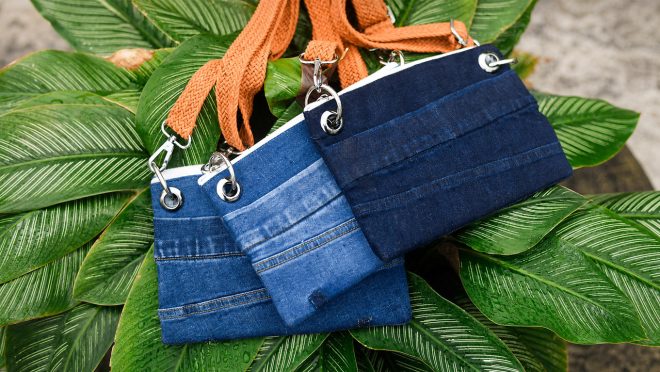
Rejected garments and used denim can be transformed into fashionable, functional products, offering a potentially profitable and more sustainable business model. Photo: Bidora
Baah sources its raw material from two places: garments rejected before they ever shipped and used denim collected from informal collection points around Dhaka.
“We thought, why not explore denim for bags,” Mirajul said, describing the early thinking behind the brand. “We tried to make it stylish, relevant, so that conscious-minded people who are aware of sustainable practices can purchase these products.”
The team experiments constantly, mixing denim with jute, layering different washes and weights against each other, printing directly onto the fabric, building patchwork from multiple sources.
None of it is simple. Denim resists the kind of quick handling that a thinner fabric allows.
“Yes, it’s true that it’s a bit of a difficult material to work with,” Mirajul said, “but the artisans I have are mostly ex-garment workers. All of them are female. They have experience with the material. We provided suitable machines so that they can easily work.”
What surprised him most was not the production challenge but the reception.
“In our country, there is a stigma around used products,” Mirajul said. “But surprisingly, customer response was quite positive.”
Sajia Shoheli, who runs the upcycled-denim brand Bidora, came to the same material from a different direction.
“First we were thinking about reselling Chinese products here in Bangladesh, and I even ordered some,” she said. “But I realised the way they show pictures, the products are too low in quality, and I thought, why not be the one to start my own business with my own products?”
That question sent her looking for available raw materials.
“One day I realised denim cloth was so widely available, and that if I turned rejected garments or used denim into something fashionable and usable, it would be profitable and a sustainable practice for my business.”
She has spent years experimenting with what denim allows.
“I tried patchwork on denim, embroidery, laser printing, block print, even tie-dye on denim,” she said. “Shibori tie-dye works so well on denim.”
Somewhere in that process of trial and error, what started as a practical decision turned into something closer to an attachment to the material itself.
“Working with the material, I grew an unexplainable passion for it,” she said. “I trained up women in my locality, provided them with sewing machines, and they now work for me in my factory.”
The economics of working with used or rejected material cut in two directions at once. The raw material is cheaper, simply because it already exists and someone is trying to get rid of it. But the labour involved is harder than working with new fabric.
Garments have to be unstitched or cut apart by hand, pieces sorted and matched, then reassembled into something with a coherent shape.
“Working with preloved or used denim, or even rejected garment items, might cost less because of the availability of raw material, but it is also tough to do,” Shoheli said. “You have to unstitch the pieces or cut the pieces, then assemble them, and denim is not an easy material to work with. It requires passion and patience to work with used materials.”
Most of the core stitching happens inside her own factory, while certain steps, like laser printing or initial patch-cutting, go out to third parties before everything comes back to her for final construction. Selling almost entirely through Facebook commerce, her business now moves around ten lakh taka a month, alongside a growing export presence and a physical display centre that, by her own admission, she has never bothered to promote, because customers keep finding it anyway.
What Shoheli notices, comparing local demand to international interest, is a gap in how seriously sustainable consumption is taken.
“Gradually our people are also becoming conscious about sustainable practice,” she said. “But in foreign countries, they value it more. We mainly do our business on online platforms, but every day, at our display centre, people come to visit and buy. We haven’t even promoted the physical store yet.”
That gap between domestic awareness and structural support is something Abu Haider Kabir Kafi, spokesperson for the Bangladesh Denim Expo, has watched develop over more than two decades of the event’s existence.
“Upcycling is a much newer concept in our country, but recycled-content denim fabrics have consistently been showcased at the Expo,” he said. “While most denim products are not made entirely from recycled materials, blended solutions have become increasingly common, with fabrics incorporating varying percentages of recycled fibres – 20, 30% or more.”
Circularity itself was the theme of the Expo’s 10th edition in 2019.
“At a time when circularity was still an emerging concept within Bangladesh’s apparel industry, the Expo played an important role in raising awareness and encouraging industry-wide discussion,” Kafi said.
But when it comes to upcycling specifically – the small-scale, garment-to-garment transformation that Baah and Bidora practise – Kafi pointed to a structural barrier.
“One of the major barriers to scaling up post-consumer textile recycling and upcycling in Bangladesh is regulatory,” he said. “Current government policy restricts the import of used and second-hand products, including garments. Since most Bangladeshi apparel is exported to international markets such as Europe and the US, garments reach consumers abroad and enter the post-consumer stage there.”
The consequence, he explained, is that the country’s own manufacturers and recyclers have limited access to the very waste stream their export industry generates.
“Because these used garments cannot be imported back into Bangladesh, manufacturers and recyclers have limited access to post-consumer textile waste streams. This significantly restricts opportunities for large-scale recycling and upcycling initiatives based on used garments, despite the country’s strong manufacturing capabilities.”