Scientists examine 35,200-year-old wolverine unearthed in Siberia
Scientists examine 35,200-year-old wolverine unearthed in Siberia
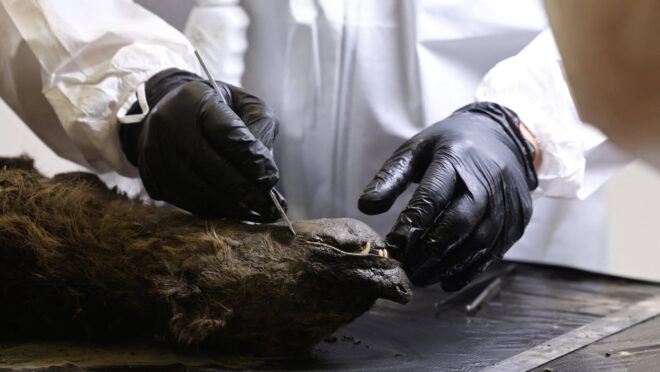
Scientists in Russia have begun examining a wolverine that lay preserved in Siberian permafrost for around 35,200 years, hoping its remarkably intact remains will provide new insights into the Ice Age predator.
Researchers in Yakutsk have started an autopsy on the animal, discovered near the Kolyma River in 2025, and are collecting biological samples for analysis. Its soft tissues and internal organs remain exceptionally well preserved, WION reports on Thursday (27 November).
The condition of the remains could help scientists understand the relationship between ancient wolverines and their modern counterparts, said Artem Nedoluzhko, scientific director of the Paleogenomics Laboratory at the European University in St Petersburg.
Researchers are collecting muscle tissue and samples from the animal’s stomach, intestines and rectum. These will be examined for fragments of animal and plant DNA, which could help establish what the predator ate.
Nedoluzhko told Reuters that the wolverine’s digestive tract was almost empty, suggesting it had gone without food for an extended period before dying. It may have become trapped somewhere and starved, although further research is needed to establish the cause of death.
Computerised tomography (CT) scans have already been carried out, indicating that the animal was male and about one year old when it died.
A rare glimpse of an Ice Age predator
The wolverine lived around 35,200 years ago, during the Pleistocene epoch, a period that included the Ice Age.
Maxim Cheprasov, head of the Mammoth Museum Laboratory at North-Eastern Federal University, said researchers had previously studied mainly skeletal remains of wolverines from this period. The preservation of the newly discovered animal’s internal organs and soft tissues offers an opportunity to learn much more about the species, he said.
Scientists are also investigating the landscape and environmental conditions in which the wolverine lived. The animal was found in the Srednekolymsky District, and soil samples from the discovery site will be analysed to help reconstruct what the area was like thousands of years ago.
The find is not the first wolverine discovery at the site. In 1970, another specimen, estimated to be 12,420 years old, was uncovered at the Berelakh mammoth burial site in Siberia.
As permafrost thaws, it is exposing more remains and artefacts from the distant past, giving researchers opportunities to investigate ancient life and the planet’s environmental history even as the changing climate raises concerns.