When literacy meets financial inclusion, empowerment begins
When literacy meets financial inclusion, empowerment begins
Literacy is more than the ability to read and write. In today’s increasingly complex economy, true literacy also means having the knowledge and confidence to understand choices, access opportunities and make informed decisions, including decisions about money. For Prime Bank PLC, this broader understanding of literacy is closely connected to its commitment to advancing financial inclusion and building a financially capable society.
The journey towards financial empowerment can begin early. A child who learns the value of saving today can grow into an adult who understands the importance of planning for tomorrow. Recognising this, Prime Bank has been taking financial literacy beyond traditional banking spaces and into schools, campuses and communities through initiatives designed to make financial knowledge accessible, engaging and relevant to everyday life.
Through its financial inclusion initiatives, including PrimeAcademia, the Bank is introducing children and young people to the fundamentals of banking, savings and responsible financial habits in an engaging manner. The initiative reflects the belief that financial awareness should not begin when a person starts earning; it should begin much earlier, when attitudes and habits are still being formed.
Prime Bank PLC has been working to build this connection between literacy and financial empowerment as part of its broader financial inclusion agenda. Through its Financial Inclusion & School Banking Department, the Bank has taken financial education beyond the traditional banking counter, reaching students, young people, marginalised communities and persons with disabilities.
The Bank has reached more than 500 schools, 35 colleges and 60 universities, engaging over 500,000 students and more than 10,000 teachers through various initiatives. It has also organised 300 Student Banking Campaigns, helping young people understand saving, responsible financial behaviour and the practical use of banking services.
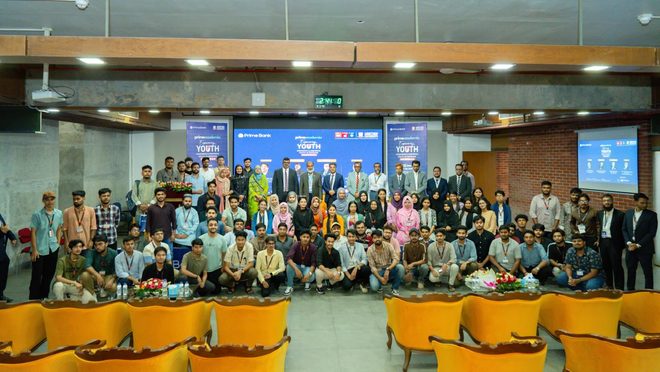
Recognising that the transition from education to employment brings new financial responsibilities, Prime Bank has organised 60 “Empowering Youth” programmes nationwide, focusing on financial literacy, money management, banking and career development. These initiatives reflect an important principle: access to financial products alone does not create financial inclusion. People also need the knowledge and confidence to use those services effectively.
Prime Bank’s contribution to financial inclusion also extends to underserved communities. The Bank has conducted 200 Financial Literacy Programmes through its branches and Agent Banking outlets, taking financial knowledge closer to people who may have limited exposure to formal financial services. This approach seeks to make inclusion more meaningful by helping people understand not only how to open an account, but also how to save, transact safely and make responsible financial decisions.
Inclusion must also be accessible. Through its “Breaking Attitudinal Barriers” initiative, Prime Bank has focused on financial literacy and banking awareness for persons with disabilities. The Bank has distributed 1,000 Braille books for visually impaired individuals and introduced financial literacy content through sign-language videos to make financial information more accessible.
These efforts point to a simple but powerful truth: opening the door to financial services is only the beginning. People must also have the knowledge, confidence and capability to walk through that door.
This is particularly relevant for Bangladesh, where millions of young people are entering the workforce and digital financial services are rapidly transforming how people save, spend and transact. Stronger financial capability can help households build savings, manage emergencies, avoid harmful borrowing and participate more confidently in the formal economy.
Prime Bank’s initiatives demonstrate how a financial institution can contribute to this transformation by taking financial education into schools, universities, communities and underserved groups. The numbers are significant, but the human impact is greater: a student learning to save, a young person making a responsible borrowing decision, a family preparing for an uncertain tomorrow, or a person with a disability gaining confidence in using formal financial services.
On International Literacy Day, the meaning of literacy extends far beyond the ability to read and write. In today’s world, it also means having the knowledge and confidence to make informed financial choices. Prime Bank PLC is contributing to this journey by promoting financial inclusion from an early age through initiatives such as puppet shows, art competitions, brainstorming sessions and Q&A sessions under its flagship academic initiative, PrimeAcademia.
The initiative uses engaging, family-friendly content and popular characters to introduce children to the basics of banking, savings and responsible financial habits. By bringing financial learning closer to children and families in an accessible and enjoyable way, Prime Bank is helping nurture a generation that is not only literate, but financially aware and capable.
When financial knowledge meets access, it creates capability. And when capability meets opportunity, it can lead to greater economic participation and empowerment, helping build a more inclusive Bangladesh.