Astronomers detect radio signal from planet outside our solar system
Astronomers detect radio signal from planet outside our solar system
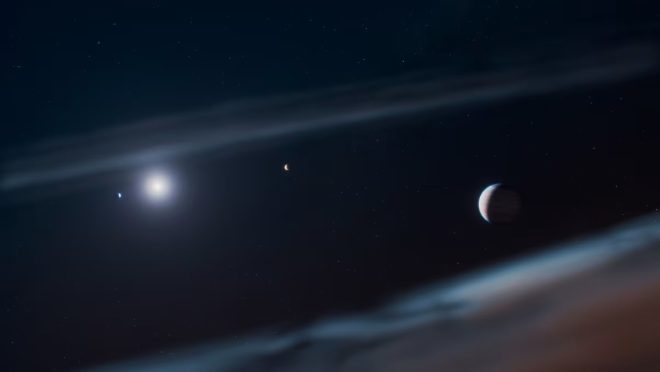
Astronomers have detected radio emissions directly from a planet outside our solar system for the first time, offering new clues about the magnetic fields of distant worlds.
The repeating radio bursts appear to originate from Beta Pictoris b, a gas giant located about 63 light-years from Earth. The planet is roughly 12 times as massive as Jupiter and orbits a young star about 1.75 times the mass of the Sun.
The signal is not evidence of intelligent life. Instead, researchers say it is produced by auroras generated by the planet’s powerful magnetic field.
“In order to see radio waves that extend all the way to the frequencies that we observed, you need an incredibly strong magnetic field,” said Edo Berger, professor of astronomy at Harvard University and a co-author of the study.
The researchers estimate that Beta Pictoris b’s magnetic field is at least 200 times stronger than Jupiter’s. Charged particles interacting with the field create auroras and produce radio waves, similar to processes observed on Jupiter.
Astronomers had previously detected possible radio emissions from exoplanets, but researchers could not rule out the possibility that the signals came from their host stars. In the new study, the team was able to localise the emission to Beta Pictoris b itself.
The researchers used MeerKAT, an array of 64 radio telescope dishes in South Africa, to detect the signal.
The finding was unexpected because scientists had assumed that exoplanet magnetic fields would behave more like Jupiter’s, producing radio emissions at lower frequencies.
The Beta Pictoris system is about 23 million years old, making it extremely young compared with our 4.5-billion-year-old solar system. Beta Pictoris b was discovered in 2008, while two other planets in the system were identified in 2019 and 2026.
The system is among the most closely studied planetary systems in the galaxy and also contains a large disk of dust and debris left over from planet formation.
However, the findings have not yet undergone peer review. The researchers say the signal has been detected multiple times and at different frequencies, but independent scientists have urged caution until the study is formally assessed.
If confirmed, the discovery could significantly improve scientists’ understanding of exoplanets and their interaction with their surrounding environments.
“Radio observations can give us a completely new view on planets beyond our system,” Berger said.
The researchers have requested additional telescope time to study Beta Pictoris b and investigate why its magnetic field appears to be so unusually strong.