Astronomers identify the first ever green star
Astronomers identify the first ever green star
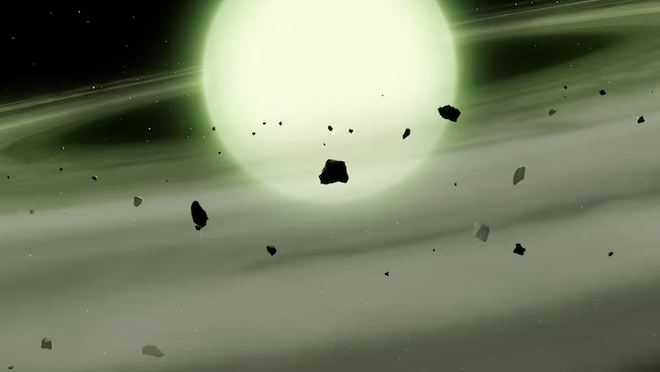
Imagine the Sun turning green for Halloween. It sounds like a scene from a science-fiction film, but scientists say our star could eventually become a far more colourful object after its death, potentially glowing green if it begins consuming planets billions of years from now.
The possibility stems from new research suggesting that white dwarfs, the dense stellar remnants left behind when Sun-like stars die, can display a surprising range of colours. If these stellar corpses consume rocky planets, asteroids or comets, their chemical composition can change, potentially producing hues ranging from yellow to pink, purple and even green.
For decades, astronomers have understood stellar colour primarily as an indicator of temperature. Cooler stars tend to appear orange or red, while the Sun emits light that appears nearly white from space. The hottest stars shine blue or pale blue. The pattern is similar to iron heated in a blacksmith’s forge, changing from red to orange and eventually white as its temperature rises.
White dwarfs, however, may not follow this familiar pattern as closely as previously thought. New research suggests that their atmospheric composition and extreme density can influence their colours, revealing a more varied palette than astronomers had anticipated.
“Most stars, including most white dwarfs, behave like ‘perfect radiators,’ so their colour is set almost entirely by temperature. But nobody had really looked into what else might be possible for white dwarfs,” Mark Hollands of the University of Warwick, who led the research, said in a statement to Space.com.
“It turns out these incredibly dense stars can produce colours nobody expected, and some of them genuinely surprised me,” he added.
White dwarfs were originally named for their characteristically white or pale blue appearance. Their light, however, may not tell the whole story. According to the researchers, their apparent uniformity could partly reflect the difficulty of observing the true colours of these distant stellar remnants from Earth.
The explanation lies in the unusual physical conditions inside white dwarfs. When stars with masses broadly comparable to the Sun exhaust their nuclear fuel, they eventually lose the ability to counteract the force of gravity through the energy generated in their cores. Their outer layers are shed, leaving behind a compact remnant that gradually cools over time.
Despite their relatively small size, white dwarfs contain enormous amounts of matter packed into a tiny volume. Their density can be millions of times greater than that of the Sun’s outer visible layer, known as the photosphere.
Under these extreme conditions, elements such as carbon, calcium and sodium interact with the surrounding dense helium plasma in ways that affect how light is absorbed. These interactions can alter the wavelengths of light escaping from the star, shifting its apparent colour away from the white or pale blue expected from a perfect radiator.
The researchers found that white dwarfs could be grouped into distinct colour categories depending on the chemical composition of their atmospheres.
Those rich in carbon could appear pink or purple. White dwarfs contaminated by material from consumed asteroids, comets and the remnants of planetary systems could develop a yellowish hue. Meanwhile, cooler white dwarfs with atmospheres containing a mixture of hydrogen and helium could appear cyan or pale blue, as collisions between hydrogen molecules and helium atoms influence the light they emit.
The findings offer a new way to understand the diversity of white dwarfs and the chemical histories of the planetary systems surrounding them. When a star dies, its gravitational influence and changing physical conditions can disrupt nearby planetary systems, sending rocky debris towards the stellar remnant.
If the Sun eventually follows a similar path, it could leave behind a white dwarf surrounded by the remains of the Solar System. Whether that stellar remnant would display an unusual colour would depend on its temperature, atmospheric composition and the material it accretes.
A green Sun, therefore, remains a possibility rather than a guaranteed cosmic spectacle. But the research suggests that even after stars reach the end of their lives, they may still have a few colourful surprises in store.