Black hole collision confirms Einstein and Hawking's predictions
Black hole collision confirms Einstein and Hawking's predictions
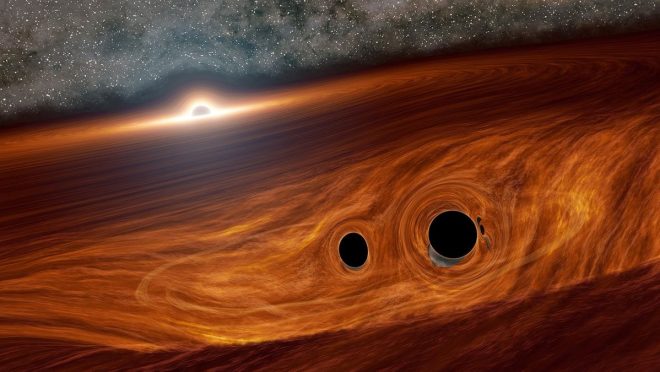
Astronomers have observed one of the most detailed black hole collisions ever recorded, providing the strongest confirmation yet of predictions made decades ago by Albert Einstein and Stephen Hawking.
The event, known as GW250114, was detected by the Laser Interferometer Gravitational-Wave Observatory (LIGO), which captured gravitational waves generated when two black holes collided around one billion light-years from Earth. The findings, published in Physical Review Letters, offer scientists an unprecedented look at how black holes behave after merging.
The two black holes were each around 30 to 35 times the mass of the Sun and orbited one another in an almost perfect circle before merging into a single black hole roughly 63 times the Sun’s mass. Researchers say the improved sensitivity of LIGO allowed them to observe the event with more than three times the precision of its first historic black hole detection in 2015.
The new observations enabled scientists to test two landmark theories in physics.
The first confirms a prediction based on Einstein’s theory of general relativity and mathematician Roy Kerr’s work, which suggests black holes are remarkably simple objects defined by just two properties: their mass and spin. By analysing the gravitational “ringing” produced after the collision, researchers found the newly formed black hole behaved exactly as the theory predicts.
The second validates Stephen Hawking’s 1971 surface area theorem, which states that when black holes merge, the surface area of the resulting black hole can never be smaller than the combined areas of the originals. Previous observations hinted at the theory, but scientists say the clarity of GW250114 provides the most convincing evidence yet.
Researchers believe the discovery marks a major milestone for gravitational-wave astronomy. Since LIGO first detected gravitational waves a decade ago, the observatory has recorded more than 300 black hole mergers, but scientists say this latest event stands out because of the exceptional level of detail captured.
The findings not only strengthen confidence in Einstein’s theory of gravity but could also help physicists tackle one of science’s biggest challenges: unifying general relativity with quantum mechanics to better understand how the universe works at its most fundamental level.