Dream, apply, fly: How Selim secured the GKS scholarship
For many Bangladeshi students, the idea of studying abroad is generally a mix of hope and uncertainty. Information is scattered, the competition is intense, and the process seems difficult.
Dream, apply, fly: How Selim secured the GKS scholarship
For many Bangladeshi students, the idea of studying abroad is generally a mix of hope and uncertainty. Information is scattered, the competition is intense, and the process seems difficult.
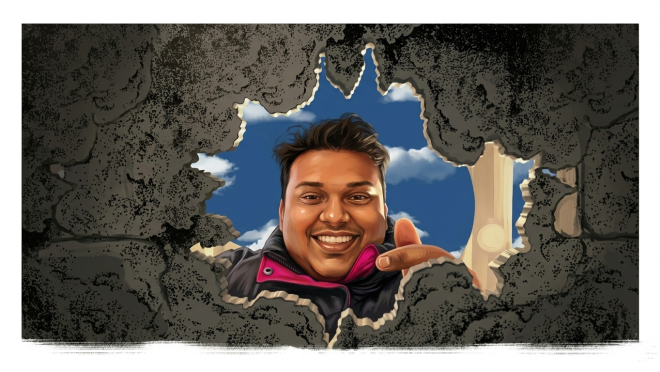
However, a select number of dedicated students overcome these obstacles each year and land opportunities that completely change their lives. Among them is Selim Sarowar.
He is currently pursuing a master’s degree at Yeungnam University on the Global Korea Scholarship (GKS), studying at the nexus of robotics, 3D vision, and artificial intelligence. But before arriving in South Korea, his journey passed through three other nations.
A journey that grew naturally
Selim did not come to GKS by chance. He had already travelled from Bangladesh to India for his studies, where he earned an Indian Government Scholarship to complete his B.Tech in Electronics Engineering. He later worked as a research intern for a year at National Tsing Hua University (NTHU) in Taiwan, where he studied convex optimisation and gained practical experience in a top-notch laboratory.
Using this foundation, he started searching for master’s programmes that matched his developing interest in robotics and artificial intelligence. Due in large part to its rapid rise in these sectors and the robust research culture at universities such as Yeungnam, South Korea immediately gained prominence. Financial assistance, organised language instruction, exposure to the industry, and an opportunity to engage in advanced research were all provided by the GKS programme.
He looked into other possibilities in Japan and Europe, but GKS seemed like the ideal choice. Selim clarified that he had ultimately been persuaded by the combination of research alignment and support.
What made his application strong
Selim obtained his B.Tech at KIIT in India after attending Saint Joseph Higher Secondary School in Dhaka prior to moving to South Korea. He was able to transition from coursework-based learning to research-driven thinking during his most influential year at NTHU in Taiwan. His work in robot learning and 3D vision is now supported by this experience.
He currently works on world-model-based robots and Vision-Language-Action models at Yeungnam University, projects supported by RISE, Future Drive Ltd., and RLRC initiatives. His goal is to use integrated perception and reasoning to train robots to comprehend and engage with the physical world.
Selim thinks the consistency of his profile made it stand out. His academic journey from Dhaka to Taiwan to India demonstrated his ability to thrive in a variety of settings. His application had more depth than most Master’s-level applicants because of his strong CGPA, involvement in extracurricular activities, and actual research experience.
He was able to create a study plan based on real experience rather than general goals because he had worked on publishable-level projects at both NTHU and KIIT. Rather than writing about AI in general, he described specific issues, stated why Yeungnam University was a good fit, and demonstrated how his knowledge in electronics might be used for 3D computer vision and robotics.
His recommendations were more impactful because they came from supervisors who had personally observed his performance.
Inside the GKS selection system
Selim faced uncertainty, just like many Bangladeshi GKS hopefuls. Months could go by without any updates because the process is lengthy. The waiting period was mentally exhausting because there was not much trustworthy information available in the country.
Another challenge was gathering the paperwork. His documents were dispersed across Bangladesh, India, and Taiwan, each of which had its own notarisation and authentication procedures. His patience and planning abilities were put to the test while he was already abroad.
Even after being selected, moving to a small Korean city, overcoming the language barrier, and adjusting to Korea’s rigorous research culture presented further difficulties. However, he eventually found his rhythm.
Both the university track and the embassy track have several steps in the selection process, but they differ somewhat. Following document screening, candidates are typically interviewed to learn more about their motivation, clarity of study plan, familiarity with Korean academic culture, and goals for the future.
Selim’s suggestion is straightforward: approach the interview as if it were a mini-thesis defence. Candidates should demonstrate how their prior experiences relate to their future objectives, understand the work of the professor they wish to study under, and have a thorough understanding of their study plan.
Maintaining communication with the target university and the embassy is crucial, since some institutions have follow-up interviews.
Life after selection: what students should expect
With the help of NIIED and the university, the actual processes such as visa processing, stipend, and housing go smoothly after selection. For their language programme, students usually begin with a D-4 visa before transferring to a D-2-7 student visa for the degree.
The stipend covers basic living expenses, but Selim comments that “it is comfortable, not luxurious.” For new students, university dormitories continue to be the most economical choice. According to Selim, even though food is easily accessible and usually delicious, it tastes very different from Bangladeshi food. Although the situation is improving every year, students may need to look a little more to find halal options depending on the city.
The academic environment is challenging. Expectations are high, work is done quickly, and laboratory hours are long. However, this setting can be transformative for students who want to develop as researchers. Everyday life is also made easier by Korea’s advanced infrastructure, efficient public transport, and safety.
Selim’s advice to future applicants
Selim shares three important pieces of advice:
- Write a specific study plan.
Choose instructors, read their papers, and clearly state your goals. The application as a whole is weakened by an unclear plan. - Build a clear narrative.
Your profile should narrate your journey, including how you arrived here, what influenced you, and why GKS can help you take the next step. - Respect the documents.
A strong application can be unexpectedly cancelled by incomplete or poorly authenticated documents. Start early.
Typical mistakes include writing generic essays, applying to universities that do not align with your interests, and showing up unprepared for the interview.
Selim’s example shows that opportunities like GKS are achievable for Bangladeshi students who are ready to plan ahead, remain consistent, and put serious thought into their applications.
His journey across multiple nations, laboratories, and academic systems serves as a reminder that determination and a clear sense of purpose can lead to opportunities that previously appeared impossible. His experience provides both motivation and a useful roadmap for students who wish to pursue a similar career path.
This article is written in partnership with Abroadmates, the all-in-one mentorship platform for study abroad.
To know more about the Global Korea Scholarship, book a session at https://www.abroadmates.com/selim-sarowar