Education spending to be raised to 5% of GDP: Minister
The country must shift from exam-centric learning to an approach that promotes curiosity, creativity, problem-solving skills, cultural participation, sports and emotional well-being, says the minister
Education spending to be raised to 5% of GDP: Minister
The country must shift from exam-centric learning to an approach that promotes curiosity, creativity, problem-solving skills, cultural participation, sports and emotional well-being, says the minister
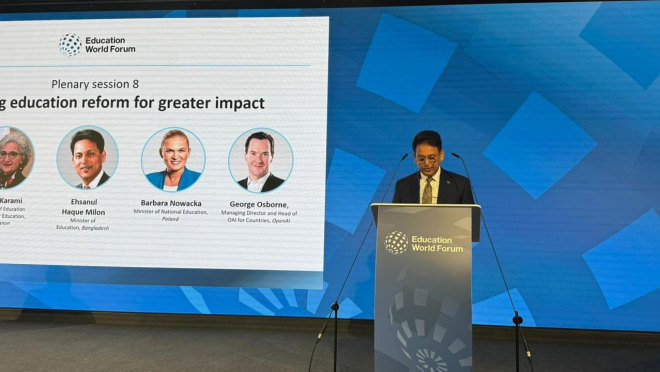
Education Minister ANM Ehsanul Hoque Milon has said the government plans to gradually increase spending on education to 5% of GDP as part of broader efforts to reform the sector and shift learning towards a “learning with happiness” model.
Bangladesh’s education sector requires major reforms to develop employable skills, creativity and confidence among young people, he said while speaking at a plenary session of the Education World Forum 2026 in London today (20 May).
The annual forum, considered the world’s largest gathering of education ministers, brought together representatives from around 150 countries this year.
He said Bangladesh had returned to the democratic path after what he described as a prolonged democratic deficit, adding that the newly elected government under Tarique Rahman holds a strong public mandate to reform the education system. “One of the clearest messages from our people is that education system must change,” he said.
He said the country must shift from exam-centric learning to an approach that promotes curiosity, creativity, problem-solving skills, cultural participation, sports and emotional wellbeing.
Describing “learning with happiness” as a key policy direction, he said students should acquire not only academic qualifications but also the skills, values, and confidence needed for employment, entrepreneurship, and innovation.
The minister also outlined planned reforms, including strengthening third-language teaching, introducing vocational and technical education at secondary level, expanding mid-day meal programmes, and providing students with basic supplies such as uniforms, shoes and bags.
On digital education, he said teachers must lead the transformation process, highlighting the government’s “One Teacher, One Tab” initiative aimed at equipping educators with digital tools.
He further noted that emerging technologies, including artificial intelligence, should support teachers and students while helping reduce educational inequality rather than widening it.