
University of Frontier Technology, GoPlane Limited sign MoU to boost industry-academia collaboration
University of Frontier Technology, GoPlane Limited sign MoU to boost industry-academia collaboration
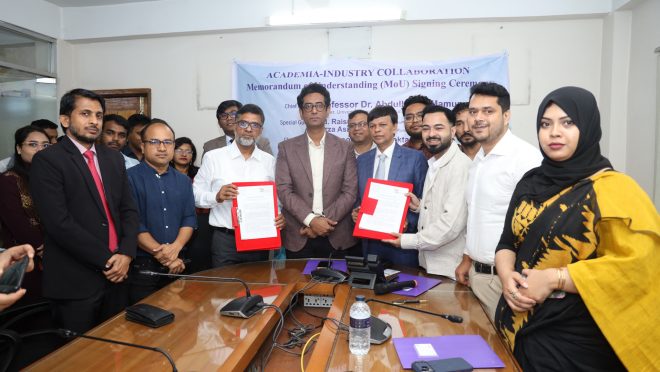
The University of Frontier Technology, Bangladesh and GoPlane Limited yesterday (31 October) signed a memorandum of understanding (MoU) to improve the quality of higher education, expand research and innovation, and better align university education with industry needs.
Representatives of both organisations signed the MoU during a ceremony titled “Academia – Industry Collaboration: MoU Signing Ceremony” at the conference room of the university’s administrative building on 31 October, 2026, according to a press release.
Professor Abdullah-Al-Mamun, member of the University Grants Commission of Bangladesh, attended the event as the chief guest, while Professor Md Mokhtar Ali, vice-chancellor of the University of Frontier Technology, Bangladesh, chaired the session. GoPlane Limited Director Md Raisul Islam and Managing Director Mirza Asif were present as special guests. Representatives from various technology and industrial organisations – including Walton, Mojaru, Robotech Valley, Battery Low Interactive, Bangladesh Research and Education Network, PeopleNTech, Felicity IDC, the Duke of Edinburgh’s International Award Foundation, DataSoft, BracNet, and KPJ – along with faculty members, officials, and students of the university, also participated in the programme.
Speaking as the chief guest, Mamun said universities across the country are being prepared for modern technology, artificial intelligence (AI), research, and innovation-based education to raise the information and communication technology (ICT) sector’s contribution to the gross domestic product to 10% over the next five years and fulfil the government’s election manifesto pledge of building a knowledge-based and technology-driven economy. Special emphasis is being placed on ensuring the effective participation of universities in developing the digital economy, alongside creating skilled human resources, technological innovation, and new employment opportunities, he added.
Highlighting the role of higher education institutions in building a digital economy, Mamun said initiatives have already been taken to launch departments in modern disciplines such as AI, information technology, cybersecurity, robotics, automation, data science, and nanotechnology at several universities in the country. This will help build technology-driven skilled human resources and further strengthen the digital economy.
He noted that the government does not want to limit its activities to formulating plans or delivering speeches, but rather aims to strengthen the foundation of the digital economy through visible and pragmatic initiatives. The government’s goal is to accelerate economic progress through technological innovation, skill development, digital infrastructure expansion, and the creation of young entrepreneurs, making universities key partners in the digital transformation drive.
Emphasising the creation of young entrepreneurs and technology-driven employment, Mamun said the government wants to prepare students not merely as job seekers, but as skilled entrepreneurs and job creators. In the 2026 – 27 fiscal year budget, a Tk500 crore startup fund has been proposed to encourage young entrepreneurs, alongside a total initiative of Tk800 crore to develop the creative economy. Of this amount, Tk300 crore has been proposed as a direct allocation, while another Tk500 crore is planned to be mobilised from corporate social responsibility funds.
Pointing to employment prospects in the technology sector, Mamun said the government plans to create two lakh new jobs annually in the ICT sector. To achieve this target, universities must modernise curricula in line with industry demands, develop skills, expand practical training programmes, and increase opportunities for students to participate in internships, research, and innovative projects.
Addressing the importance of building smart AI cities, he said the world is rapidly moving towards AI-driven urban management and digital economies, and Bangladesh must keep pace by integrating AI, the internet of things, big data, and modern digital infrastructure. This will make urban management, traffic control, healthcare, education, environmental conservation, and citizen services more modern, transparent, and effective.
On expanding the digital education system, Mamun stressed increasing the technological capacity of teachers, establishing smart classrooms, and expanding the use of modern learning materials. If the government’s proposed “One Teacher, One Tab” initiative is implemented, teaching methods will become more technology-driven and effective, he said.
In his presidential address, Vice-Chancellor Mokhtar said effective partnerships with industrial organisations are crucial to making university education practical and aligned with workplace demands. Such initiatives will play a positive role in developing students’ professional skills, applying research practically, and expanding innovative activities, he said, expressing his commitment to continuing collaborative efforts to enhance academic excellence and institutional capacity.
Through the signed MoU, an institutional framework has been established between the University of Frontier Technology, Bangladesh and GoPlane Limited for mutual cooperation in exchanging knowledge and experience, developing skills, conducting research, driving innovation, and developing technology-driven solutions.
During the ceremony, Mamun and Mokhtar jointly inaugurated the university’s indigenously developed directory application. Developed by the university’s ICT Service Office using its own workforce and technical capacity, the app will provide quick and easy access to essential university-related information. Work on developing similar software and applications is also underway to accelerate the university’s digital transformation.
In another segment of the programme, an interactive session was held between students and industry representatives, allowing students to share their expectations and gain practical insights and career guidance from industry experts.
The event was organised by the National and International Collaboration Cell of the University of Frontier Technology, Bangladesh.


