A Bangladeshi voice on London's modest fashion stage
A Bangladeshi voice on London's modest fashion stage
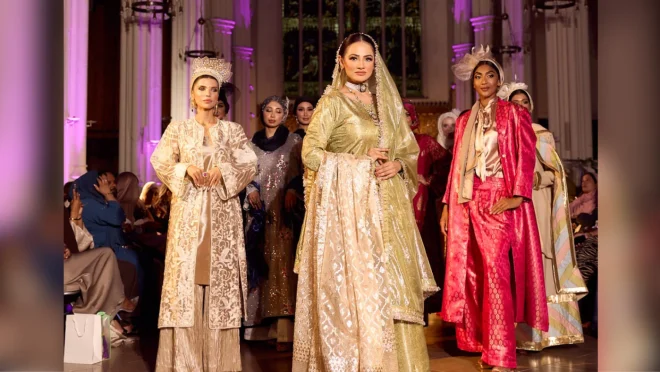
As modest fashion gains international visibility, independent designers continue to face barriers to exposure and commercial opportunities. Modest Fashion Week UK aims to bridge that gap through runway showcases and industry networking.
Modest fashion has never been defined by a single silhouette. It can take the form of a flowing abaya, a carefully layered ensemble, a sharply tailored co-ord set or an elaborate occasionwear piece. Its vocabulary shifts across cultures, generations and personal preferences, making it one of fashion’s most diverse expressions of identity.
Yet despite its growing presence in the international fashion industry, modestwear designers often find themselves navigating a market where visibility, commercial opportunities and access to established fashion networks remain uneven. Independent labels, in particular, need more than a collection to establish themselves; they need platforms that allow their work to reach audiences beyond familiar communities.
This is the space Modest Fashion Week UK (MFW UK) hopes to occupy. Founded by British-Bangladeshi entrepreneur Tashkia Azmi in 2025, the platform brings together modest fashion designers, creative professionals and entrepreneurs through runway showcases and industry networking.

Its second London edition, held on 12 September 2026 at St John’s Church, Hyde Park Crescent, welcomed approximately 250 guests. With six participating labels representing the UK, Mauritius, Türkiye, Canada and Pakistan, the event offered a glimpse into the different design languages shaping modest fashion across international markets.
For Azmi, the intention is to challenge the limited ways in which modest clothing is sometimes perceived, and to create a space where designers can present their own interpretations without having to fit into a prescribed aesthetic.
“Modest fashion has always been more than clothing to me. It represents identity, confidence, culture and the freedom to express ourselves. I wanted to create a platform where designers from different backgrounds could showcase their creativity and build opportunities for growth. As a British-Bangladeshi entrepreneur, I am proud to connect our cultural heritage with the global fashion industry,” said Azmi.
Six labels, different interpretations
The international lineup was central to the showcase, bringing together designers whose approaches to modest dressing reflect different cultural influences and markets.
Representing the UK, Tash’s Boutique presented luxury modest fashion informed by Bangladeshi craftsmanship and contemporary silhouettes. Founded by Azmi, the label sits between South Asian design influences and the wider international modestwear market.
Its approach challenges the assumption that modest clothing must be restricted to traditional or monochromatic designs. The label’s wider collections include co-ord sets, kaftans, abayas and eveningwear, demonstrating how modest dressing can accommodate both everyday wardrobes and more elaborate occasions.

Modest fashion is no longer defined by coverage alone, but by silhouettes, textures, craftsmanship and the art of personal styling.
Manchester-based Modest Valoria brought another perspective to the runway, focusing on modern and wearable modest fashion. Its design identity reflects an interest in clothing that combines practicality with a polished appearance, making modest dressing part of everyday style rather than something reserved for special occasions.
From Mauritius, Zoya’s Abaya represented the international abaya market. The abaya has undergone considerable stylistic variation over the years, moving beyond a singular traditional silhouette into a wider category that accommodates different cuts, fabrics, detailing and personal preferences.
Istanbul-based Melissa’s Playhouse brought a casual modestwear perspective to the showcase. Türkiye has its own distinctive relationship with modest fashion, where everyday dressing, layering and personal expression intersect.
Canadian designer Nargis Ladak, based in Toronto, brought a North American perspective to the event, while Palachi Official represented a connection between the UK and Pakistan. The UK-based label draws on its Karachi roots and Pakistani fashion influences.
The question about coverage
One persistent misconception about modest fashion is that it is primarily about how much of the body a garment covers. While coverage is an important consideration for many consumers, the category has evolved into a much wider conversation about design, craftsmanship, styling and identity.
An abaya, for instance, can be approached as a traditional garment or reinterpreted through different fabrics, proportions and detailing. Similarly, modest occasionwear can incorporate intricate embellishment and luxurious materials, while everyday modestwear can take the form of coordinated separates, relaxed tailoring and versatile layering.

The diversity of the six participating labels reflects this distinction. Their presence on the same runway suggests that modest fashion is not a uniform trend but a category capable of accommodating different design philosophies.
This is also where platforms such as MFW UK become relevant. By bringing together labels from different countries,they allow designers to encounter audiences and creative approaches outside their immediate markets.
The woman behind the platform
Azmi’s involvement in modest fashion began with her own entrepreneurial journey. In addition to founding MFW UK, she established Tash’s Boutique, drawing on her Bangladeshi heritage and professional experience in the UK.
Her background, however, was not initially in fashion. She spent more than 14 years working in London’s luxury hospitality and events sector, with professional experience at Rosewood London, Kimpton Fitzroy, Marriott, The Ivy Collection and D&D London.

Tashkia Azmi, founder of MFW UK and Tash’s Boutique, draws on her Bangladeshi heritage and over 14 years of experience in London’s luxury hospitality and events industry.
That experience gave her a grounding in event production, guest relations and commercial partnerships, skills she has since brought into the fashion industry.
Her earlier journey with Tash’s Boutique also gave her first-hand insight into the challenges independent modestwear labels can face. Building a fashion business requires more than developing attractive garments; it involves establishing a recognisable identity, reaching the right customers and creating opportunities for sustainable growth.
MFW UK emerged from a desire to bring independent designers into a shared space where their work could receive greater visibility.
The creative network behind the runway
The presentation of a fashion collection depends on an extensive creative network. Beyond designers and models, choreographers, makeup artists, videographers and production teams help translate a collection’s identity into a complete runway experience.
MFW UK’s second edition was co-produced by Lady Boss Events, with Bangladeshi choreographer Joy Raj leading the runway choreography. Bangladeshi creative professional Tanvir handled the official videography, while Shabana Subhani, founder of Backstage Beauty Collective, led the makeup and backstage beauty team.

The event also received PR support from Saba Azam, a British-Pakistani professional with years of experience in the UK’s fashion industry, contributing her expertise to the event’s communications and public relations.
Also the event’s photography was led by Jarek Duk, a London-based luxury retail and fashion photographer with years of experience working with high-end brands in the UK market.
Their involvement highlighted the contribution of British-Bangladeshi creative professionals to the UK’s fashion and events landscape.
A wider runway for modest fashion
MFW UK is preparing to develop a regional presence. Its plans include showcases, exhibitions, networking opportunities, workshops and community initiatives, with Birmingham, Manchester, Bristol and Cardiff among the potential destinations.
A Midlands Gala and Fashion Showcase is planned for January 2027, combining runway presentations with business networking and an exhibition experience.
The longer-term ambition is to establish connections with international designers, investors and As Azmi looks towards regional expansion and further international collaborations, the platform’s challenge will be to sustain that diversity while creating meaningful opportunities for the designers it brings together.